
On October 1, 2026, Google added one sentence to its guidance on AI-generated content.
“It is critical to manually factcheck and review all AI-generated content for accuracy and trustworthiness before publishing.”
As Search Engine Roundtable pointed out, Google doesn't often use the word “critical” in its Search documentation. It used it twice that day.
And it did it in the middle of a spam update.
If your blog, practice pages or FAQs were drafted by AI and nobody checked the facts, you have a problem today. Not someday.
Here's the short version: AI content isn't banned. Unchecked AI content on a legal site is now a ranking risk, an AI-citation risk and a bar-rule risk at the same time.
Below is what changed, why it hits law firms harder than almost any other business, and the review process that fixes it.
What Did Google Change About AI-Generated Content on October 1, 2026?
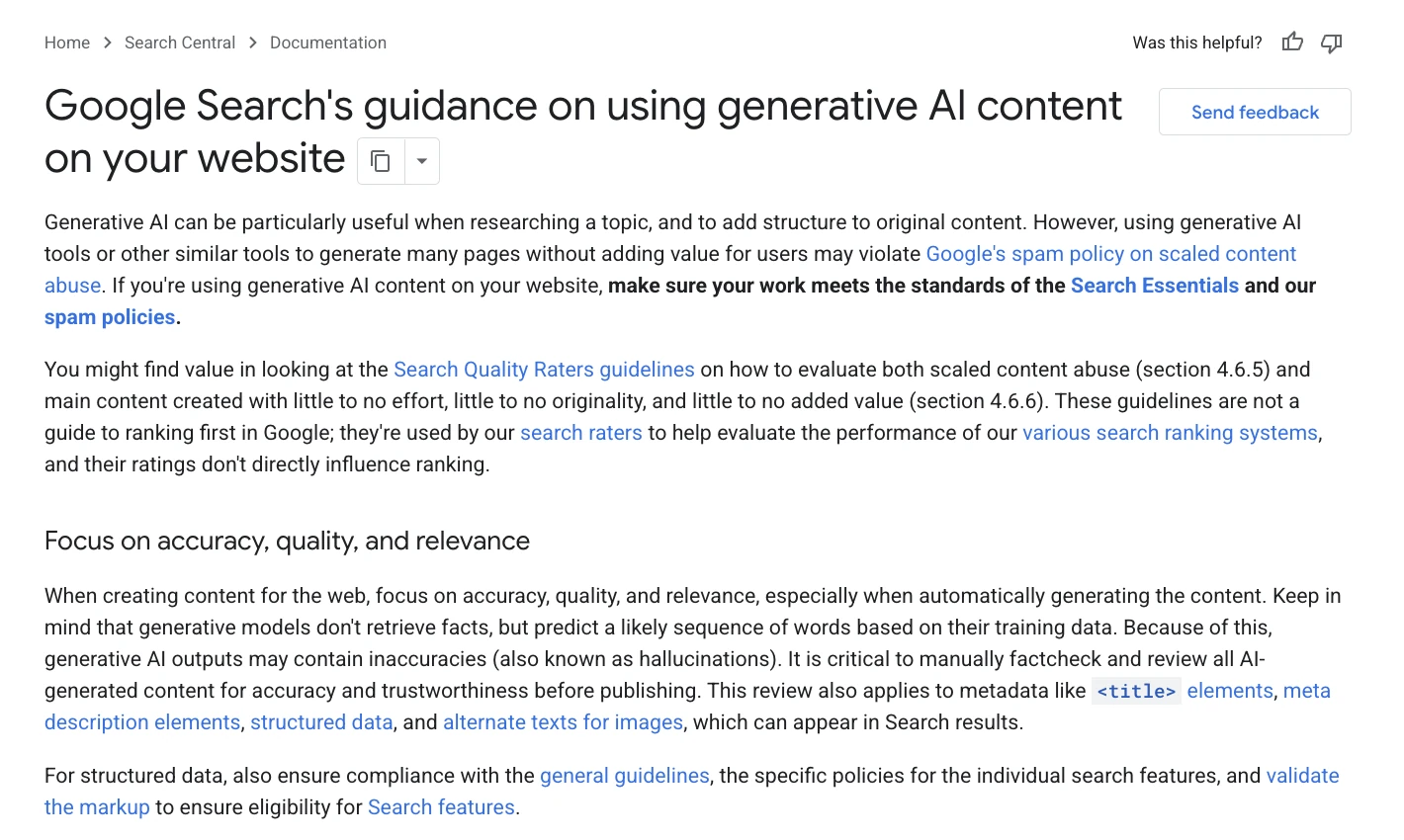
Google updated its page titled “Google Search's guidance on using generative AI content on your website” to say that manually fact-checking and reviewing all AI-generated content before publishing is critical.
The same guidance says that review covers your page titles, meta descriptions, structured data and image alt text, not only the article body.
Google explained the reason in plain terms. Generative models don't retrieve facts. They predict a likely sequence of words based on their training data, so their output can contain inaccuracies, which Google calls hallucinations.
Read that again.
AI doesn't look anything up. It writes what usually comes next.
For a recipe blog, a bad guess is an annoyance. For a page telling an injured person how long they have to file, it's a real problem.
Google's documentation changelog lists the change on October 1, 2026. Google says it updated the guide with information from its Search Quality Rater Guidelines, to sync the documentation with the presentations it gives at developer events.
That matters. This is how Google already trains people to judge pages, now written into the public guidance.
The Four Instructions in Google's Updated Guidance
| What Google says | What it means for your firm |
|---|---|
| Using AI to generate many pages without adding value may violate the scaled content abuse spam policy | 200 near-identical AI city pages is the risk, not one AI-assisted blog post |
| Focus on accuracy, quality and relevance, and manually fact-check all AI content before publishing | Every deadline, statute and number gets checked by a person |
| The review also applies to titles, meta descriptions, structured data and alt text | The text Google shows in search results counts too |
| Consider telling readers how content was created | A clear byline and reviewer line builds trust |
Strip the page down and Google tells you four things. The table above lays them out.
If you want to see exactly what was added, Search Engine Roundtable published a highlighted comparison. The Internet Archive also holds the pre-update version from September 27, 2026.
Google Also Rewrote Its Quality Guidance the Same Day
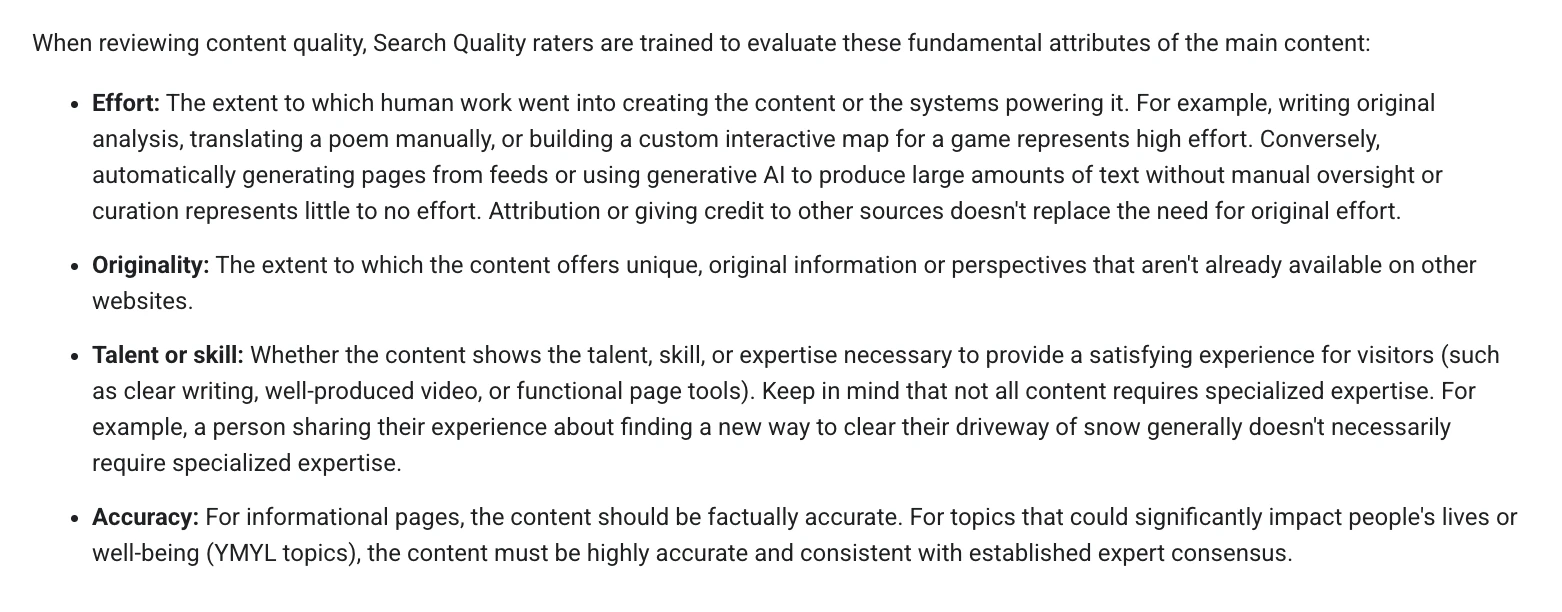
On the same day, Google updated its page on creating helpful, reliable, people-first content.
The new section says raters evaluate four attributes of a page's main content: effort, originality, talent or skill, and accuracy.
Two lines in that section matter most here: one aimed at AI content, one aimed at your industry.
On effort, Google says using generative AI to produce large amounts of text without manual oversight or curation represents little to no effort. It adds that crediting other sources doesn't replace the need for original effort.
On accuracy, Google says pages on topics that can significantly affect people's lives must be highly accurate and consistent with established expert consensus.
Legal information is one of those topics. We'll get to why below.
Does Google Penalize AI-Generated Content?
✅ Low risk
- AI helps draft or structure
- A person verifies every fact
- Adds original insight
- Attorney signs off
❌ Spam risk
- AI pages at scale
- Published straight from the tool
- Same copy, new city name
- No original value
No. Google does not penalize content for being written with AI.
Google's own guidance says generative AI can be useful for researching a topic and for adding structure to original content.
The risk is volume without value. Google says using AI to generate many pages without adding value for users may violate its spam policy on scaled content abuse.
So stop asking whether AI touched the page. Ask these instead:
- ✅ Did a qualified person check every fact?
- ✅ Does the page say something your competitors' pages don't?
- ✅ Would it still be worth reading if Google didn't exist?
- ❌ Is it one of fifty pages that read the same with a city name swapped?
- ❌ Did it go live straight from the AI tool?
If you're answering “yes” to either of the last two, that's where your exposure is.
What Scaled Content Abuse Means for a Law Firm Site
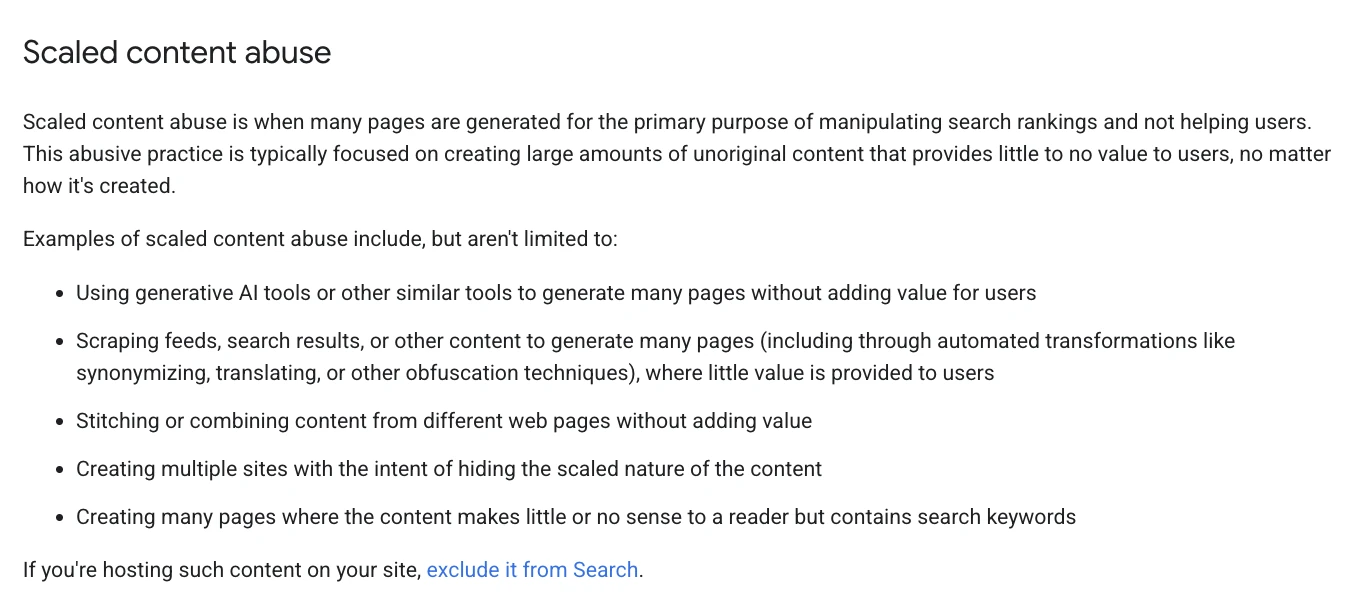
Scaled content abuse is Google's term for producing many pages mainly to manipulate rankings rather than to help people, no matter how those pages were made. Google's spam policies apply whether the pages were written by AI, by people, or by both.
On law firm sites, it usually looks like one of these:
- City page farms. “Car accident lawyer in [city]” repeated across 80 suburbs, same copy, new city name.
- Question mills. An AI-written blog post for every legal question your keyword tool spits out, with no attorney input.
- Practice area padding. Pages for case types the firm doesn't actually handle, built to catch traffic.
Google points site owners to sections 4.6.5 and 4.6.6 of its Search Quality Rater Guidelines. Those sections cover scaled content abuse and main content created with little effort, originality or added value.
If your attorney SEO strategy depends on page count, it's time to rethink it.
Why the Timing With the September 2026 Spam Update Matters
The spam update and the guidance change overlapped
- Sep 24: announced
- Sep 25 to 27: first impact reported
- Sep 30: second wave reported
- Oct 1: AI guidance updated
- Oct 4 to 6: possible final phase
Google changed its AI guidance while a spam update was rolling out.
The update was announced September 24. Search Engine Roundtable reported a likely first wave of impact September 25 to 27 and what may have been a second wave September 30. The same outlet reported a possible final phase October 4 to 6.
Be clear on what's known. Google has not said this spam update targets AI content. The connection is an inference that search industry reporters have raised, not a Google statement.
What Google has said is telling, though.
At its Search Central Live event in Europe, Google's speakers said it's running more spam updates because there's far more new content than before. They also said it's using AI to catch more of it, and that scaled content is becoming a bigger problem than link spam, according to an attendee recap reported by Search Engine Roundtable.
Expect more spam updates, not fewer.
Why Is Law Firm Content Held to a Higher Accuracy Standard?
YMYL: “Your Money or Your Life.” Topics that could significantly impact people's lives or well-being.
Legal content is YMYL, and Google holds YMYL pages to a stricter accuracy standard than ordinary informational pages.
YMYL stands for “Your Money or Your Life.” It's Google's term for topics that could significantly impact people's lives or well-being.
Google's updated helpful content guidance draws the line in two sentences:
- Ordinary informational pages should be factually accurate.
- YMYL pages must be highly accurate and consistent with established expert consensus.
Someone reading your page about a filing deadline, a wrongful death claim or a DUI arraignment is making a decision about their legal rights.
That's YMYL by any definition.
The Four Things Google's Raters Check on Every Page
| Attribute | Google's definition (summarized) | Passes on a law firm site | Fails on a law firm site |
|---|---|---|---|
| Effort | How much human work went into the content | Attorney analysis of how your local courts handle a claim type | AI text published with no oversight |
| Originality | Information not already available elsewhere | Your case data, your settlement process, your local experience | A rewrite of the top five ranking pages |
| Talent or skill | The expertise needed to satisfy the reader | Clear answers written or reviewed by a licensed attorney | Generic copy any firm in any state could post |
| Accuracy | Factually accurate; highly accurate for YMYL | Every deadline and statute verified against the source | A “two years in most states” guess |
Google's raters score a page's main content on four attributes. The table shows what each one looks like on a law firm site.
One caveat matters here. Google says rater scores don't directly change rankings. Raters help Google evaluate whether its ranking systems are working.
But raters are trained on what Google wants its systems to reward. What raters look for is the clearest public map you have.
What “Highly Accurate” Looks Like on a Personal Injury Page
❌ AI draft
- “In most states, you have two years to file a personal injury claim.”
✅ Verified
- “[State] law gives you [X] years from the date of injury to file most personal injury lawsuits under [statute]. Claims against a government agency can require notice much sooner. Reviewed by [attorney], [date].”
That comparison is the most common failure on a PI site.
The AI version sounds reasonable. That's the problem.
It's vague enough to sound right and wrong enough to cost someone their claim. It skips the exceptions that actually decide cases: government notice deadlines, the discovery rule, and special rules for minors.
The verified version names the state, cites the statute, flags the trap, and shows who checked it.
That's what “consistent with established expert consensus” means in practice. It's also the difference between a personal injury SEO page that earns trust and one that quietly sends people away.
What Do Bar Rules Already Require for AI Content?
| Rule | What it covers | What it means for AI website content |
|---|---|---|
| ABA Formal Op. 512 | Lawyers' use of generative AI tools | Don't rely on AI output without appropriate independent verification |
| Model Rule 1.1 | Competence, including with the tools you use | Know that AI tools predict text and can be wrong |
| Model Rule 7.1 | False or misleading statements about your services | A wrong fact about the law on your site is a misrepresentation |
| Model Rule 5.3 | Supervising nonlawyers who assist you | Your agency's AI drafts are your responsibility |
Your bar rules point the same direction, and they got there first.
ABA Formal Opinion 512, issued July 29, 2024, says lawyers must verify AI output to an appropriate degree. Your website is a communication about your services under Model Rule 7.1.
And Model Rule 5.3 makes you responsible for the nonlawyers who assist you, which can include outside vendors like your marketing agency.
A quick but important note: these are ABA Model Rules. Your state's version is what binds you, and states differ, especially on advertising.
Check your state bar's rules and any AI ethics opinion it has issued. This article isn't legal advice.
ABA Formal Opinion 512 and Verifying AI Output
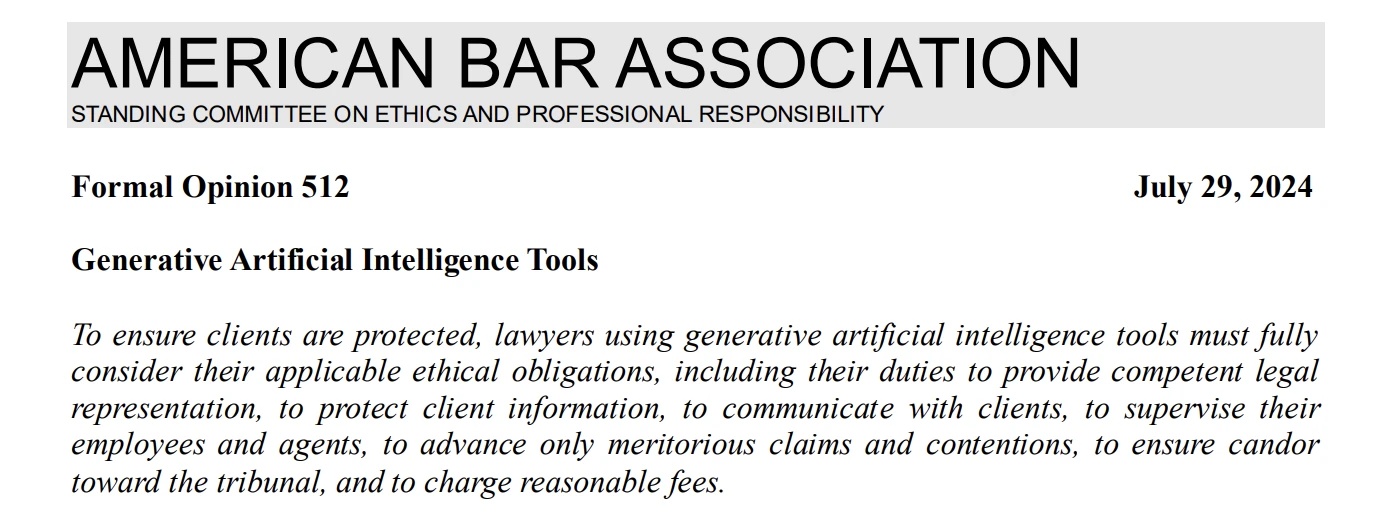
Opinion 512 focuses on legal work: research, drafting, filings, client advice. It isn't a marketing opinion.
But its core warning lines up almost word for word with Google's.
The ABA describes generative AI tools as prediction tools that produce a statistically probable output. Google says they predict a likely sequence of words. Two institutions, two years apart, same diagnosis.
The opinion's conclusion is that lawyers shouldn't rely on AI output without an appropriate degree of independent verification or review.
If that standard applies to a brief a judge will read, it's hard to argue it doesn't apply to a page a potential client will rely on.
Rule 7.1: A Wrong Fact on Your Website Is a Misleading Communication
Under Model Rule 7.1, a communication is misleading if it contains a material misrepresentation of fact or law.
- Wrong filing deadline
- Misrepresentation of law
- Misleading communication
Model Rule 7.1 says a lawyer can't make a false or misleading communication about the lawyer or the lawyer's services.
Under the rule, a communication is misleading if it contains a material misrepresentation of fact or law.
Your website is a communication about your services. A wrong deadline is a misrepresentation of law. A made-up statistic is a misrepresentation of fact.
“The AI wrote it” won't help you much. Your name is on the site.
Your Agency's AI Drafts Are Your Responsibility (Rule 5.3)
Rule 5.3: you supervise the whole chain
- AI tool
- Agency writer
- Fact-check
- Attorney review
- Published page
Model Rule 5.3 covers your responsibility for nonlawyers who assist you. Opinion 512 applies the supervision duties to AI use, and its summary names your duty to supervise your employees and agents.
If you pay an agency for content, ask three questions this week:
- Do you use AI to draft our content? The honest answer is almost always yes.
- Who checks the facts, and against what source?
- Who signs off before anything goes live?
If the answer to number three is “nobody at your firm,” fix that first.
How Often Does AI Get Legal Facts Wrong?
Court decisions on AI-hallucinated material, by type
Often enough that courts have issued more than 2,000 decisions about it.
According to Damien Charlotin's AI Hallucination Cases Database, courts and tribunals worldwide had issued 2,149 decisions addressing AI-hallucinated material as of October 5, 2026.
1,473 of those decisions came from U.S. courts. Worldwide, 854 involved a lawyer, not a self-represented litigant, relying on the hallucinated material.
To be fair to the data: these are court filings, not websites. Nobody tracks website errors this way.
But the failure is identical. A professional trusted AI output, didn't check it, and published it under their name.
If it gets past lawyers in filings that judges read line by line, it's a safe bet it gets past them on pages nobody reviews.
The Errors That Show Up on Law Firm Pages
Hunt for these on every AI-drafted legal page
- Wrong deadlines
- Wrong fault rules
- Damage caps that don't exist or changed
- Wrong statute numbers
- Citations that don't say what the page claims
- Invented statistics
- Outdated law
- Outcome promises
These are the errors to hunt for on any AI-drafted legal page:
- Wrong deadlines. Statutes of limitations, government notice periods, appeal windows.
- Wrong fault rules. Mixing up pure comparative, modified comparative and contributory negligence.
- Damage caps that don't exist in your state, or that changed.
- Wrong statute numbers, or real numbers attached to the wrong rule.
- Case citations that don't exist or don't say what the page claims.
- Invented statistics with no source.
- Outdated law. The database tracks repealed laws and overturned case law separately for a reason.
- Outcome promises (“you will receive compensation”), which raise their own advertising rule problems.
Notice that most of these involve numbers. Numbers are where AI guesses hide.
What Does Google Say to Fact-Check Beyond the Article Text?
| Element | Where people see it | What to check on a law firm page |
|---|---|---|
| Title element | The clickable headline in Google results | Practice area and city are correct; no claims you can't back (“#1 rated”) |
| Meta description | The snippet under the headline | No promised outcomes; deadlines and fees match the page |
| Structured data | Behind the scenes, and in some search features | Firm name, address, phone and attorney names are exact; no self-serving review markup |
| Alt text | Image search, screen readers | Describes the image; no keyword stuffing |
Google says the review applies to four elements beyond the body copy: title elements, meta descriptions, structured data and image alt text.
They're easy to auto-generate and easy to skip in review.
Two notes specific to law firms.
First, Google stopped showing FAQ rich results on May 7, 2026, according to its changelog. If an AI tool is still adding FAQ markup to every page, it's adding markup that no longer earns a search feature.
Second, Google says to validate structured data and follow its general guidelines. Run every template through Google's Rich Results Test before it ships across your site.
The Fact-Check Workflow for AI-Assisted Law Firm Content
Six steps, in order, on every page
- Mark every checkable claim
- Verify each claim at the primary source
- Attorney review of the legal substance
- Check title, meta description, schema and alt text
- Show who wrote it and who reviewed it
- Re-verify on a schedule
Here's the process that meets Google's standard and your bar's: six steps, in order, on every page.
It takes longer than publishing straight from the tool. That's the point.
Step 1: Mark Every Checkable Claim
“Most injury claims must be filed within two years. Under Section 12-345, you can recover up to $500,000. Our firm won the largest verdict in the county.”
Every highlighted phrase must be verified or cut.
Before anyone edits for style, highlight everything that can be true or false.
That means every number, date, deadline, dollar amount, statute reference, case name, statistic and superlative (“the largest verdict in the county”).
If it can be checked, it gets checked. If it can't be checked, it gets cut.
Step 2: Verify Each Claim Against the Primary Source
✅ Verify against
- Statute text on your state legislature's site
- Court rules and local procedures
- Government data from the agency that collected it
❌ Not a source
- Another law firm's blog
- A legal directory article
- A second AI tool
Check each highlighted claim against the original source: the statute text, the court's rules, or data from the agency that collected it.
Don't verify against another firm's blog, a legal directory article, or a second AI tool asked to “double-check.”
Another firm's blog may be exactly where the AI picked up the wrong answer.
Step 3: Have a Licensed Attorney Review the Legal Substance
Attorney review checklist
- The rule is current and correct for your state
- The exceptions that decide cases are named
- Nothing reads as a guarantee of outcome
- It matches how your firm handles these cases
Verification confirms the facts. Attorney review confirms the meaning.
A licensed attorney at your firm should confirm that the rule is current and correctly stated for your state, and that the exceptions that actually decide cases are named.
They should also confirm that nothing reads as a guarantee of outcome, and that the page matches how your firm actually handles these cases.
This is the step that turns “factually accurate” into “consistent with established expert consensus.”
Step 4: Check the Title, Meta Description, Schema and Alt Text
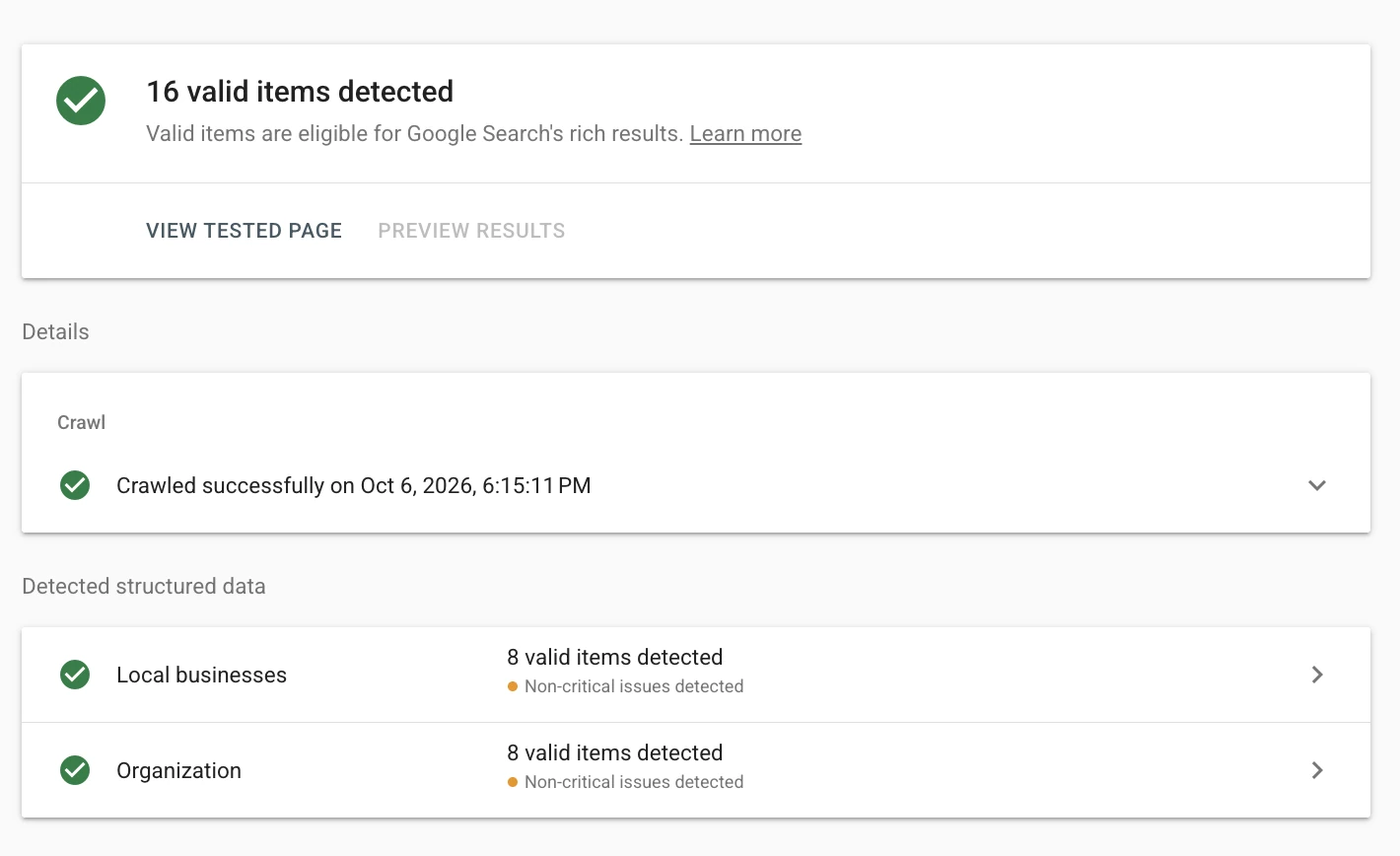
Run the same check on the parts of the page people don't read in full:
- Read the title and meta description as if they were the whole page.
- Validate structured data in the Rich Results Test.
- Confirm the firm name, address and phone match your Google Business Profile exactly.
- Read every alt text line.
Mismatched name, address and phone details also undercut your local SEO. Fixing them helps twice.
Step 5: Show Who Wrote It and Who Reviewed It
Written by [Author name]
Reviewed by [Attorney name], licensed in [State]
Last reviewed: [Date]
Google's helpful content guidance asks site owners to make clear who created the content and how. For a law firm page, that means a real author byline linked to an author page, and a last-reviewed date.
Add a “Reviewed by” line naming the licensed attorney, but only if that review actually happened.
This is where your reviews and reputation work and your content work meet. Readers trust named people.
Step 6: Re-Verify on a Schedule
| Page type | Review cadence |
|---|---|
| Deadline, statute and damages pages | Every 6 months |
| Practice area pages | Every 12 months |
| Any page affected by a new law or ruling | Immediately |
Laws change. Pages don't update themselves.
Set a cadence like the one above, and stick to it.
Only change the “last reviewed” date when someone actually reviewed the page. Google's guidance specifically warns against changing dates to make content look fresher than it is.
Should You Disclose AI Use on Your Law Firm Website?

Google doesn't require an AI disclosure label on ordinary web pages. Its guidance suggests you consider explaining how content was created when automation is involved, in a way that makes sense for your audience.
Your state bar may have its own view on AI in lawyer advertising. Check it before you decide.
Here's the practical take.
An “AI-generated” label tells a reader nothing about whether the page is right.
A line that says who wrote it, which attorney reviewed it, and when, tells them everything that matters.
How Unverified AI Content Costs You Signed Cases
The loss is invisible: nobody tells you they didn't call.
A wrong fact costs you the person reading the page. The ranking loss comes second.
Here's how it happens:
- Someone reads that they have “two years” to file. Their claim is against a city bus, and their state requires notice much sooner. They miss it and never call.
- Someone reads a fault rule that doesn't apply in your state. They decide they're partly to blame and can't recover. They never call.
- Someone spots an error, and the page stops sounding like a firm that knows what it's doing. They call the next firm on the page.
None of those people show up in your analytics as a loss.
They just never become a signed case.
For perspective: on paid search, we plan around roughly $3,000 per signed case. A page that quietly turns away qualified claimants is burning the organic equivalent of that every month, and you'll never see the invoice.
If you want your content measured by the cases it produces rather than by traffic, start with how we approach lead generation for lawyers.
Does This Affect Whether AI Overviews and ChatGPT Cite Your Firm?
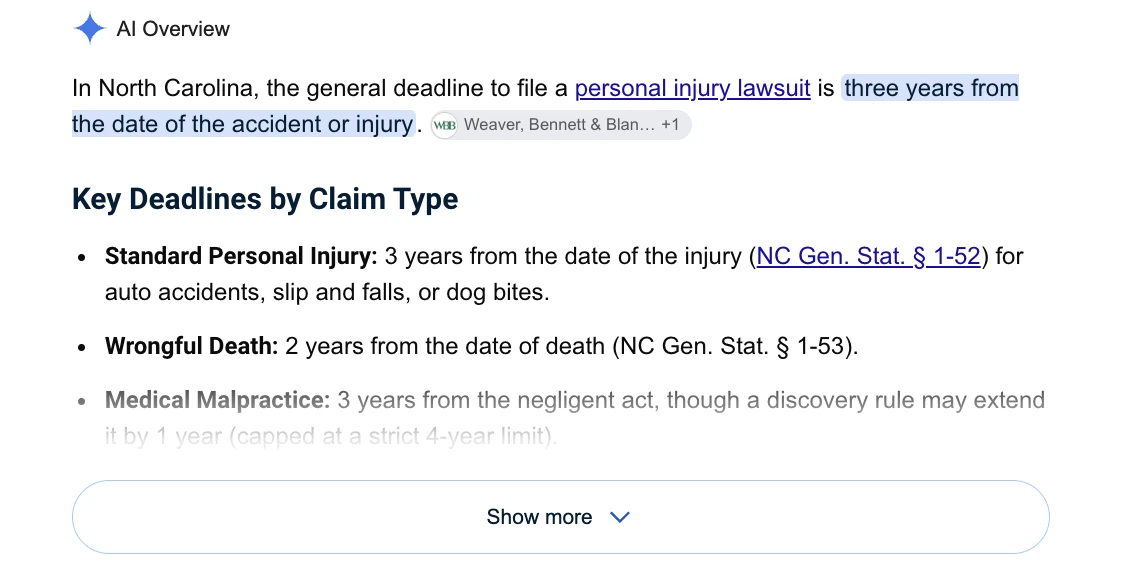
For Google, yes.
Google clarified in May 2026 that its spam policies apply to generative AI responses in Search, according to its documentation changelog. Content that breaks those policies has no business expecting a spot in AI Overviews or AI Mode.
Google's guide to optimizing for generative AI features also stresses non-commodity content: information that isn't the same as everything else on the topic.
Accurate, original, clearly sourced pages give an AI answer something worth citing. Vague AI copy that matches a hundred other firms' pages gives it no reason to pick yours.
Other answer engines, like ChatGPT and Perplexity, work differently. Our view is that the same logic holds: a page with one clear, verified, sourced answer is easier to quote than a page of guesses.
No one can promise you an AI citation. You can stop giving AI systems reasons to skip you. More on that in our guides to GEO for lawyers and how law firms rank in ChatGPT.
How to Audit the AI Content Already on Your Site
Five-step content audit
- Inventory pages written since AI tools came in
- Prioritize by risk, then traffic
- Run the six-step workflow
- Fix, merge or remove
- Log every review
Start with the pages that can hurt someone if they're wrong, then work down.
- Inventory. List every page published or rewritten since your firm or agency started using AI tools. If you don't know when that was, ask.
- Prioritize by risk, then traffic. Deadline, statute, damages and procedure pages come first. High-traffic practice pages come next.
- Run the six-step workflow on each page, starting with Step 1.
- Fix, merge or remove. Correct the errors. Merge near-duplicate city or topic pages into one strong page. Remove pages for cases you don't handle.
- Log every review with who checked it and when, so Step 6 actually happens.
If you're rebuilding your content plan around this, our law firm SEO guide and our approach to content marketing for law firms cover what to publish once the cleanup is done.