Two months ago I wrote that law firms couldn't advertise on ChatGPT. OpenAI's ad policy said it in plain English: legal services were not permitted.
That's no longer true.
On August 31, 2026, OpenAI updated its advertising policies. Legal-services ads are now allowed in the United States, as long as the advertiser is licensed to practice law where the ad is shown. Personal injury is named in the policy. So are immigration, legal claims, and document preparation.
We got our own account into the Ads Manager and started building campaigns the same week. This post walks through what changed, what the platform actually looks like from the inside, and how a law firm should approach it.
If you'd rather not figure it out yourself, book a call and we'll set up and run the campaigns for you.
In this post we'll cover:
- The exact policy language, before and after
- The full timeline of how OpenAI got here
- A screenshot tour of the Ads Manager: campaigns, ad groups, bids, context hints, and ads
- How to set up a compliant law firm campaign
- What we think this means for PI firms specifically
What Changed In OpenAI's Ad Policy
Here's the Legal services section of OpenAI's ad policies as of the August 31, 2026 update:
"Ads for legal advice, representation, or legal services offered to individuals or businesses are permitted in the US only when the advertiser is licensed to practice law in the jurisdiction where the ad is shown. This includes services related to immigration, personal injury, legal claims, or document preparation."
Compare that to the version that was live from June through August:
"Ads for legal advice, representation, or legal services offered to individuals or businesses are not permitted. This includes services related to immigration, personal injury, legal claims, or document preparation."
Same sentence structure. One word flipped from "not permitted" to "permitted," with a licensing condition attached. The practice areas that were previously called out as banned are now the ones explicitly named as eligible.
Two things carried over from the old policy:
- Legal-services ads outside the U.S. are still prohibited.
- General legal education and media (podcasts, LSAT prep, educational content) remain allowed where no legal service is being offered.
Legal services also sit in OpenAI's "restricted" category, which means manual review and extra verification. Expect to prove you're licensed. Expect ads to get held longer than a generic e-commerce ad would.
Before Aug 31, 2026
- Any offer of legal representation
- Personal injury, immigration, claims
- Document preparation services
- "Free consultation" ads
- Only education or media allowed
After Aug 31, 2026
- Legal representation and advice
- Personal injury, immigration, claims
- Document preparation services
- Advertiser must be licensed where the ad shows
- Subject to manual review
Want Us To Set Up Your ChatGPT Ads?
We'll build the account, write the context hints, set the bids, and run the campaigns for your firm. Book a call and we'll walk you through it.
The Timeline: Pilot To Ban To Reversal
If you've been half-following this story, here's how it actually unfolded. It changed direction three times in eight months.
January 16, 2026: Ads Come To ChatGPT
OpenAI announced it would begin testing ads for logged-in U.S. adults on the Free and Go tiers. Pro, Business, and Enterprise stayed ad-free. Ads would appear at the bottom of responses, clearly labeled and separated from the answer. Health, mental health, and politics were excluded from advertising entirely, and OpenAI was explicit that "ads do not influence the answers ChatGPT gives you."
At this stage, buying was invite-only and skewed toward big brands.
May 5, 2026: Self-Serve Ads Manager Launches
OpenAI opened a beta self-serve Ads Manager so businesses of any size could sign up directly at ads.openai.com. The same announcement added cost-per-click bidding alongside the existing CPM model, plus a conversions API and pixel for measurement. Agency holding companies (Dentsu, Omnicom, Publicis, WPP) and ad-tech partners were announced at the same time.
Ads show up as "Sponsored" cards beneath the response, at what OpenAI calls "active and decision-oriented" moments: someone learning about a category, comparing options, or deciding what to do next. For a lawyer, that describes the exact moment a potential client is typing "what do I do after a car accident" into ChatGPT.
June 4, 2026: Legal Services Get Cut
About a month after the self-serve launch, OpenAI updated the policy to explicitly exclude legal services. Custom Legal Marketing documented the reversal: professional services had initially been permitted, then the "not permitted" language above was added. That's the version I wrote about in July, and it's why our earlier advice was to run education-only campaigns.
August 31, 2026: Legal Services Come Back
The policy page now reads "Updated: August 31, 2026" and the language flipped to "permitted in the US only when the advertiser is licensed to practice law in the jurisdiction where the ad is shown." LawLytics covered the change the same day. We confirmed it on the live policy page while writing this post.
My read on why: legal is one of the highest-CPC categories on Google. OpenAI needs revenue. Excluding an entire category that pays $50 to $300 a click on search didn't make sense for long. The licensing requirement is how they're threading the needle on consumer protection.
Inside The ChatGPT Ads Manager
Most of what's been written about ChatGPT ads is speculation from people who haven't logged in. So here's what it actually looks like. These are screenshots from our WEBRIS account, taken the week of September 8, 2026. The platform is still labeled "Beta."
The Structure: Campaigns, Ad Groups, Ads
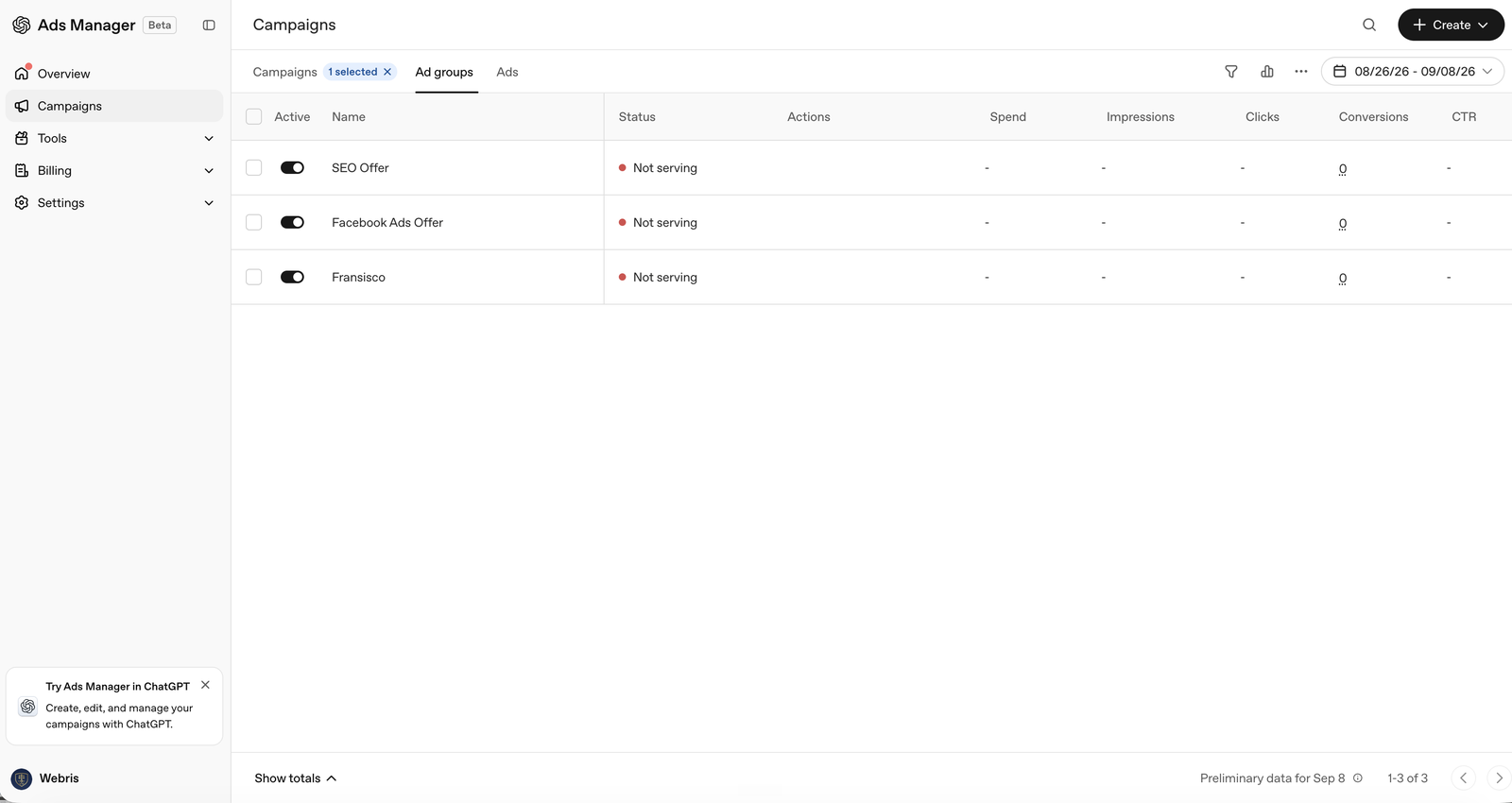
If you've run Google Ads, the hierarchy is familiar. A campaign holds ad groups. Ad groups hold ads. In the screenshot at the top of this post, our campaign is called "Legal Marketing" and it has three ad groups underneath it, one per offer.
Reporting columns are what you'd expect: spend, impressions, clicks, conversions, CTR. There's a "Show totals" toggle, date range picker, filter, and export. Nothing exotic. The conversions column ties back to the pixel or conversions API that launched in May.
Ad Groups: Bidding And Context Hints
The ad group is where the real decisions live. Two settings matter.
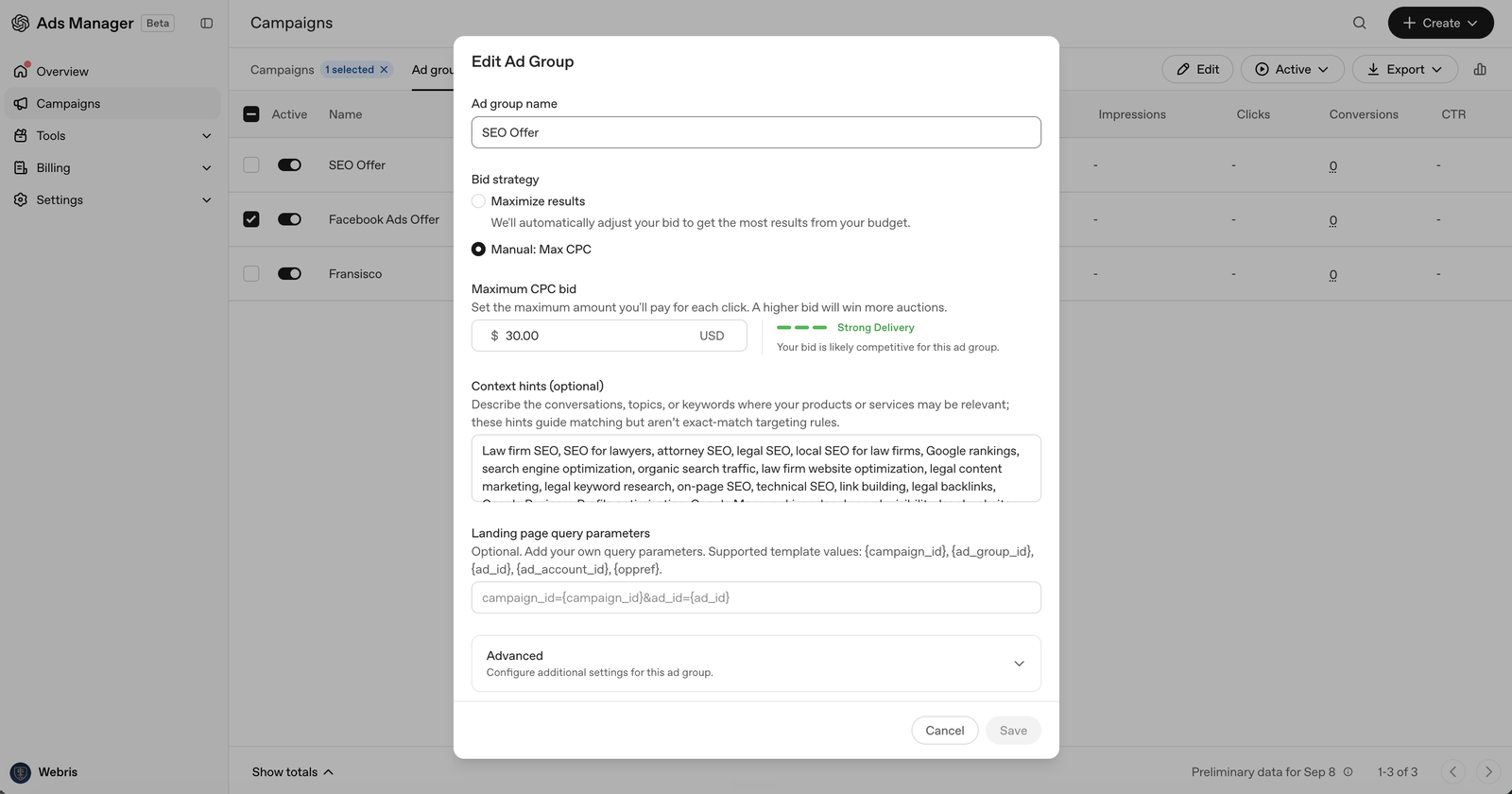
Bid strategy. You get two options. "Maximize results" lets OpenAI set bids automatically against your budget. "Manual: Max CPC" lets you cap what you'll pay per click. We set ours at $30 and the platform flagged it as "Strong Delivery" with the note "your bid is likely competitive for this ad group." That's a B2B ad group targeting law firm owners, not a consumer PI campaign, so don't read too much into the number. But $30 buying a "strong" rating on a legal-adjacent audience tells you the auction is not yet crowded. On Google, $30 wouldn't get a PI firm out of bed.
Context hints. This is the part that's different from every other ad platform. There are no keywords and no audience targeting in the Google or Meta sense. Instead you describe, in plain language, the conversations where your service is relevant. The field's own label says it: "these hints guide matching but aren't exact-match targeting rules."
OpenAI's help center goes further: "Context hints are not exact-match controls, audience targeting rules, or instructions to show your ad only for specific conversations." Their guidance is to keep each ad group focused on a single theme or intent area and to cover the different ways people describe the same problem.
For our SEO ad group, the hints read like a topic cluster: law firm SEO, attorney SEO, local SEO for law firms, Google rankings, legal content marketing, link building, Google Business Profile optimization, and so on. For a PI firm, you'd write the conversations an injured person has: what to do after a car accident, whether to accept an insurance settlement, how much a case is worth, whether you need a lawyer for a minor accident.
The ad group also has a landing page query parameter field. It supports template values like {campaign_id}, {ad_group_id}, and {ad_id}, so you can pass attribution through to your intake system. Set this up before you launch or you'll have no idea which ad group signed the case.
The Ad Itself
Ads are simple. A title (50 characters), a description (100 characters), a link, and an image. That's it.
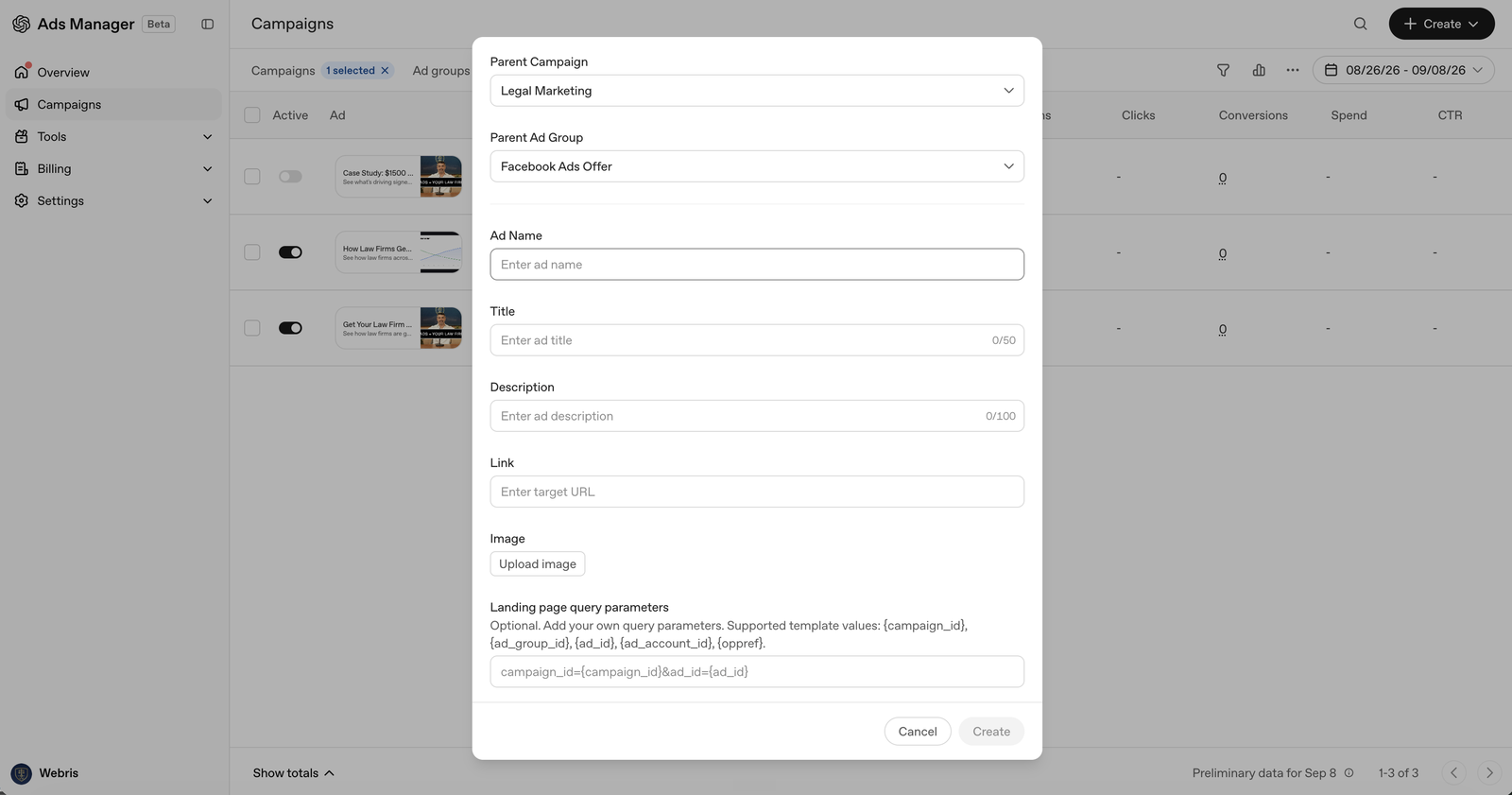
Fifty characters is tight. "Injured In A Car Accident? Talk To A Lawyer Today" is 49. You don't get a headline, a sub-headline, and three lines of body copy like Meta. You get one line and one supporting sentence. Write it like a Google search ad, not a Facebook ad.
Here's one of ours in the edit view, with the preview at the bottom showing how it renders as a "Sponsored" card under the Webris name:
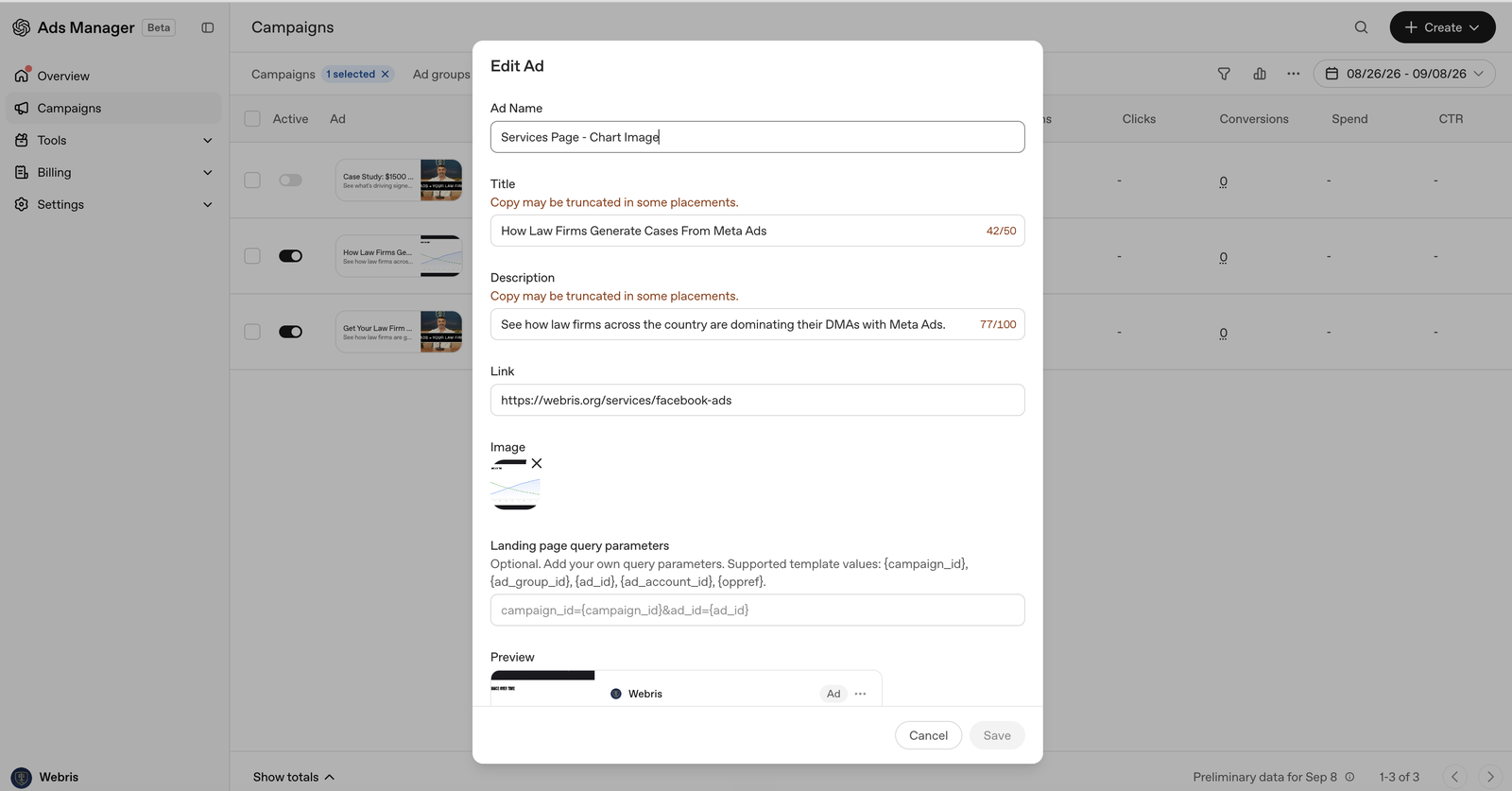
Notice the warning on both the title and description: "Copy may be truncated in some placements." Our title was 42 of 50 characters and it still got the warning. Front-load the important words. If your firm name is what matters, it goes first. If the practice area is what matters, that goes first.
Skip The Learning Curve
We're already inside the Ads Manager building campaigns for law firms. Let us set up and run yours so you're live before your competitors are approved.
How To Set Up A Law Firm Campaign
Here's how we'd structure a first campaign for a personal injury firm, based on what we've seen in the platform and what OpenAI's policy requires.
- Sign up at ads.openai.com. The rollout is still gradual, so you may wait. Apply now regardless. Have your bar license information ready because legal is a restricted category and you will be asked to verify.
- One campaign per firm, one ad group per case type. Car accidents, truck accidents, slip and fall, wrongful death. Keep each ad group to a single intent, which is what OpenAI's own guidance says. Mixing case types in one ad group muddies the context hints.
- Write context hints as conversations, not keywords. Think about what someone actually types into ChatGPT after a crash. "Should I take the insurance company's first offer." "How long do I have to file a claim in Florida." "Do I need a lawyer if I wasn't hurt badly." Write 15 to 30 of these per ad group.
- Start with Manual Max CPC. The auction is new and thin. Set a bid you're comfortable with, watch the delivery indicator, and adjust. Don't hand OpenAI's algorithm your budget on day one.
- Only advertise where you're licensed. The policy says "licensed to practice law in the jurisdiction where the ad is shown." If you're a Florida firm, you're a Florida advertiser. Don't try to run national. That's the fastest way to lose the account.
- Pass the tracking parameters. Use the landing page query parameters field to pass
{ad_group_id}and{ad_id}to your intake form or CRM. Install the pixel. Without this you're flying blind. - Send the click to a page built for it. Someone coming from a ChatGPT conversation has already done research. They don't need a hero video. They need a phone number, a short form, and proof you handle their exact case type. Our Meta Ads funnel landing pages are a good starting point.
- Budget $1,000 to $2,500 for the first month. Enough to learn what gets approved and what converts. Not enough to hurt if the platform isn't ready.
What This Means For Personal Injury Firms
I've spent a decade buying media for PI firms. Here's my honest take on where this fits.
The intent is real. People are already asking ChatGPT what to do after an accident. We know this because we track it for clients as part of our GEO work. Someone asking "how much is my car accident case worth" is further down the funnel than someone scrolling Instagram. That's Google-search-level intent at what are currently much lower prices.
The volume is small. Ads only show to Free and Go tier users, over 18, in the U.S. That's a fraction of ChatGPT's total user base, and ChatGPT's total user base is a fraction of Google's. This is not going to replace your Google or Meta spend in 2026. It's a supplemental channel.
The advantage is being early. Our $30 bid got a "Strong Delivery" rating. That won't last. When every PI firm in your DMA figures this out, CPCs will look like Google's. The firms that build campaigns, learn the context hint system, and collect conversion data in the next six months will have a structural edge over the firms that show up in 2027.
The rules can change again. They already have, twice. Build this as one input into a client acquisition system you own, not as the system itself. Same thing I said about buying leads and Colorado's ban. Platforms are rented. Your brand, your list, and your reviews are owned.
Get In While The Auction Is Empty
Book a call and we'll map out a ChatGPT Ads campaign for your practice area and market, plus how it fits with your Meta and GEO programs.
The Caveats
A few things to keep in mind before you get excited.
- Our ads haven't served yet. Everything in our account shows "Not serving" while it sits in review. We don't have CPC, CTR, or cost-per-case data from this platform. Anyone telling you they do is guessing. We'll publish numbers when we have them.
- Sensitive-context rules still apply. OpenAI doesn't show ads in what it calls sensitive contexts, including personal and mental health conversations. Some injury conversations are going to touch those lines. Expect some of your target conversations to be ad-free by design.
- State bar rules still apply. OpenAI allowing your ad doesn't make it compliant with your state's attorney advertising rules. Disclaimers, "attorney advertising" labels, testimonial restrictions. Same rules as everywhere else. If you're in a state with new rules like California's SB 37, read them before you write copy.
- It's a beta. The UI says so. Features will move. Reporting will change. Don't build anything fragile on top of it.
Final Thoughts
In July I told you that you couldn't buy your way in front of injured clients on ChatGPT. As of August 31, you can.
The platform is real, the policy is public, and the auction is empty. That combination doesn't last long in legal marketing. It didn't on Google in 2008 and it didn't on Facebook in 2018.
Get an account. Build one clean campaign. Track it properly. Then keep doing the work that makes ChatGPT recommend your firm in the answers themselves, because that part is still free.
Or let us handle it. Book a call and we'll set up and run your ChatGPT ads alongside the Meta and GEO work that's already signing cases.
Sources:
- OpenAI Advertising Policies (Updated August 31, 2026)
- OpenAI: Our approach to advertising and expanding access (January 16, 2026)
- OpenAI: New ways to buy ChatGPT ads (May 5, 2026)
- OpenAI Help Center: Create Ad Groups for ChatGPT Ads
- Custom Legal Marketing: Law Firms Can Now Sign Up as Advertisers on ChatGPT (documents the June 4, 2026 exclusion)
- LawLytics: ChatGPT Ads for Lawyers, What's Allowed, What Isn't (August 31, 2026)
- Screenshots: WEBRIS ChatGPT Ads Manager account, captured September 2026