
- What SB 37 requires
- How it impacts Google, YouTube, Facebook/Instagram, and TikTok
- Which practice areas are most affected
- What it means for lead vendors and firms that buy leads
- Clear non-compliant vs compliant ad examples, platform by platform
July 2026 Update: SB 37 Is Now Enforceable Law
SB 37 has been in effect for six months. Compliance is no longer theoretical. Here is what has changed since the law took effect on January 1, 2026. The Beverly Hills Bar Association published an analysis warning that SB 37 significantly increases compliance risk and penalties. Here is how enforcement works:- A consumer files a complaint with the State Bar of California
- The State Bar has 21 days to determine whether substantial evidence of a violation exists
- If flagged, you have 72 hours to pull the ad
- If the ad stays up or gets republished, consumers and competitors can sue
What SB 37 Requires (Plain English)
Under SB 37, an “advertisement” includes any written, recorded, or electronic communication that encourages someone to hire a lawyer — even if it’s shown to a limited audience or routed through a lead-gen funnel. Official bill text. Attorney ads must now:- Identify at least one California-licensed attorney, law firm, or certified lawyer referral service responsible for the ad
- Disclose a bona fide California office location (city/town/county) or the attorney’s State Bar address
- Avoid guarantees, predictions, or promises of results
- Avoid “fast cash” or “quick settlement” messaging
- Avoid misleading awards, rankings, or impersonations
Platform-by-Platform: What Changes and How to Stay Compliant
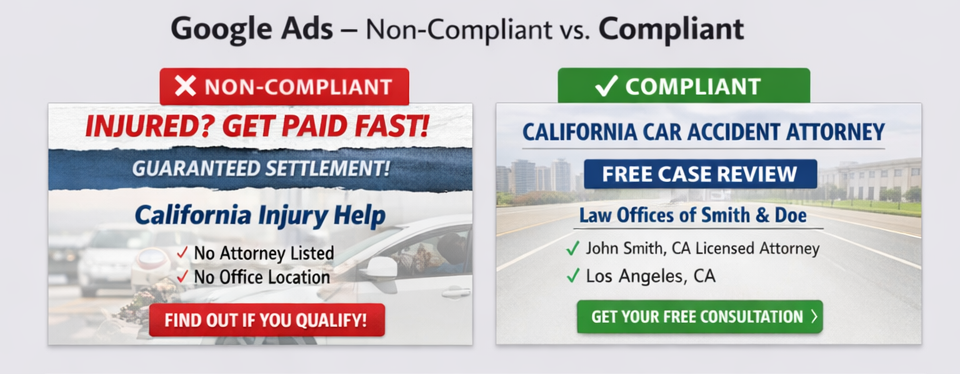
Let's dive into each digital advertising platform and talk about how SB 37 will impact each of your campaigns there.Google Ads (Search, Display, Performance Max, Landing Pages)
Google ads often rely on short headlines and strong claims — which is where many SB 37 issues appear.
What changes
- Landing pages are considered part of the advertisement
- Generic “California accident help” pages are risky
- Claims implying guaranteed or fast results are a problem
- Lead-gen landing pages must still identify the responsible CA attorney and office location
Key takeaway: If a consumer can’t clearly tell who the lawyer is and where they practice, the ad is at risk.
YouTube Ads (Pre-Roll, Shorts, Long-Form)
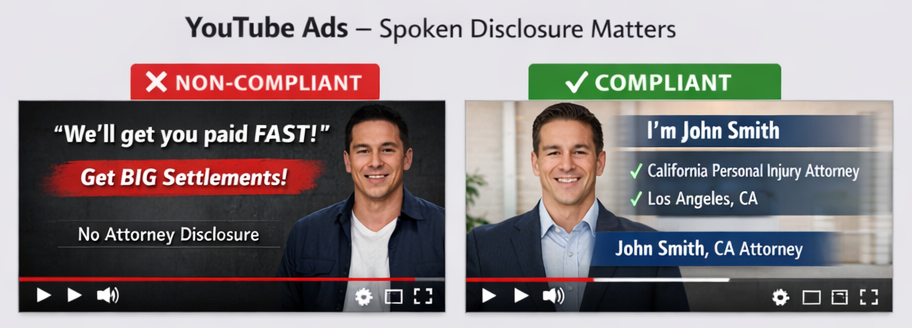
SB 37 explicitly requires disclosures to be “intelligible if spoken.”
What changes
- Fast disclaimers at the end of videos are risky
- Spoken guarantees are prohibited
- Attorney identity and CA location must be clear
Key takeaway: If it’s spoken, it must be clear, slow enough, and understandable — not buried.
Facebook & Instagram Ads (Feed, Reels, Lead Forms)
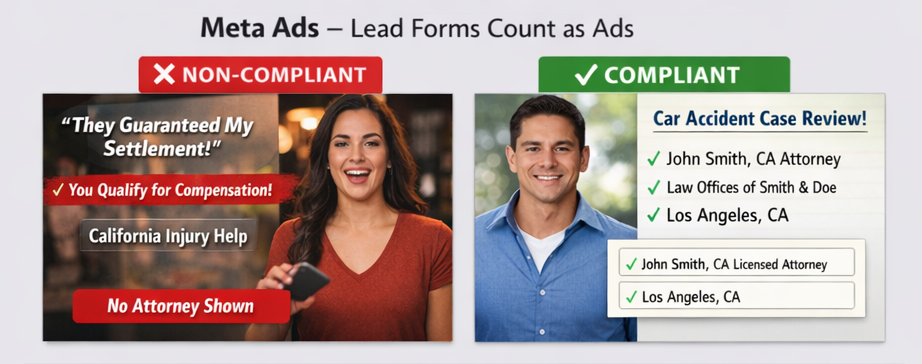
Meta ads blur the line between content and advertising — SB 37 treats them all as ads.
What changes
- “Organic-looking” ads are still ads
- Lead forms and thank-you screens count
- Testimonials and “you qualify” language are risky
- Spokespersons must be clearly disclosed
Key takeaway: If the lead form hides the lawyer’s identity, the entire funnel is exposed.
TikTok Ads (UGC, Spark Ads, Storytelling)
TikTok’s “storytime” culture is directly in SB 37’s crosshairs.
What changes
- “Fast money” narratives are dangerous
- Creators cannot appear to be the lawyer
- Attorney and location disclosures must be visible
Key takeaway: TikTok ads must tell stories without implying certainty or speed.
Legal Practice Areas Most Affected
SB 37 applies to all legal advertising, but enforcement pressure will hit hardest in:
- Personal injury and auto accidents
- Mass tort and product liability
- Workers’ compensation
- Immigration
- Criminal defense
- Family law
If your marketing historically leaned on strong promises or third-party lead funnels, SB 37 is a material risk.
Lead Vendors and Bought Leads: The Biggest Shift
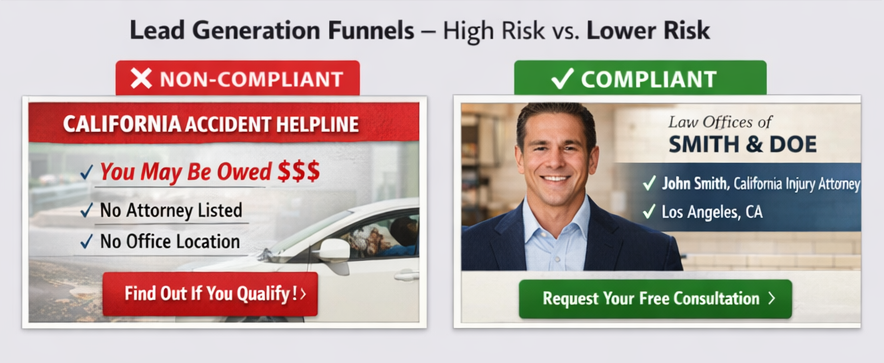
SB 37 directly targets the lead-broker ecosystem.
High-risk structure
- Generic “California Accident Help” branding
- No attorney named
- No CA office location
- Leads sold to multiple firms
- Vendor claims “we’re not a law firm”
Lower-risk structure
- Funnel identifies the responsible CA attorney or firm
- CA office location is disclosed
- No guaranteed results language
- Contracts clarify advertising responsibility and indemnification
If a vendor refuses transparency, that’s a red flag under SB 37.
What Your Law Firm Should Do Now
- Inventory every ad, landing page, and lead form
- Standardize CA attorney + location disclosures
- Remove guarantees and fast-cash language
- Audit lead vendors and contracts
- Create a rapid takedown process for challenged ads
Final Thoughts
SB 37 isn’t just a compliance update — it’s a marketing architecture reset.
Firms that build transparent, attorney-led marketing will adapt easily. Firms that depend on anonymous funnels and aggressive promises will face higher costs, fewer vendors, and more scrutiny.
Need help? Our team of experts is standing by to audit your law firm's advertising ecosystem and help you get complaint with California laws.