
Google's dominance is cracking. For the first time since 2015, Google's search market share has dropped below 90%, and AI search platforms like ChatGPT, Perplexity, and Google's own AI Overviews are absorbing the queries that used to flow straight into blue links.
If you run a law firm, this shift creates a question you can't ignore: should you keep investing in traditional SEO, pivot to generative engine optimization (GEO), or try to do both?
We manage SEO and GEO campaigns for law firms across the country, and the answer we see in real data is clear: the firms winning right now are doing both. Here's exactly how it works and how to implement it at your firm.
What Is SEO vs GEO? The Complete Breakdown
Search Engine Optimization (SEO): Quick Refresher
SEO has been the backbone of legal marketing for over two decades. When a potential client types "car accident attorney near me" into Google, SEO determines whether your firm appears in those critical top results.
You know how it works: Google crawls and indexes your pages, ranks them based on hundreds of factors (keywords, backlinks, page speed, user experience), and displays them as ranked blue links. Users click through to your website. It's a linear, predictable system that law firms have relied on for years.
For SEO, you're tracking: keyword positions, organic traffic, click-through rates, and conversion rates.
Generative Engine Optimization (GEO): How It Works
GEO works differently. Instead of ranking websites, it gets your firm mentioned directly by AI. Instead of clicking through search results, users have conversations with AI platforms that provide direct answers and recommendations.
Here's what that looks like in practice: a potential client opens ChatGPT and types "I was rear-ended yesterday and have whiplash. Who are the best personal injury lawyers in Chicago who handle car accident cases?" ChatGPT generates a personalized response, potentially citing your firm with a direct link, based on authority signals it has pulled from across the web.
GEO metrics are different: how often AI cites your firm, traffic from AI platforms (trackable via UTM codes), lead quality from those visits, and whether AI recognizes your brand.
Where SEO and GEO Actually Differ
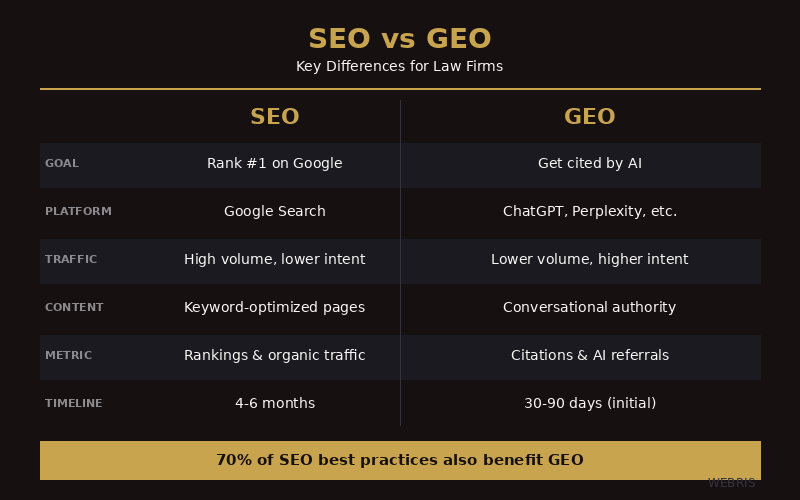
Intent Level: Linear vs Conversational
SEO Traffic: Someone types "divorce lawyer" and clicks through options. The intent is clear but generic.
GEO Traffic: Someone spends 20 minutes discussing their specific situation with ChatGPT: "I'm a business owner going through divorce in Texas, have two kids, stay-at-home spouse, complex assets including two businesses and a rental portfolio." The AI provides a hyper-specific recommendation.
Why does this matter? GEO traffic arrives pre-qualified and ready to hire. These aren't people still comparing six firms. They've already had a detailed conversation about their situation, and the AI told them to contact you specifically.
Citation vs Ranking: A New Success Model
Traditional SEO focuses on ranking #1 for target keywords. GEO focuses on being cited as an authoritative source in AI-generated answers.
SEO goal: "Rank #1 for 'personal injury lawyer Chicago.'" GEO goal: "Get cited when AI discusses Chicago personal injury lawyers for car accident cases."
Citations aren't ranked 1-10 like Google results. AI models select sources based on authority, relevance, and context, and there are typically only 3-5 sources cited in any given response. Getting into that short list is the new game.
Content Strategy: Keywords vs Authority
SEO content strategy centers on targeting specific keywords, optimizing title tags and meta descriptions, building topic clusters around practice areas, and analyzing search volume and competition.
GEO content strategy centers on demonstrating deep subject matter expertise, writing conversational, thorough content, answering specific legal questions thoroughly, and building authority signals across multiple platforms beyond just Google.
Why Both SEO and GEO Matter for Your Law Firm
GEO isn't replacing SEO. It's adding a new channel on top of Google.
Recent data shows Google's global search share has dropped below 90% for most of 2025, with ChatGPT picking up real usage, especially among younger demographics. Among 18-24 year-olds, 66% now use ChatGPT to find information compared to 69% who still use Google. That's the closest competition Google has faced in decades.
For law firms, this means your potential clients are splitting their research across platforms. A car accident victim might start with a Google search, then turn to ChatGPT for more specific guidance. If your firm only shows up on one of those platforms, you're leaking leads to competitors who show up on both.
The 70% Overlap Advantage
About 70% of effective SEO practices also benefit GEO performance, according to legal marketing experts tracking both strategies. High-quality authoritative content, consistent NAP (Name, Address, Phone) across platforms, strong reputation management, technical website optimization, and local search optimization all feed both channels.
That remaining 30% is GEO-specific: conversational content formatting, entity-level schema markup, cross-platform brand consistency, authority building beyond Google, and AI-friendly content structure. That 30% is where most law firms are falling behind right now.
Real Results: The Traffic Quality Difference
Based on analytics data from law firms we manage that are tracking both SEO and GEO performance, here's what the numbers look like:
Google Traffic: Higher volume, lower intent, broader funnel. A typical PI firm sees around 1,500 monthly organic visits with a 2-3% conversion rate and shorter session durations.
ChatGPT Traffic: Lower volume, much higher intent, already-qualified leads. The same firm might see 54 monthly visits from ChatGPT (tracked via ChatGPT UTM codes), but with a 15-20% conversion rate and much longer session times.
Do the math: 54 high-intent GEO visitors at 15% conversion = 8 leads. 1,500 SEO visitors at 2.5% conversion = 37 leads. But those 8 GEO leads are further along in the decision process and close at a higher rate. When you factor in close rates, the cost-per-signed-case from GEO traffic is often lower than from traditional SEO.
GEO by Practice Area: Why One Strategy Doesn't Fit All
One of the biggest mistakes we see firms make is treating GEO like a universal strategy. How AI responds to legal queries varies by practice area, and your approach should too.
Personal Injury: High-Intent, Location-Specific
PI queries in ChatGPT tend to be highly location-specific and urgency-driven. People aren't just asking "who's a good PI lawyer?" They're describing their accident, their injuries, and their location in detail. AI models weight local authority signals heavily for PI, meaning your Google Business Profile, local directory listings, and case results on your website all feed the AI's recommendation engine.
Focus areas: detailed case results pages with specific dollar amounts, location-specific practice area pages, and structured data that explicitly ties your firm to your service area.
Family Law: Emotionally Complex, Question-Heavy
Family law queries are among the most conversational in AI search. People describe detailed personal situations (custody concerns, asset division, domestic violence) and expect nuanced guidance. AI models tend to favor firms with detailed FAQ content and empathetic, authoritative writing on sensitive topics.
Focus areas: in-depth FAQ sections addressing specific custody, divorce, and support scenarios. Content that demonstrates understanding of emotional complexity performs better than purely legal/technical content.
Criminal Defense: Urgency and Availability
Criminal defense queries often happen at odd hours (post-arrest, weekend incidents) and the AI tends to prioritize firms that signal 24/7 availability, fast response times, and specific experience with the charge in question. Schema markup indicating business hours and emergency availability matters more here than in any other practice area.
Focus areas: charge-specific content pages, clear availability signals, case result data organized by charge type.
GEO and Local SEO: The Intersection Most Firms Miss
Here's something most agencies won't tell you: local SEO signals are one of the strongest inputs for GEO performance in legal. When someone asks ChatGPT for a lawyer in a specific city, the AI pulls from the same local authority signals that power Google's local pack.
Your Google Business Profile, your directory listings on Avvo, FindLaw, Justia, and Super Lawyers, your local review volume and sentiment, and your city-specific content pages all feed the AI's understanding of who the authoritative firms are in a given market.
This means local SEO optimization does double duty. Every improvement to your local presence simultaneously strengthens your GEO positioning. Firms that have invested heavily in local SEO over the past few years are finding they already have a head start in AI search, even without doing anything GEO-specific.
Multi-Location Firms: Scaling GEO Across Markets
If your firm operates in multiple cities, your GEO strategy needs to be location-aware. Create distinct practice-area-plus-location content for each office (not duplicate pages with just the city name swapped). AI models can detect thin, templated content and will deprioritize it in favor of firms with genuinely location-specific information.
What works: build location pages that include specific county court information, local judges, jurisdiction-specific procedural details, and community involvement. This kind of content signals to AI that your firm genuinely operates in that market, doesn't just claim to.
How to Implement Both SEO and GEO for Maximum Impact
Phase 1: SEO Foundation (Months 1-3)
Your GEO success depends on solid SEO fundamentals. Start with a technical SEO audit covering site speed, mobile responsiveness, Core Web Vitals, and security. Then move to content authority building: thorough practice area pages, FAQ sections answering real client questions, case studies and success stories, and a regular publishing cadence. Finally, lock down local SEO optimization including Google Business Profile, directory consistency, review management, and local keyword targeting.
Phase 2: GEO Implementation (Months 2-6)
Once SEO foundations are solid, layer in GEO-specific strategies. Implement schema markup at the entity level (not just basic organization schema — practice-area-specific structured data). Build cross-platform brand consistency so AI models encounter the same information about your firm everywhere they train. Optimize legal directory profiles on Avvo, FindLaw, Justia, Martindale, and Super Lawyers. Pursue PR and media mentions that create the authority signals AI models rely on.
On the content side, shift to conversational formats that mirror how people actually ask questions in ChatGPT. Create long-form, comprehensive guides (like our GEO guide for lawyers). Develop content that follows the client journey from problem awareness through attorney selection. And start monitoring AI platforms regularly to see if and how your firm appears.
Phase 3: Integrated Optimization (Ongoing)
Once both channels are running, the ongoing work is testing and refinement. Query AI platforms monthly with your target searches and document who gets cited. Analyze what your cited competitors are doing differently. Identify content gaps where you have expertise but aren't being recognized. Refine both SEO and GEO strategies based on what the data tells you.
Track two sets of metrics: traditional SEO metrics (rankings, traffic, conversions) and GEO-specific metrics (citation frequency, AI platform traffic, lead quality scores). The firms that measure both can allocate budget and effort based on which channel is producing better ROI at any given time.
Your 30-Day GEO Implementation Checklist
Week 1: Assessment. Audit current SEO performance. Test your firm's presence in ChatGPT, Claude, Perplexity, and Google AI Overviews by searching for your practice area + location. Set up AI traffic tracking with UTM codes. Identify your top 10 target queries for both SEO and GEO.
Week 2: Content Foundation. Write FAQ sections for each practice area. Develop conversational content that answers the specific questions potential clients ask AI. Implement schema markup for your firm, attorneys, practice areas, and office locations. Verify NAP consistency across all platforms.
Week 3: Authority Building. Claim and optimize legal directory profiles (Avvo, FindLaw, Justia, Super Lawyers, Martindale). Submit press releases about recent case wins or firm milestones. Claim your Google Knowledge Panel if eligible. Build cross-platform citation consistency.
Week 4: Testing and Refinement. Query AI platforms with all 10 target searches and document results. Screenshot any citations (yours or competitors'). Analyze competitor presence in AI results and identify what they're doing that you're not. Develop your ongoing monthly testing protocol.
The Competitive Advantage of Early Adoption
This is a blue ocean opportunity. Most law firms haven't discovered GEO yet, and the ones that have are still figuring it out. That creates a real first-mover advantage for firms that commit to it now.
Think about it this way: when Google AdWords launched in 2000, early-adopting law firms dominated their markets for years before competition drove up costs. We're seeing the same dynamic play out with AI search right now. Firms establishing authority signals today will be the ones AI recommends tomorrow, and displacing an established recommendation is much harder than building one from scratch.
With ChatGPT processing over 1 billion daily queries and 800 million weekly active users, the volume is already there. Google still dominates overall search, but AI platforms are capturing the highest-intent segment of legal queries, specifically the people who are furthest along in the decision process and most likely to hire an attorney.
The Bottom Line: SEO + GEO = Maximum Visibility
SEO and GEO aren't competing strategies. They're two halves of the same system. The firms running both right now are going to be very hard to catch once AI search hits critical mass.
Your potential clients are already using AI to research legal services. What you need to figure out is whether your firm is the one getting recommended or whether that recommendation is going to a competitor. If you want to find out, try searching for your practice area and city in ChatGPT right now. If your firm isn't mentioned, that tells you everything you need to know.
Contact us to develop your integrated SEO and GEO strategy before your competitors lock down the AI recommendations in your market.
Frequently Asked Questions
SEO (Search Engine Optimization) focuses on ranking your law firm's website in Google's traditional search results. GEO (Generative Engine Optimization) focuses on getting your firm cited and recommended by AI platforms like ChatGPT, Perplexity, and Google's AI Overviews. SEO drives traffic through ranked blue links. GEO drives traffic through AI-generated recommendations and citations. Both are important because potential clients are now splitting their research across traditional search and AI platforms.
No. GEO is not replacing SEO. Google still handles the vast majority of legal searches, and traditional SEO remains critical for driving website traffic. However, AI platforms are capturing an increasingly important slice of high-intent legal queries, particularly from younger demographics and people with complex legal situations who prefer conversational research. Running both strategies simultaneously is the move, especially since about 70% of SEO best practices also benefit GEO performance.
Open ChatGPT (or Claude, Perplexity, or Google AI Overview) and search for your practice area plus your city. For example: "Who are the best personal injury lawyers in Miami?" or "I need a divorce lawyer in Dallas who handles complex asset division." If your firm isn't mentioned in the AI's response, your competitors are likely getting those recommendations instead. This is a clear indicator that GEO optimization should be a priority.
GEO results can appear faster than traditional SEO because AI models update their training data and web browsing capabilities regularly. Some firms see citation improvements within 30-60 days of implementing GEO-specific strategies like schema markup, directory optimization, and conversational content. However, building strong AI authority is an ongoing process, similar to how SEO authority builds over time. The firms that start now will have a real advantage over those that wait.
Since approximately 70% of GEO optimization overlaps with SEO best practices, the incremental cost of adding GEO to an existing SEO campaign is relatively modest. The GEO-specific work (schema markup implementation, AI platform monitoring, conversational content development, cross-platform authority building) typically adds 20-30% to an existing SEO budget. Given that GEO leads tend to convert at significantly higher rates than traditional organic leads, the ROI often justifies the additional investment.