Your blog probably has a problem you didn't create.
Most law firm blogs are written by an agency, a freelancer, or AI. Then they get published under an attorney's name. Sometimes under a name that doesn't belong to anyone.
As of October 2026, Google's own guidance for site owners calls fabricated author profiles a form of deception.
Here's the short version: ghostwriting isn't the problem. Lying about who wrote it is.
Below is exactly what Google changed, why it hits law firms harder than other sites, and how to fix your law firm content without deleting your blog.
What Google Changed
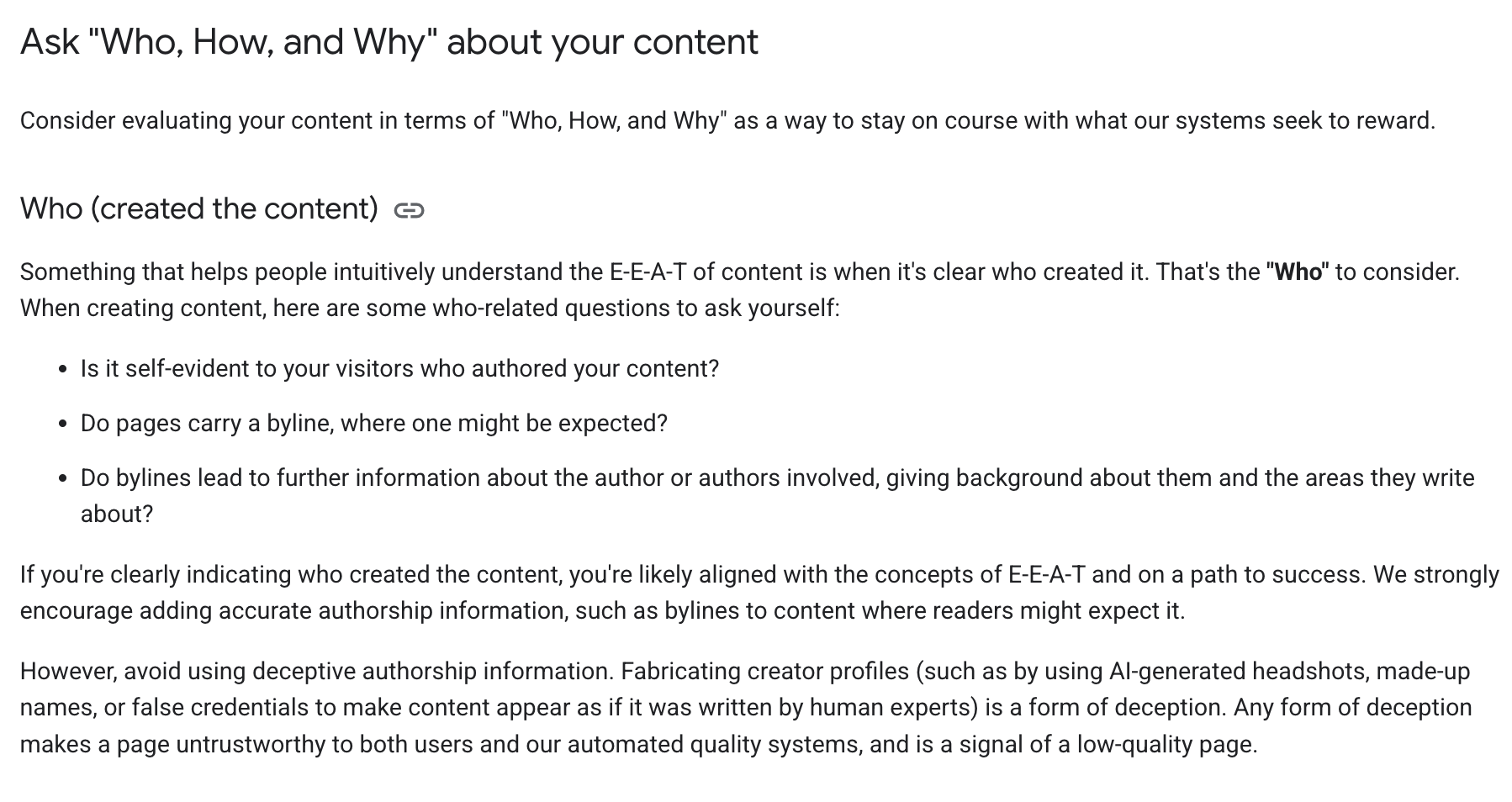
Google added a paragraph to its Creating helpful, reliable, people-first content page warning site owners against deceptive authorship information.
Search Engine Journal reports the version with the new paragraph is dated October 1, 2026. The live page shows a last update of October 5, 2026.
The paragraph sits in the "Who (created the content)" section. It comes right after Google's advice to add accurate bylines.
Google gives three examples of fabricated creator profiles:
- AI-generated headshots
- Made-up names
- False credentials
Google says these are used to make content look like it was written by human experts. It calls that deception and says it makes a page untrustworthy to users and to Google's automated quality systems.
Read that again. Automated systems. Not just human reviewers.
Google's page also describes this as "a signal of a low-quality page."
Search Engine Journal compared the live page against a copy saved June 8, 2026. That copy goes from the bylines advice straight to the "How" section, with no warning at all.
Quality Rater Guidelines on Fake Authors
How fake author profiles moved from Google's rater manual into its guidance for site owners
- Jan 2025
Rater guidelines list fake author profiles as deception - Jun 8, 2026
Site owner page: no warning - Oct 1, 2026
Site owner page adds the warning
The idea isn't new. What's new is who Google is saying it to.
Google's Search Quality Rater Guidelines already treated fake author profiles as deception. Since the January 23, 2025 update, section 4.5.3 lists AI-generated content with made-up author profiles, and profiles that falsely claim credentials, as examples.
Raters are told to give pages that use deception the Lowest rating. Search Engine Journal covered that rater language when it came out.
Here's the difference that matters.
Quality raters don't control rankings. Google says on the same page that rater data isn't used directly in its ranking algorithms.
The rater guidelines are a manual for Google's testers. The people-first page is guidance written for you. It's now telling you directly that its automated systems treat deception as a low-quality signal.
E-E-A-T is Google's shorthand for experience, expertise, authoritativeness, and trustworthiness. If you've been told it's "just rater stuff," that argument got weaker in October 2026.
It's one more reason your attorney SEO strategy has to start with what's true on the page.
Is There a Fake Author Penalty?
❌ Not in the update
- No penalty announced
- No ranking update or rollout window
- No detection method explained
✅ What Google did say
- Fake profiles are deception
- Deception is a low-quality signal
- Automated systems are named
Google didn't announce a penalty, a new ranking system, or a rollout window with this change.
It also didn't explain how its systems would identify a fake profile.
So there's no "fake author update" to wait for. There's no recovery checklist from Google either.
What you do have is Google stating in writing what it considers low quality. On a legal site, that's not a line you want to test.
Ghost Blogging for Law Firms
| Byline setup | What the reader sees | Is it honest? |
|---|---|---|
| Invented persona | "Sarah Mitchell, Legal Analyst" with an AI headshot. She doesn't exist. | ❌ No. This is Google's exact example. |
| Real attorney, never read it | "By John Smith, Esq." John has never seen the post. | ❌ No. The implied claim is false. |
| Real attorney, actually reviewed it | "Written by [writer]. Reviewed by John Smith, Esq." | ✅ Yes. The reader knows who did what. |
Ghost blogging isn't against Google's guidance. Deceptive authorship is.
Ghost blogging is when someone other than the named author writes a post. Whether that's deceptive depends on what the byline tells your reader.
Most firms are running one of three setups.
❌ The invented persona. "Sarah Mitchell, Legal Analyst," with a stock photo or AI headshot. Sarah doesn't exist.
This is the exact scenario Google's paragraph describes. Made-up name, fake headshot, implied expertise.
❌ The real attorney who never read it. The post says "By John Smith, Esq." John has never seen it.
The name is real. The bar number is real. But the claim the byline makes, that a lawyer wrote this, is false.
✅ The real attorney who actually reviewed it. A writer drafts the post.
John reviews it, fixes what's wrong, and signs off. The byline says so.
That's honest. The reader knows who did what.
I know what you're thinking: "My agency has done it this way for years."
I'll be honest about the middle one. It's the setup most firms run, and Google's examples don't name it word for word.
But Google's concern is content made to look like it came from human experts when it didn't. I wouldn't bet a practice on the gap between "made-up name" and "real name on a post he never read."
YMYL for Law Firms
YMYL: topics that can significantly affect a person's health, financial stability, safety, or well-being.
Legal content falls in this group. Of the four parts of E-E-A-T, Google says trust matters most.
Fake bylines hurt law firms more than most sites. Legal content is YMYL, and trust is the signal Google says matters most.
YMYL ("Your Money or Your Life") is Google's term for topics that could significantly affect a person's health, financial stability, safety, or well-being.
Google says its systems give even more weight to content with strong E-E-A-T on those topics.
Of those four, Google says trust is most important.
A fake author goes straight at trust. On a personal injury site, where someone is deciding who handles their accident claim, that's the worst signal to fake.
Google's Main Content Criteria
| Attribute | What Google means (paraphrased) | What it means for your blog |
|---|---|---|
| Effort | How much human work went into the content. Mass-produced AI text with no oversight counts as little to no effort. | A drafted, edited, attorney-checked post. Not 40 unreviewed AI posts a month. |
| Originality | Information or perspective not already available elsewhere. | Your courts, your case types, your intake process. Not a rewrite of the state statute page. |
| Talent or skill | The expertise needed to give the visitor a satisfying experience. | Someone who knows the practice area actually checks the post. |
| Accuracy | Content should be factually accurate. YMYL content must be highly accurate and match expert consensus. | Correct deadlines, current damage caps, the right jurisdiction. |
The same October update added a definition of main content and four attributes Google's raters judge it on.
Main content is any part of a page that directly helps it achieve its purpose. On a blog post, that's the article text, headings, images, and any tools on the page.
One line here is aimed squarely at content mills. Google says attribution or credit to other sources doesn't replace original effort.
So citing three other blogs doesn't make a rewrite original.
And fixing the byline alone won't save a thin post. The byline and the work behind it have to match. That's the foundation of any law firm SEO strategy that holds up.
Do Author Bylines Help SEO?
✅ Real byline
- No direct ranking boost
- Builds reader trust
- Supports the call
❌ Fake byline
- No ranking boost either
- Named a low-quality signal
- Loses the prospect who checks
Not directly. In January 2024, Google's Search Liaison account said bylines don't help pages rank better, as Search Engine Journal reported.
That's the part most firms get backwards.
An author byline isn't a ranking lever you can fake your way into. It's a trust statement to the reader.
A true one gives nothing up. A false one is now named by Google as a low-quality signal. There's no upside to faking it.
Google's own "Who" questions are short:
- Is it obvious to visitors who wrote the content?
- Is there a byline where a reader would expect one?
- Does the byline lead to more information about the author and what they write about?
If you can answer yes, honestly, you're where Google wants you.
Think about how this plays out with a real prospect. Someone hurt in a crash reads your post on filing deadlines, then clicks the author's name.
If they land on a real attorney with bar admissions and a track record, that supports the call. If they land on a stock photo and a vague bio, you just lost a signed case you were close to.
AI-Written Law Firm Blogs
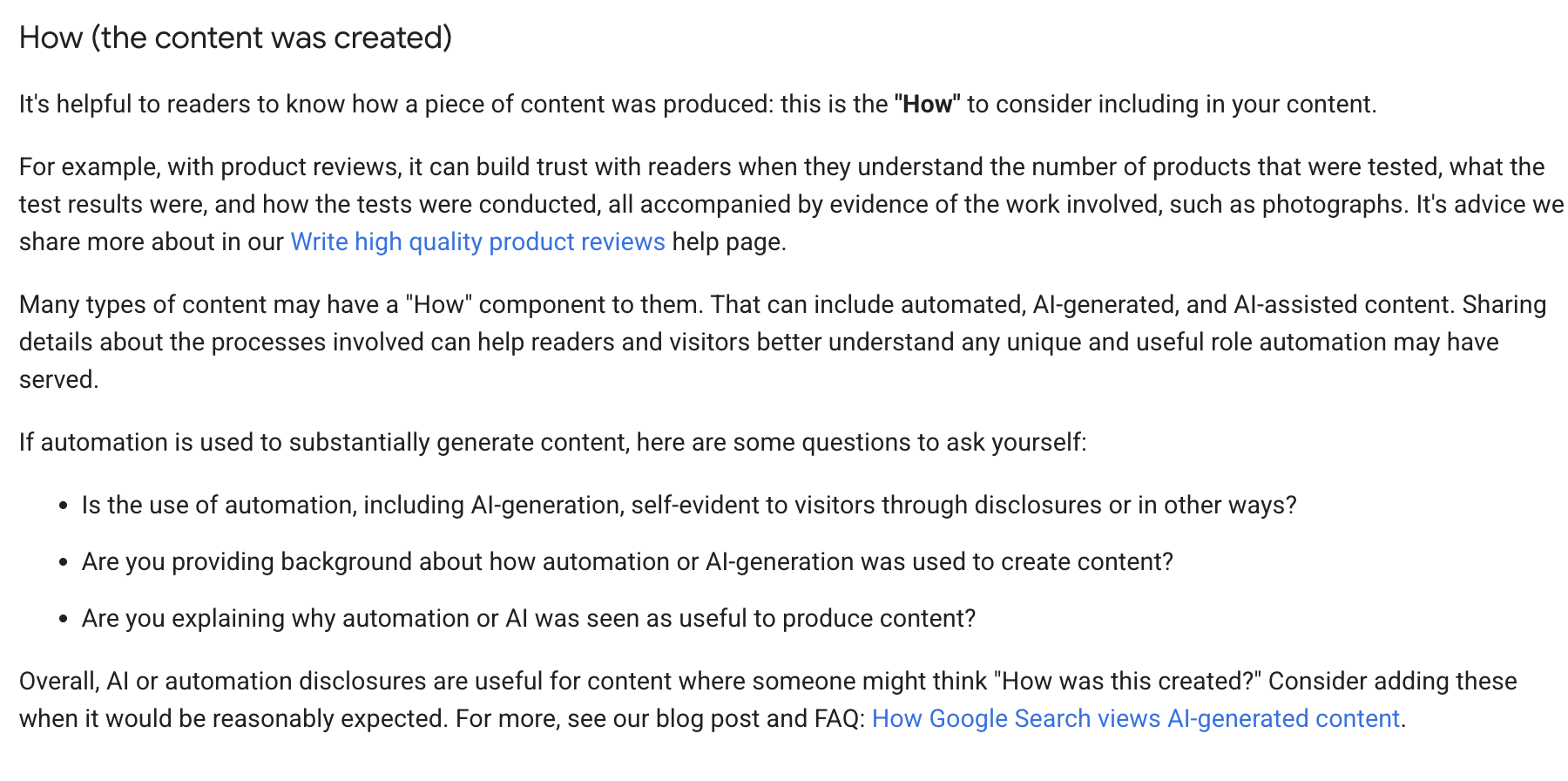
AI content isn't banned. Deceptive AI content is.
Google's guidance asks how content was made. If automation substantially generated it, Google suggests asking three things:
- Is the use of AI obvious to visitors, through a disclosure or otherwise?
- Are you explaining how AI was used?
- Are you explaining why AI was useful for this content?
The hard line is in Google's spam policies on scaled content. Using automation primarily to manipulate rankings is a violation.
For your firm, keep it simple.
AI can draft. An attorney verifies. The byline tells the truth about both.
What you can't do is publish an AI draft under an invented "legal expert" with an AI headshot. That's the exact example Google gave.
How to Audit Blog Authorship
A five-step authorship audit
- Export every post with its author.
- Tag each post by byline type.
- Check every author page for a real person and accurate credentials.
- Act: reassign, switch to a firm byline, rewrite, or retire.
- Document who reviewed each post and when.
You can do this in one afternoon for most firm blogs. Here's the process.
- Export every post with its author. Your CMS can export this, or run a crawl and pull the author field.
- Tag each post by byline type. Invented persona, attorney (not reviewed), attorney (reviewed), firm byline, or no byline.
- Check every author page. Does the person exist? Is the photo real? Are the credentials and bar admissions accurate today?
- Pick an action for each post using the three options below.
- Document reviews going forward. Who reviewed it, when, and what changed.
Start with your highest-traffic posts. Then anything covering deadlines, statutes, settlement values, or insurance rules. Those carry the most accuracy risk.
If your blog was built by a personal injury SEO vendor, ask them directly who wrote each post and who reviewed it. You're the one whose name is on it.
Option 1: Add an Attorney Reviewer
Written by [Writer Name], Legal Content Writer.
Reviewed by [Attorney Name], Partner, licensed in [State].
Reviewed [Date]
This is the best option for posts that already get traffic.
An attorney reads the post, corrects anything wrong, and the byline shows both roles.
Only list a reviewer who actually reviewed it. A "reviewed by" line on a post nobody read is the same problem in a new spot.
And don't bump the published date to look fresh. Google's guidance flags changing dates when the content hasn't substantially changed. If the review led to real edits, an honest "updated" date is fine.
Option 2: Use a Firm Byline
❌ Misleading
- "By John Smith, Esq." on a post John never reviewed
✅ Honest
- "By the [Firm Name] Legal Team," linked to your About page
For posts no attorney can review yet, credit the firm and link to your About page.
It's weaker than a named attorney for trust. But it's true, and it removes the false claim today.
Treat this as a holding pattern. Move posts to Option 1 as attorneys review them.
Option 3: Rewrite or Retire
| Post situation | Action |
|---|---|
| Gets traffic, content is accurate | Attorney review, then reassign the byline (Option 1) |
| Gets traffic, content is outdated or wrong | Rewrite, attorney review, then reassign |
| No traffic, no links, thin content | Retire it. 301 redirect to the closest relevant page, or remove it. |
| Author page for an invented persona | Delete the persona. 301 redirect the author page to your attorneys page. |
Some posts aren't worth saving under any byline.
Don't leave a fake person live on your site. Reassigning the posts but keeping "Sarah Mitchell, Legal Analyst" on an author page leaves the deception in place.
Attorney Bio Page Checklist
Attorney author page checklist
- A real photo of the attorney
- Full name and title at the firm
- Bar admissions and states licensed
- Practice areas they actually handle
- Education
- A link to their state bar profile
- Links to other real profiles
- A list of posts they wrote or reviewed
An author page is a page about the person who wrote or reviewed your content. On most firm sites, the attorney bio page does this job.
Google's guidance asks whether bylines lead to background on the author and the topics they write about. The checklist above is what that looks like for an attorney.
Every claim on the page has to be true and checkable. False credentials are the third example in Google's paragraph.
Your Google reviews and bar profile already tell readers whether your attorneys are real. The author page should match them.
Author Schema for Attorneys
Three fields that have to match the visible page
- author.name
Same name as the byline - author.url
The attorney's bio page - sameAs
State bar and real profiles
Author schema is structured data that tells search engines who created a page. You add it to the page as JSON-LD.
Google's Article structured data docs support an author property with the person's name and a URL. Two rules: match what's visible on the page, and point to real profiles.
On the blog post:
{
  "@context": "https://schema.org",
  "@type": "BlogPosting",
  "headline": "How Long Do You Have to File a Car Accident Claim in [State]?",
  "datePublished": "2026-10-23",
  "dateModified": "2026-10-23",
  "author": {
    "@type": "Person",
    "name": "[Attorney Name]",
    "jobTitle": "Personal Injury Attorney",
    "url": "https://www.yourfirm.com/attorneys/attorney-name/"
  },
  "publisher": {
    "@type": "Organization",
    "name": "[Firm Name]",
    "url": "https://www.yourfirm.com/"
  }
}
On the attorney's bio page, Google supports ProfilePage structured data:
{
  "@context": "https://schema.org",
  "@type": "ProfilePage",
  "mainEntity": {
    "@type": "Person",
    "name": "[Attorney Name]",
    "jobTitle": "Personal Injury Attorney",
    "worksFor": { "@type": "Organization", "name": "[Firm Name]" },
    "sameAs": [
      "[State bar profile URL]",
      "[LinkedIn profile URL]"
    ]
  }
}
If a writer drafted the post and an attorney reviewed it, show both roles in the visible byline. Keep the schema author as the person who actually wrote it.
One warning. Schema doesn't make a fake author real. Marking up an invented person just labels the deception in machine-readable form.
Fake Authors and AI Search
One consistent attorney identity across every source
- Firm bio page
- State bar profile
- Directory and review profiles
- One consistent attorney identity
A fake persona has no footprint outside your site.
The same trust standard applies. Google hasn't created a separate one for AI.
In its May 2025 guidance on succeeding in AI search, Google points site owners back to this same people-first content page to self-evaluate.
Google hasn't documented that an author page or author schema gets you cited in an AI answer. Ignore anyone who promises that.
What's reasonable: when your attorney's name, credentials, and practice areas match across your site, bar profile, and directories, AI systems get one consistent picture of a real person. A fake persona with no footprint anywhere else gives them nothing.
For the bigger picture, see our guides on GEO for lawyers and how law firms rank in ChatGPT.
Frequently Asked Questions
- Will Google penalize ghostwritten posts?
- Do you have to disclose a ghostwriter?
- Can a paralegal be the author?
- Does this apply to practice area pages?
Will Google Penalize Ghostwritten Posts?
No penalty has been announced.
Deceptive authorship is named as a signal of a low-quality page.
Google hasn't announced a penalty tied to this change. Its guidance says deceptive authorship is a signal of a low-quality page, and that its automated quality systems treat deception as untrustworthy.
Do You Have to Disclose a Ghostwriter?
Google asks for accurate authorship, not a credit for every contributor.
If the byline is honest about who wrote it, you're aligned.
Not to Google, as long as the byline is accurate. If the byline implies an attorney wrote it and one didn't, that's the problem.
Can a Paralegal Be the Author?
✅ Fine
- "Jane Lee, Paralegal"
❌ Not fine
- "Jane Lee, Esq." with no law license
Yes, if it's true and their role is labeled accurately. Don't add "Esq." or imply a law license they don't have.
Does This Apply to Practice Area Pages?
Bylines where readers expect them. Accurate credentials everywhere.
A firm byline is fine on practice area pages.
The accuracy rule does. Google asks for bylines where readers would expect one. Practice area pages usually don't carry a personal byline, and crediting the firm is fine there.
Any credentials you show still have to be accurate.