
Most law firms are still paying for blog posts.
Their future clients are picking a lawyer from the map pack.
Hawk Law Group stopped chasing organic traffic this year. Its Google Maps visibility more than doubled.
| Metric | Period compared | Before | After | Change |
|---|---|---|---|---|
| Share of Augusta where Hawk ranks top 3 on Google Maps | May 21 vs. Oct 15, 2026 | 26.5% | 57.1% | +30.6 pts |
| Map grid points where Hawk ranks #1 (of 49) | May 21 vs. Oct 15, 2026 | 2 | 14 | +12 |
| Average Google Maps rank across the grid | May 21 vs. Oct 15, 2026 | 5.86 | 4.71 | 1.15 places higher |
| Organic sessions, Augusta personal injury page | 60 days before vs. after relaunch | 278 | 296 | +6% |
| Organic sessions, whole site | 60 days before vs. after relaunch | 5,586 | 4,228 | -24% |
Sources: Local Falcon grid scans for "augusta personal injury lawyers," 7x7 grid, 5-mile radius around Hawk's Augusta office. Google Analytics 4, organic search sessions, Jun 16 to Aug 14 vs. Aug 15 to Oct 13, 2026. For average rank, lower is better.
Here's why that matters.
When someone in Augusta gets hurt and searches for a lawyer, they pick from the map pack. The blue links underneath barely get clicked for hiring searches. We showed that with real Search Console data in the state of search for law firms.
So our SEO team cut content, rebuilt the practice area pages that matter, and pointed everything at the searches people make when they're ready to hire. Organic traffic went down. The map pack went up.
You can read how the original Hawk work started in the Hawk Law Group SEO case study. Here's what changed since, what the data shows, and the process you can run on your own site.
What Content Does A Law Firm Website Need?
A law firm website needs four types of content: practice area pages, location pages, attorney bios, and supporting articles. Each one has a single job.
| Page type | Its job | Example |
|---|---|---|
| Practice area page | Rank for a service in a market and sign cases | Augusta car accident lawyer |
| Location page | Prove you serve a specific office or city | Aiken, SC office |
| Attorney bio | Prove a real, qualified person handles the case | Named partner profile |
| Supporting article | Answer one question and pass relevance to a practice area page | "How long do I have to file a wrongful death claim in Georgia?" |
A practice area page is the page that targets a legal service plus a market, like "Augusta personal injury lawyer."
It's the page that should be signing cases. Everything else on your site exists to support it.
Most firms have all four types of page. The problem is they have too many of each, and the pages overlap.
If you want the bigger picture of how these pieces fit together, start with our law firm SEO guide.
Why Publishing More Content Stopped Working
- 40 near-identical city pages
- Three posts answering the same question
- Copy that fits any firm in any state
- One page per practice area per market
- One answer per question
- Copy only your firm could write
Publishing more content stopped working because Google now treats content made at scale to chase rankings as spam. It doesn't matter whether a person or AI wrote it.
In March 2024, Google strengthened its spam policy on scaled content.
According to Google's March 2024 core update announcement, the policy now targets producing content at scale to boost rankings, whether automation, humans, or both are involved.
Read that again. Humans included.
That covers most of what law firms were sold over the last decade:
- ❌ 40 "car accident lawyer" pages, one per suburb, with the city name swapped
- ❌ Three blog posts answering the same question in slightly different words
- ❌ Practice area copy so generic it could sit on any firm's site in any state
- ✅ One page per practice area per market that actually answers what the client searched
There's a second problem with too much content. Overlapping pages split your ranking signals.
When several pages cover the same topic, links and relevance get spread across all of them. Google's documentation on consolidating duplicate URLs explains that picking one preferred URL lets search engines consolidate those signals into a single page.
One strong page beats five weak ones fighting each other.
I'll be honest: expansion did help Hawk early on. But over time it produced pages that were weaker, overlapping, or out of date. That's what we fixed.
What Happened To Hawk's Google Maps Rankings?
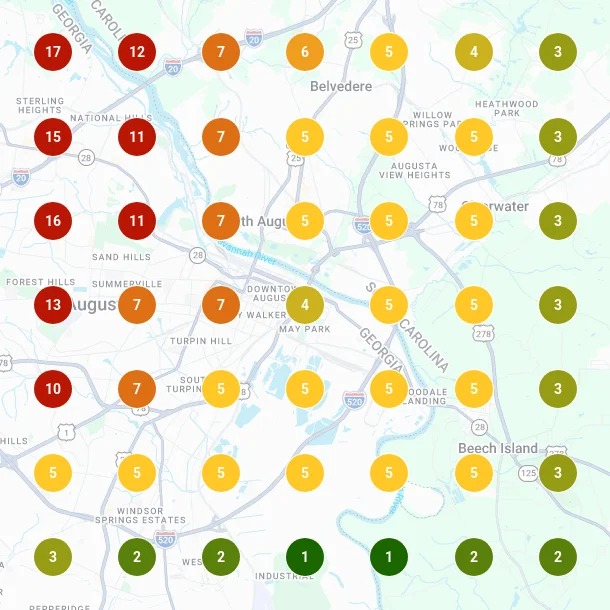
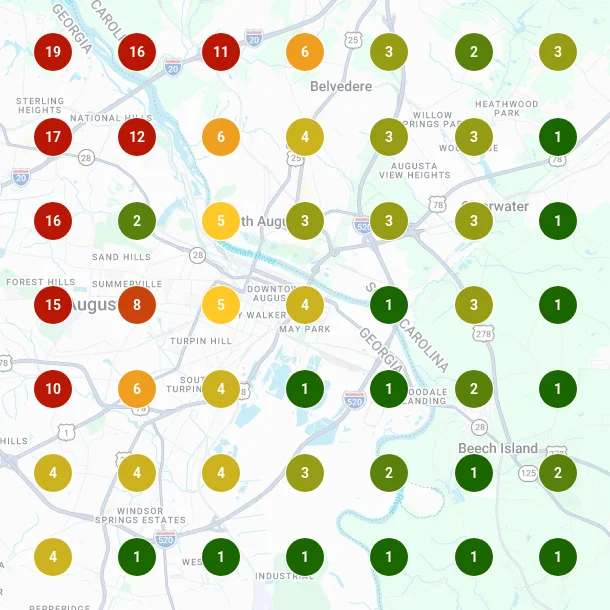
Hawk now ranks in the Google Maps top three across 57% of Augusta for "augusta personal injury lawyers," up from 26.5% in May 2026. It ranks #1 at 14 of 49 points across the city, up from 2.
We measure this with a grid scan. A grid scan checks your Google Maps ranking from dozens of points across a city, because map results change depending on where the searcher is standing.
One search from your office tells you almost nothing. A grid tells you what the whole market sees.
Look at the center of the grid. At its own downtown office, Hawk still ranks #4. The gains came south and east of downtown, where it now ranks #1 across most of the grid. A single search from the office would have missed the whole story.
| Metric | May 21, 2026 | Oct 15, 2026 |
|---|---|---|
| Grid points ranking #1 | 2 | 14 |
| Grid points ranking top 3 | 13 | 28 |
| Share of grid in the top 3 | 26.5% | 57.1% |
| Average map rank | 5.86 | 4.71 |
Source: Local Falcon, 7x7 grid, 5-mile radius around 338 Telfair St, Augusta. Keyword: "augusta personal injury lawyers."
From Invisible To The Top Three, Twice
In March 2025, Hawk didn't rank in the top three anywhere on the grid. At 18 of the 49 points, it didn't show up on the map at all.
By August 2025, it held the top three across 73% of Augusta. That's the work in the original case study.
Then it slipped. By May 2026, the top-three share was down to 26.5%.
I'll be honest: map rankings aren't permanent. Competitors push reviews, Google shifts results, and ground you won gets taken back. The October scan shows the rebuild winning most of it back. We're still working on the rest.
Organic Traffic Fell, And That's Fine
Sitewide organic sessions dropped 24% after the relaunch. The practice area pages built to sign cases held or grew.
| Landing page | Before | After | Change |
|---|---|---|---|
| Whole site | 5,586 | 4,228 | -24% |
| Homepage | 985 | 592 | -40% |
| Augusta personal injury lawyer | 278 | 296 | +6% |
| Aiken County personal injury lawyer | 44 | 71 | +61% |
| Evans personal injury lawyer | 50 | 58 | +16% |
| Augusta wrongful death lawyer | 3 | 16 | +433% |
Source: Google Analytics 4, organic search sessions by landing page. Jun 16 to Aug 14, 2026 (before) vs. Aug 15 to Oct 13, 2026 (after).
Look at which page grew. Hawk's Google Business Profile links straight to the Augusta personal injury page.
That page is where map searchers land. It's also the page we rebuilt first.
Rankings tell the same story. Ahrefs tracks where Hawk ranks for its personal injury keywords in the US:
| Keyword | Monthly searches | Jun 15 | Oct 14 |
|---|---|---|---|
| personal injury attorney augusta ga | 300 | 10 | 6 |
| personal injury lawyers in augusta ga | 250 | 11 | 7 |
| personal injury attorney augusta | 400 | 10 | 7 |
| personal injury lawyer augusta ga | 600 | 11 | 8 |
| medical malpractice attorney augusta ga | 150 | 10 | 5 |
| augusta auto injury lawyer | 1,500 | 3 | 3 |
Source: Ahrefs Site Explorer, US organic keywords for hawklawgroup.com, best position on Jun 15, 2026 vs. Oct 14, 2026.
Not everything moved up. Hawk's Augusta car accident keywords slipped over the same period, from top-three positions to roughly 7 to 11.
That page is next in line for the same treatment. We're still experimenting, and it's difficult to isolate the impact of any single change. We changed the whole structure around the pages that matter, not one thing.
Step 1: Audit Every Practice Area Page And Blog Post
Start by listing every practice area page and blog post on your site, pulling at least 12 months of Google Search Console data for each, and assigning every URL one of five actions.
This is the step most firms skip.
It's also the step that made everything else work for Hawk. We audited every existing practice area page and blog post before writing a single new word.
Keep, Improve, Merge, Redirect, Or Remove
| Action | When to use it | What you do |
|---|---|---|
| Keep | The page ranks, gets clicks, and is the only page for its topic | Leave it alone |
| Improve | Right topic, weak page: generic copy, outdated law, no proof | Rewrite it using Step 2 |
| Merge | Two or more pages cover the same topic | Combine the best parts into one page, then 301 redirect the others to it |
| Redirect | The page has links or traffic but no reason to exist on its own | 301 redirect it to the closest relevant page |
| Remove | No traffic, no links, no relevance to your cases | Delete it, or redirect if anything still points to it |
Every URL on your site gets exactly one of these five actions.
A 301 redirect is a permanent redirect from one URL to another.
Google's documentation describes a redirect as a strong signal that the target page should become the preferred version. That's how the authority from merged pages lands on the page you keep.
Don't delete a page that has backlinks. Redirect it. Otherwise you throw away links you already earned.
How To Find Pages Competing For The Same Keyword
Keyword cannibalization is when two or more of your pages compete for the same search, so Google splits rankings between them and neither ranks well.
Here's how to find it in Google Search Console:
- Open Performance and click Search results.
- Add a Query filter for one of your money keywords, like "car accident lawyer [your city]."
- Click the Pages tab.
- If two or more of your URLs show impressions for that query, you have a split.
Run this for every priority keyword.
The page with the most clicks and the strongest backlinks is usually the one to keep. Merge the rest into it.
Step 2: Rebuild Each Practice Area Page Around What The Client Searched
A practice area page ranks when it answers the client's actual question, explains the law in your state, proves your attorneys' experience, and is clearly about your market.
This is where most of the gains came from.
We moved Hawk's priority pages away from generic SEO copy. Every rebuilt page had to be specific: to the search, to Georgia and South Carolina law, to Hawk's attorneys, and to Augusta.
Your personal injury SEO results depend on these pages more than anything else on your site.
Answer The Question In The First Paragraph
"If you've been injured in an accident, you need an experienced and compassionate legal team on your side."
"If you were hurt in a crash in Augusta, Georgia law generally gives you two years to file a lawsuit. Call us before you talk to the other driver's insurance company."
The first two sentences of a practice area page should tell the reader what to do and what the law allows. Skip "we understand how hard this is."
The first intro could be on any firm's site in America.
The second one answers a real question, names the market, and tells the reader what to do next.
This also matters for AI search. Answer engines pull direct, self-contained answers. We cover that more in how law firms rank in ChatGPT.
Explain Your State's Law, Not Generic Law
| State | General personal injury deadline | Statute |
|---|---|---|
| Georgia | 2 years from the date of injury | O.C.G.A. § 9-3-33 |
| South Carolina | 3 years | S.C. Code § 15-3-530(5) |
Example of the state-specific detail a practice area page needs. Not legal advice. Exceptions apply in both states.
Generic legal content says "deadlines apply." A ranking practice area page names the deadline, the statute, and the exceptions that matter in your market.
Augusta sits on the Georgia-South Carolina line.
A firm there gets clients from both sides of the Savannah River. So Hawk's pages explain both states' rules. That's information a national template never includes.
According to a Georgia appellate decision quoting the statute, O.C.G.A. § 9-3-33 requires actions for injuries to the person to be brought within two years after the right of action accrues.
South Carolina's Section 15-3-530 sets a three-year period for injury to the person. It also covers wrongful death, with the clock starting at the date of death.
Two rules for legal content:
- Cite the statute directly. Not another law firm's blog post about it.
- Never guarantee an outcome. No "you will receive compensation." Have an attorney at the firm review every legal claim before it goes live.
Prove Experience With Attorneys, Awards, And Results
- "Aggressive"
- "Experienced"
- "We fight for you"
- Named attorney, linked bio
- Awards a reader can verify
- Relevant case outcomes
A practice area page should show who handles the case and what they've done. Generic claims like "aggressive" and "experienced" prove nothing.
On Hawk's rebuilt pages, we added:
- Named attorneys handling that practice area, linked to their bio pages
- Verifiable awards, meaning ones a reader can look up
- Case outcomes relevant to that practice area
- Firm history: Hawk has served the area since 1984
Before you publish case results, check your state bar's advertising rules. Many states require disclaimers.
Attorney bios also matter beyond the page. They're how Google connects a real, qualified person to your firm. More on that in attorney SEO.
Make The Page Unmistakably Local
- Office address matches the Business Profile
- The courts where cases are filed
- Real local roads and crash areas
- Nearby communities you serve
- Both states' law, if you border one
- Fails if "Augusta" could be "Atlanta"
A local practice area page should be impossible to copy and paste into another city. If you can swap "Augusta" for "Atlanta" and the page still makes sense, it isn't local enough.
Local detail that belongs on the page:
- Your office address, matching your Google Business Profile exactly
- The courts where your cases are filed
- The roads and areas where your clients' accidents happen, like I-20 and the Bobby Jones Expressway in Augusta
- The surrounding communities you serve, like Evans, Martinez, and North Augusta
We go deeper on this in local SEO for attorneys.
Step 3: Build A Supporting Cluster Around Each Priority Page
A topical cluster is a group of articles that each answer one specific question about a practice area and link back to that practice area page. The cluster tells Google your site covers the topic in depth.
This is different from "publish more blogs."
Disconnected blog posts on random topics don't help your practice area pages. Every supporting article in a cluster has a job: answer one question and pass relevance to one page.
Your content marketing should work this way. Each article earns its place by supporting a page that signs cases.
Example: Nine Articles Around Augusta Wrongful Death
For Hawk, we published nine supporting articles around Augusta wrongful death. Each one links back to the main wrongful death practice area page.
Organic sessions to that page went from 3 to 16 when we compared the 60 days before and after the relaunch. Small numbers, but a page that barely got found now does.
Good supporting article topics answer the questions families actually ask:
- How long they have to file
- Who is allowed to file the claim
- What damages are available
- What happens when the death involved a truck, a workplace, or a medical provider
Step 4: Link Pages On Purpose Without Breaking What Already Ranks
Internal links should connect practice area pages, supporting articles, and location pages that are actually related. Leave pages that already rank well alone unless the data says otherwise.
Rules we followed on Hawk:
- Supporting articles link up to their practice area page, using descriptive anchor text
- Practice area pages link across to closely related practice areas, like car accidents to truck accidents
- Location pages link to the practice area pages relevant to that office
- Every internal link points to the final URL, not to an old address that redirects
The last rule matters most after a relaunch.
Google's documentation recommends linking to your preferred URL rather than a duplicate. A link that runs through a redirect wastes a step.
Be careful with pages already performing well. Before you change links or anchor text on a ranking page, check its GSC trend. If it's climbing, don't touch it.
What Supports The Page: Entities, Technical Cleanup, And Reviews
Entities
Structured data connecting the firm, its attorneys, and its offices.
Technical
Clean redirects, working URLs, and every important page indexed.
Local authority
Reviews, consistent citations, and local links.
Three things help Google understand and trust your practice area pages: structured data connecting your firm, attorneys, and offices; a clean technical foundation; and local authority from reviews and citations.
None of these will rank a weak page.
But a strong page without them leaves rankings on the table.
Connect The Firm, Attorneys, And Offices With Structured Data
Structured data is code on your page that tells search engines exactly what your business is, who works there, and where it's located.
For Hawk, we cleaned up the structured data so it clearly connects:
- The firm as a legal service business
- Each attorney as a person who works for the firm
- Each office location, with addresses that match the Google Business Profile exactly
It's also why Hawk's organic result shows review stars. That's structured data at work.
Consistent entity data also helps AI answer engines identify your firm correctly. We cover that in GEO for lawyers.
Clean Up The Technical Mess After A Relaunch
- Map every old URL to a new one
- 301 redirect each to the closest match
- Remove redirect chains
- Fix broken internal links and URLs
- Resubmit the XML sitemap
- Check the Page indexing report
Every website relaunch breaks something. The fix is to find it fast, before Google decides your pages are gone.
Hawk's site relaunched in August 2026. The new build gave us a cleaner foundation and more flexibility to improve individual pages. It also left cleanup work.
- ✅ Map every old URL to a new one, and 301 redirect it to the closest match
- ✅ Remove redirect chains, where one redirect points to another redirect
- ✅ Fix broken internal links and broken URLs
- ✅ Resubmit your XML sitemap in Google Search Console
- ✅ Check the Page indexing report in Search Console for pages that dropped out of the index
Win The Map Pack With Reviews And Local Authority

You win the map pack by being relevant to the search, close to the searcher, and well known. Reviews are the part of that you control most directly.
According to Google's Business Profile help center, local results are based mainly on relevance, distance, and prominence.
Google also states that review count and review score factor into local ranking. More reviews and positive ratings can improve where you show up.
Hawk went from 79 Google reviews at the time of the original case study to 223 reviews with a 4.9 rating in October 2026.
But review count isn't everything. Look at who Hawk shares the Augusta top three with:
| Firm | Google reviews | Top-3 grid points |
|---|---|---|
| Malchow Johnson Injury Lawyers | 483 | 36 |
| The Mike Hostilo Law Firm | 703 | 33 |
| Hawk Law Group | 223 | 28 |
| M. Austin Jackson Injury Lawyers | 420 | 11 |
Source: Local Falcon grid scan, October 15, 2026, 49 points. Review counts as listed on each Google Business Profile at scan time.
Hawk holds the top three at 28 points with a third of the leader's reviews. Reviews got Hawk into the conversation. Relevance and proximity keep it there.
The firm made asking for reviews part of how every case closes. Our lawyer reviews guide explains how to set that up.
Beyond reviews, local authority comes from:
- Consistent citations: your firm name, address, and phone number identical across directories
- Local links from organizations in your market, covered in lawyer link building
- A clear connection between your firm, your attorneys, and the markets you serve
How Long Does This Take?
Expect months, not weeks. The first climb took about five months. Two months after the relaunch, Hawk was back to 57%.
Map rankings also move backward if you stop. Hawk's slide between November 2025 and May 2026 is the proof.
Treat it like intake: something you work on every month, not a project you finish.
How Do You Measure Whether Fewer Pages Is Working?
- Total organic traffic
- Total impressions
- One search from your office
- Map grid rankings across your city
- Visits to practice area pages
- Calls and signed cases
Measure where cases come from: the map pack and your practice area pages. If you judge consolidation by total traffic, it will always look like a failure.
Cutting informational blog posts lowers total traffic. That's expected. Most of that traffic was never going to hire you.
Impressions mislead too. In Search Console, impressions for Hawk's "personal injury lawyer" searches fell sharply from mid-August. Over the same period, its map visibility doubled and visits to its personal injury page went up.
Track these instead:
- Map rankings across a grid of your city, every month, for your top hiring keywords
- Organic visits to each priority practice area page, in Google Analytics
- Calls, form fills, and signed cases from the map pack and organic search
One warning from our own audit. Tag the website link on your Business Profile with UTM parameters, and make sure your redirects keep them. If your profile links to the www version of your site and the redirect drops the tags, every map pack visit shows up as plain organic traffic, and you can't tell the two apart.
Frequently Asked Questions
How many pages?
One per practice area per market you actually serve.
Delete old posts?
Only if they have no traffic, no links, and no relevance.
How Many Practice Area Pages Should A Law Firm Have?
A car accident page for every suburb within driving distance.
One car accident page per market where you have an office.
One page per practice area per market you actually serve, and no more. If two pages would answer the same search, they should be one page.
A firm with offices in two markets and five practice areas might need ten practice area pages.
It doesn't need fifty pages for every suburb within driving distance.
Will Deleting Old Blog Posts Hurt My Rankings?
Not if you handle it correctly. Delete only posts with no traffic, no links, and no relevance. Redirect anything with links or traffic to the closest related page.
Removing weak pages lets Google focus on the pages that matter.
Deleting a page with backlinks and no redirect throws those links away. That's the mistake to avoid.
Hawk didn't need more content. It needed fewer, better pages built for the searches that sign cases. The map pack is where that work shows up first.