
A personal injury case from Google Ads should cost about $3,000 at position one. That is 16 clicks at a blended $190 to $200 per click, with 25% of clicks becoming leads and 25% of leads signing. Pay much more and the campaign is buying the wrong keywords. Pay much less and you are probably not in position one.
That number is not a guess. It comes out of a forecast you can build in an afternoon, and this post walks through it on a real Wisconsin firm.
"What's this going to cost us per case?"
Every personal injury firm asks it before they sign off on Google Ads. Almost nobody gets a real answer.
They get a range. They get "it depends on the market." They get an agency that wants to "test for 90 days and see."
Testing for 90 days in personal injury means $45,000 to $60,000 to learn a number you could have estimated in an afternoon.
So here's the process we run before a PI firm spends a dollar with us. Seven steps. One spreadsheet. The output is a target cost per signed case, a monthly budget, and a list of the keywords you should not be bidding on.
I'm going to walk you through it using a firm we just did this for: a personal injury practice in Wisconsin, based in a mid-sized market, looking at Google Ads for the first time. Every number below is theirs. The name isn't.
Step One: Price Position One, not the Average
This is where almost every forecast goes wrong, so I'm putting it first.
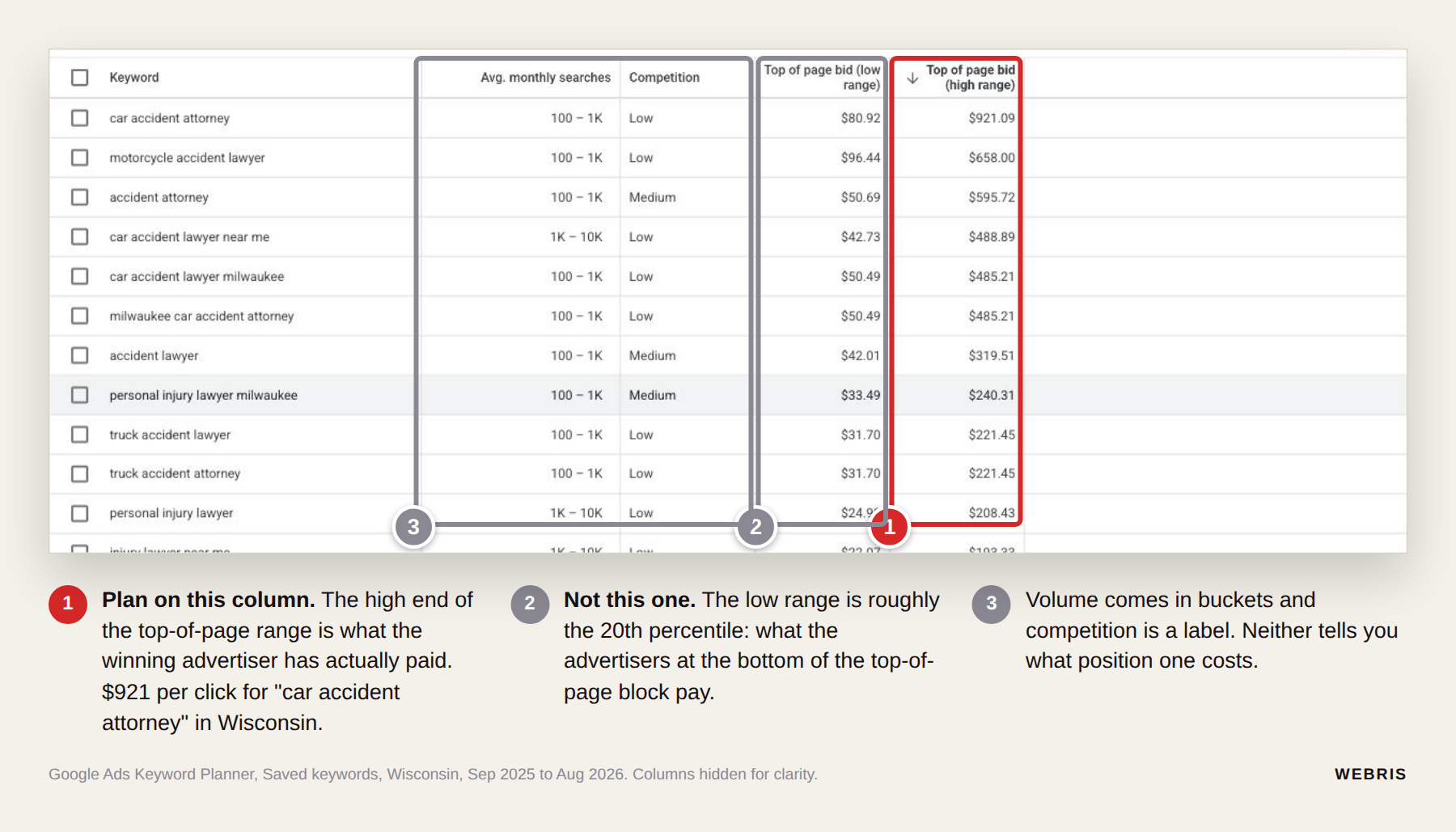
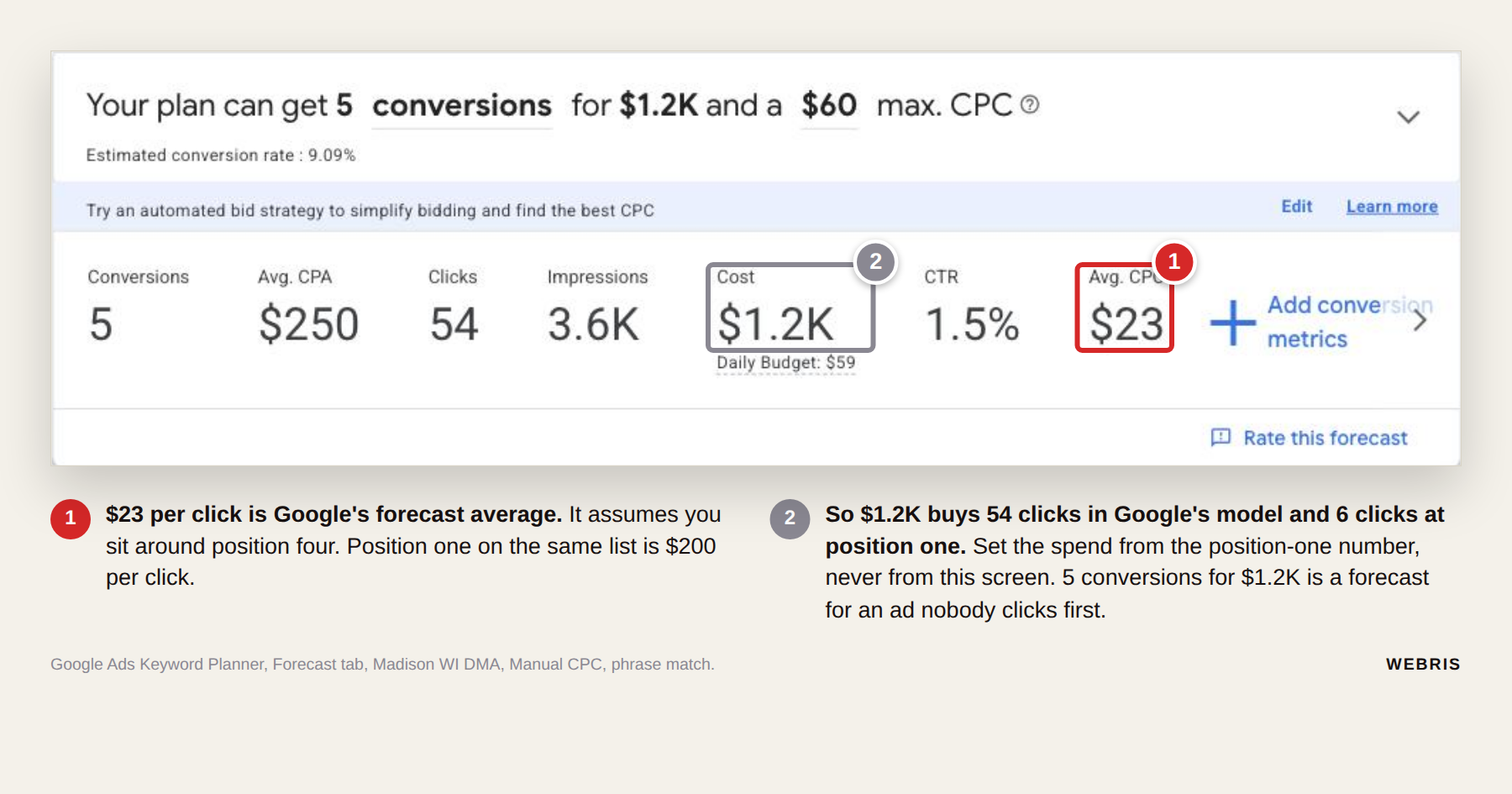
Google gives you a lot of cost per click numbers. Keyword Planner shows a low top-of-page bid and a high top-of-page bid. The forecast tool spits out an "average CPC." Industry reports publish a blended number for all legal advertisers. WordStream's 2026 benchmarks put the legal average at $9.87 a click.
$9.87 a click has nothing to do with personal injury.
Here's what those numbers actually are, in Google's own words from the Keyword Planner documentation:
- Top of page bid (low range): "an approximation of the 20th percentile" of what advertisers have paid for a top-of-page bid.
- Top of page bid (high range): "an approximation of the 80th percentile."
Read that again. The low range is what the advertisers at the bottom of the top-of-page block are paying. The high range is what the winners pay.
In personal injury, only the winner matters. If you're not the first result, people click the first result. Whoever sits in position two gets the callers who didn't get an answer from position one, and the callers who don't have a case.
So we plan every keyword at the high end of the top-of-page range. Not the low end. Not the midpoint. Not the forecast tool's average, which assumes you'll happily sit in position four.
For our Wisconsin firm, that one decision changed the forecast from about $23 a click (what Google's forecast tool suggested) to $284 a click. That's not a rounding error. That's the difference between a campaign that works on paper and one that works.
Step Two: Pull the Full Keyword List, Geo-targeted to the Market
Next you need the actual list. Not "personal injury lawyer" and three variations. The whole thing.
We build it in three buckets:
- Core PI terms. Personal injury lawyer, personal injury attorney, injury lawyer near me, injury attorney near me, personal injury lawyer [state].
- Case-type terms. Car accident, truck accident, motorcycle accident, wrongful death, dog bite, slip and fall, premises liability, pedestrian, rideshare.
- Geo-modified terms. Every one of the above with the firm's cities attached: Milwaukee, Madison, Green Bay, and so on.
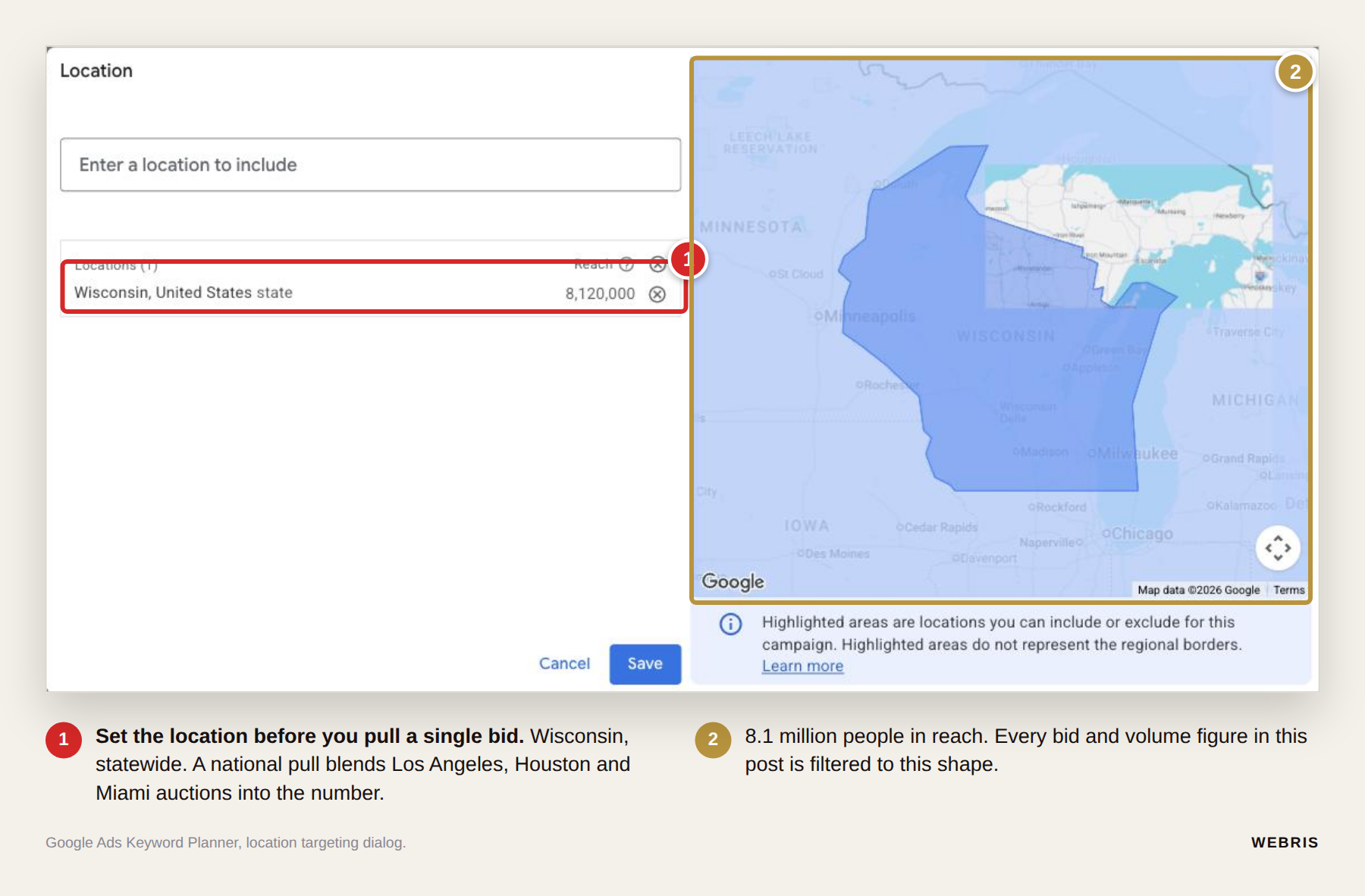
Then the part people skip: set the location to the actual market before you pull the bids. A national Keyword Planner pull gives you a blend of Los Angeles, Houston and Miami auctions. That number is useless for a firm in Wisconsin.
We pulled this list for Wisconsin statewide, twelve months of data, September 2025 through August 2026. Around 50 keywords. Here's what came back at the high end of the top-of-page range, per click:
- car accident attorney: $921 per click
- motorcycle accident lawyer: $658 per click
- accident attorney: $596 per click
- car accident lawyer near me: $489 per click
- car accident lawyer milwaukee: $485 per click
- personal injury lawyer milwaukee: $240 per click
- truck accident lawyer: $221 per click
- personal injury lawyer: $208 per click
- injury lawyer near me: $193 per click
- personal injury lawyer madison wi: $193 per click
- personal injury attorney: $171 per click
- wrongful death attorney: $94 per click
- dog bite lawyer: $84 per click
Yes, those are per click. Wisconsin is a cheaper market than Florida or Texas, and position one on "car accident attorney" still costs more than most firms pay for a lead.
You'll also notice a bunch of terms came back with no bid data at all: bicycle accident, brain injury, slip and fall, pedestrian accident, rideshare. In PI, that doesn't mean nobody searches for them. It means the auction is so thin Google won't price it. Remember that. It matters in step four.
One more thing we did here that you should do too: we researched medical malpractice, workers' comp and nursing home terms, then cut them. Different practice areas, different intake, different economics. If you don't take those cases, don't forecast them.
Step Three: Find Out Where the Demand Actually is
Now you know what clicks cost. You need to know where the clicks are.
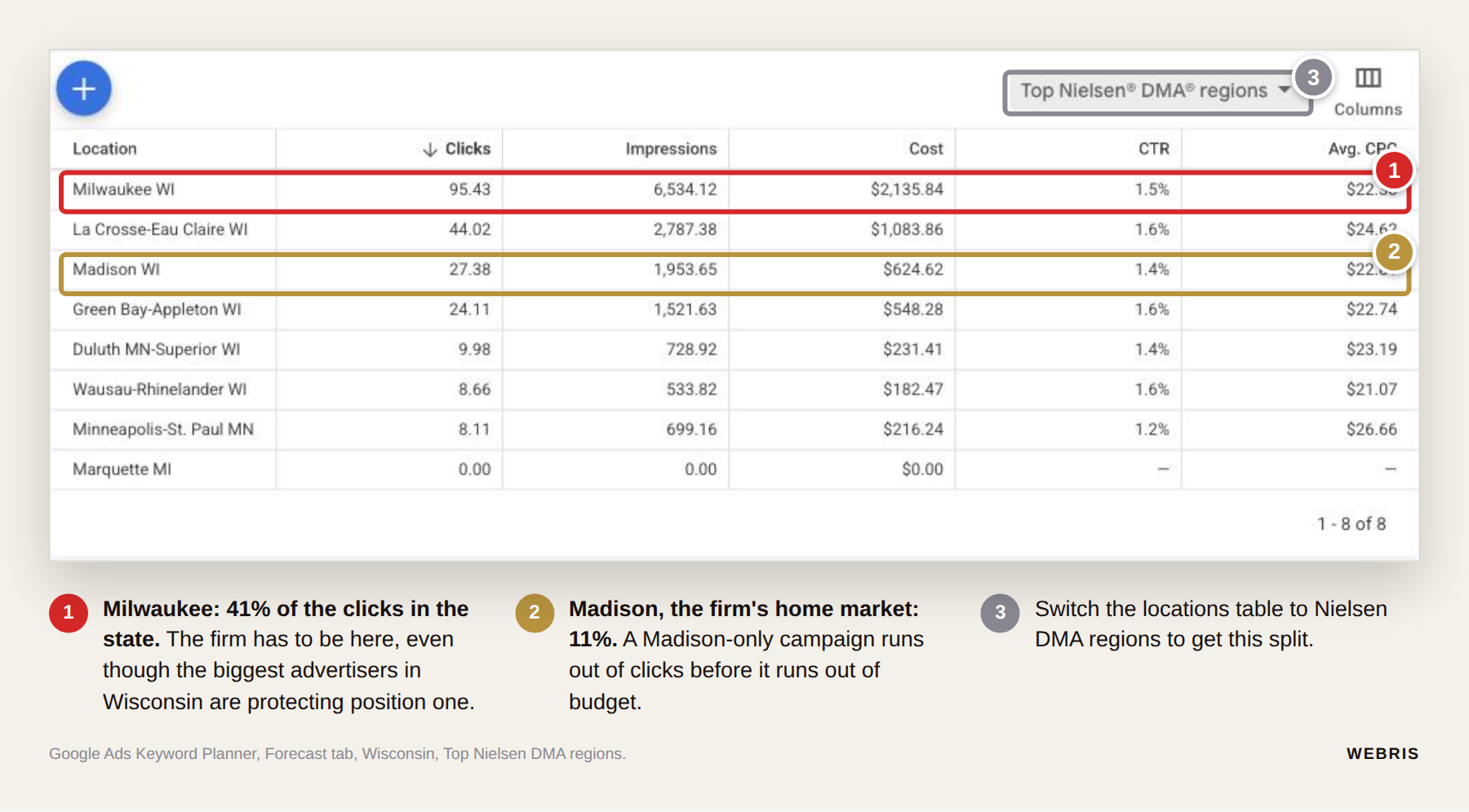
Keyword Planner's forecast tab will break the search demand down by Nielsen DMA (Google's term for a TV market). Run it for the whole state, not just the firm's home city.
Here's how Wisconsin's personal injury search demand splits:
- Milwaukee: 41%
- La Crosse / Eau Claire: 24%
- Madison: 11%
- Green Bay / Appleton: 10%
- Duluth / Superior and everything else: 15%
Our firm is based in Madison. Madison is 11% of the state.
That's the finding. A Madison-only campaign runs out of clicks before it runs out of budget. If this firm wanted five cases a month from Google, it had to be in Milwaukee, even though Milwaukee is where the biggest advertisers in the state are protecting position one.
It also told us something useful about western Wisconsin. La Crosse and Eau Claire were nearly a quarter of the demand with thin competition. That's a market nobody was fighting over.
The output of this step is a campaign geography: statewide, weighted to Milwaukee and Madison, with the phone number and landing page swapping by location. You can't get that from a keyword list alone.
Step Four: Group the Keywords and Price Each Group at Position One
Fifty keywords is too many to reason about. Seven groups is about right.
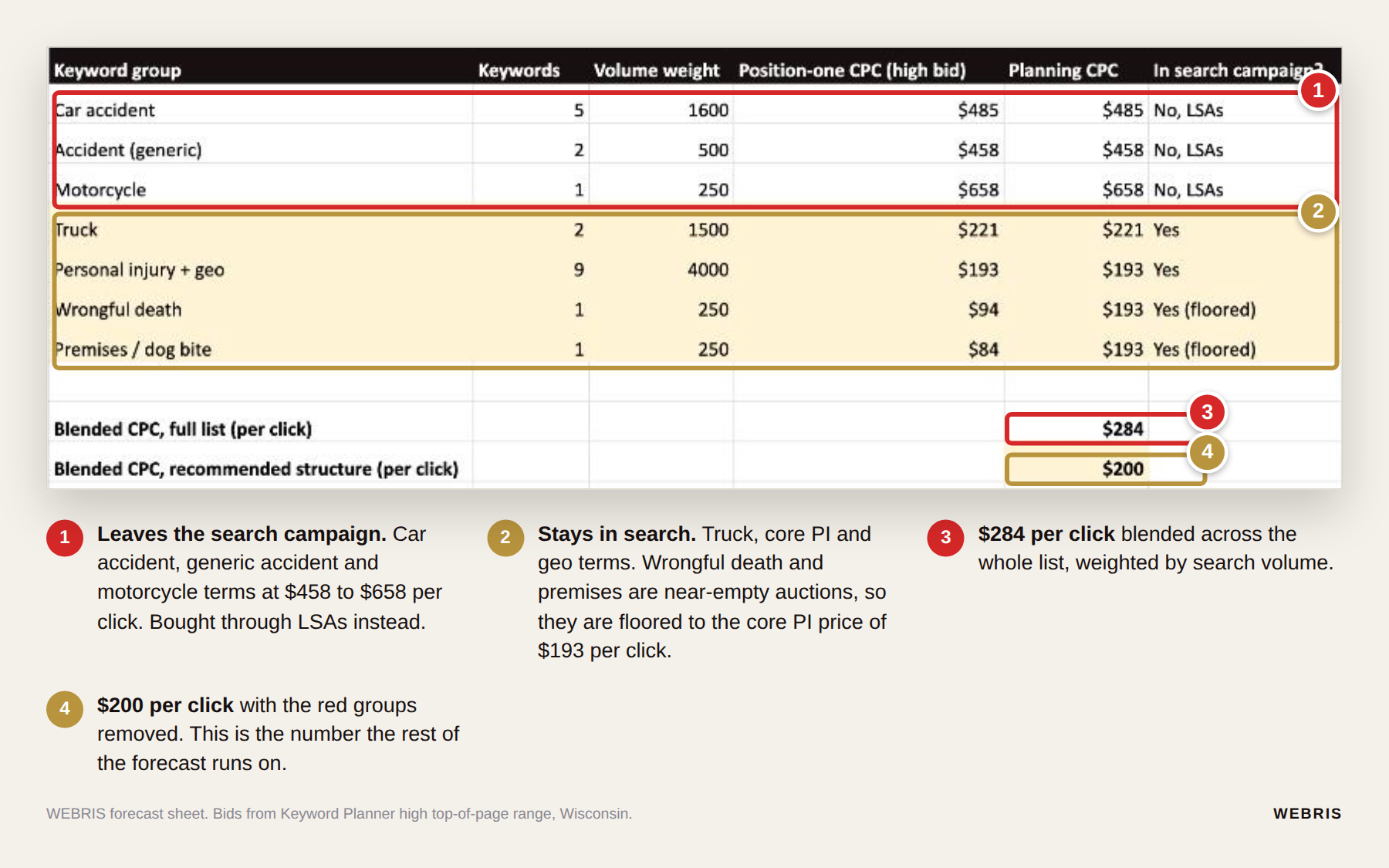
We grouped the Wisconsin list by case type and volume-weighted each group to a single planning cost per click. Again, every figure here is a cost per click, not a cost per case:
- Motorcycle: $658 per click
- Car accident: $485 per click
- Accident (generic): $458 per click
- Truck: $221 per click
- Personal injury (core + geo): $193 per click
- Wrongful death: $94 per click, floored to $193
- Premises / dog bite: $84 per click, floored to $193
Two decisions in that list need explaining.
The floor. Wrongful death at $94 a click and dog bite at $84 a click looked like bargains. They aren't. Those are near-empty Wisconsin auctions. The moment you enter with a real budget, you are the auction, and the price moves toward whatever the core PI terms cost. We floored every thin group at $193 a click, the price of the core personal injury terms, so the forecast doesn't promise cheap cases that won't exist once the campaign is live.
The blend. Weighted by search volume, the full list came out to $284 per click. Car accident and motorcycle terms, where Milwaukee's biggest firms pay $485 to $921 a click, dragged the whole thing up.
Hold onto both numbers. They're about to become a cost per case.
Step Five: Do the Math from Click to Signed Case
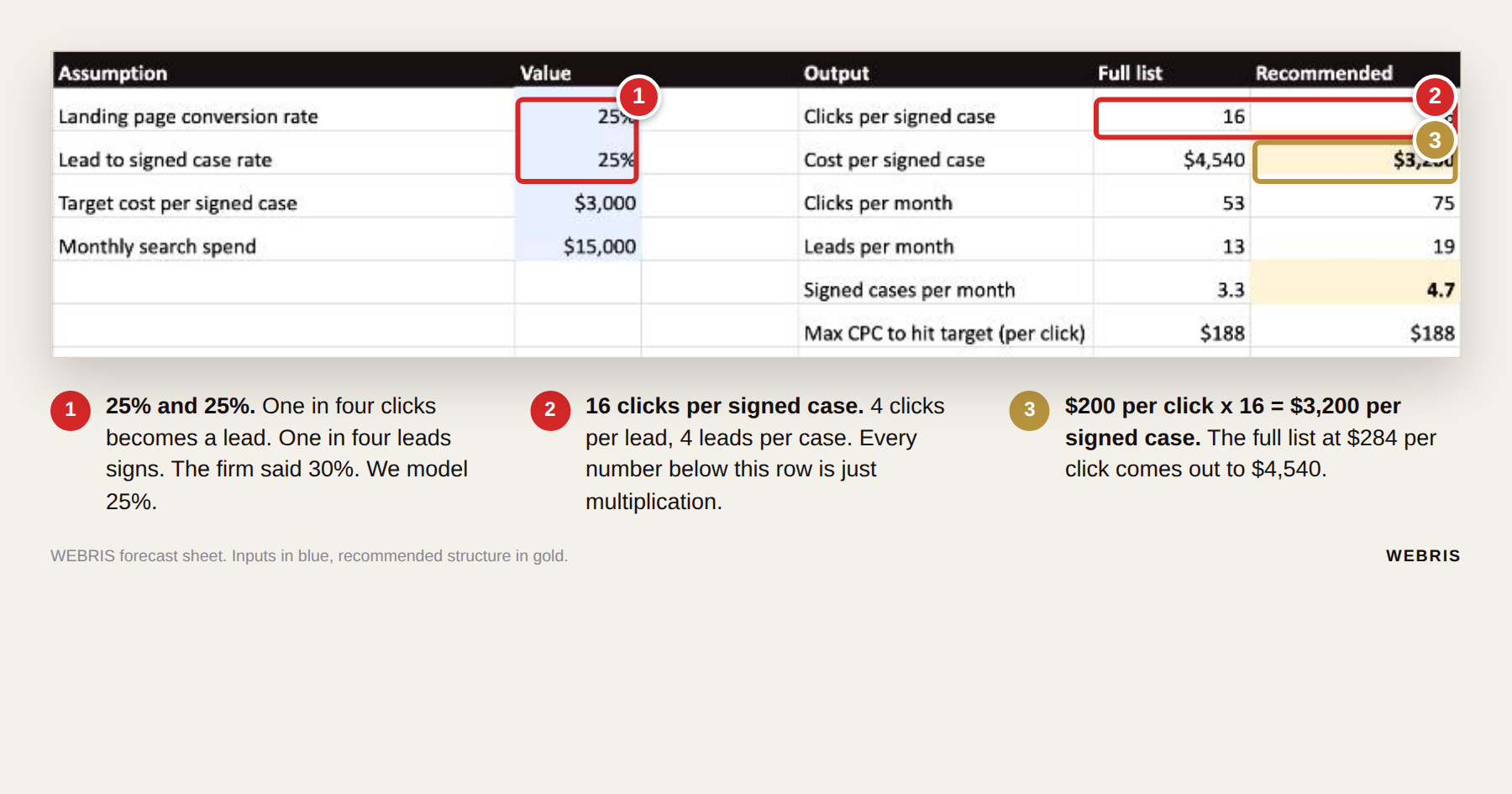
Here's the whole forecasting model. It fits on an index card.
A click becomes a lead at your landing page conversion rate. A lead becomes a case at your intake sign rate. That's it.
We plan personal injury campaigns at:
- 25% landing page conversion. One in four clicks becomes a call or a form. That's a good PI landing page with call tracking, not a homepage. If you're sending traffic to your homepage, plan at 10% and read our piece on landing pages for law firms first.
- 25% lead-to-signed-case. One in four leads becomes a retainer. This firm told us they sign closer to 30%. We heard them. We modeled 25% anyway, because a forecast built on your best month is how you end up explaining a bad quarter.
Multiply those and you get the number that runs the whole model: one signed case costs 16 clicks.
4 clicks per lead. 4 leads per case. 16 clicks per case.
So cost per signed case is just 16 times your blended cost per click.
- Full Wisconsin list at $284 per click: 16 x $284 = $4,544 per signed case
- At the 30% sign rate the firm quoted: $3,787 per signed case
Now the firm has a real number. And the firm didn't like it.
Step Six: Set the Target Cost per Case and Work Backward
This is the step that turns a forecast into a strategy.
The firm's target was $3,000 per signed case. Reasonable. For most PI practices a $3,000 acquisition cost against an average settlement fee is a very good trade, and it's roughly where we like to see personal injury lead costs land from paid search.
At 16 clicks per case, $3,000 means the blend has to come in around $188 a click. The full list was $284. So something has to go.
Here's what we did:
Lever one: cut the groups that blow the target. Car accident, motorcycle and generic accident terms left the search campaign. They were 8 keywords out of 50 and they were carrying the whole blend. Without them, the remaining personal injury, geo, truck, wrongful death and premises groups blend to $200 per click. 16 x $200 = $3,200 per signed case.
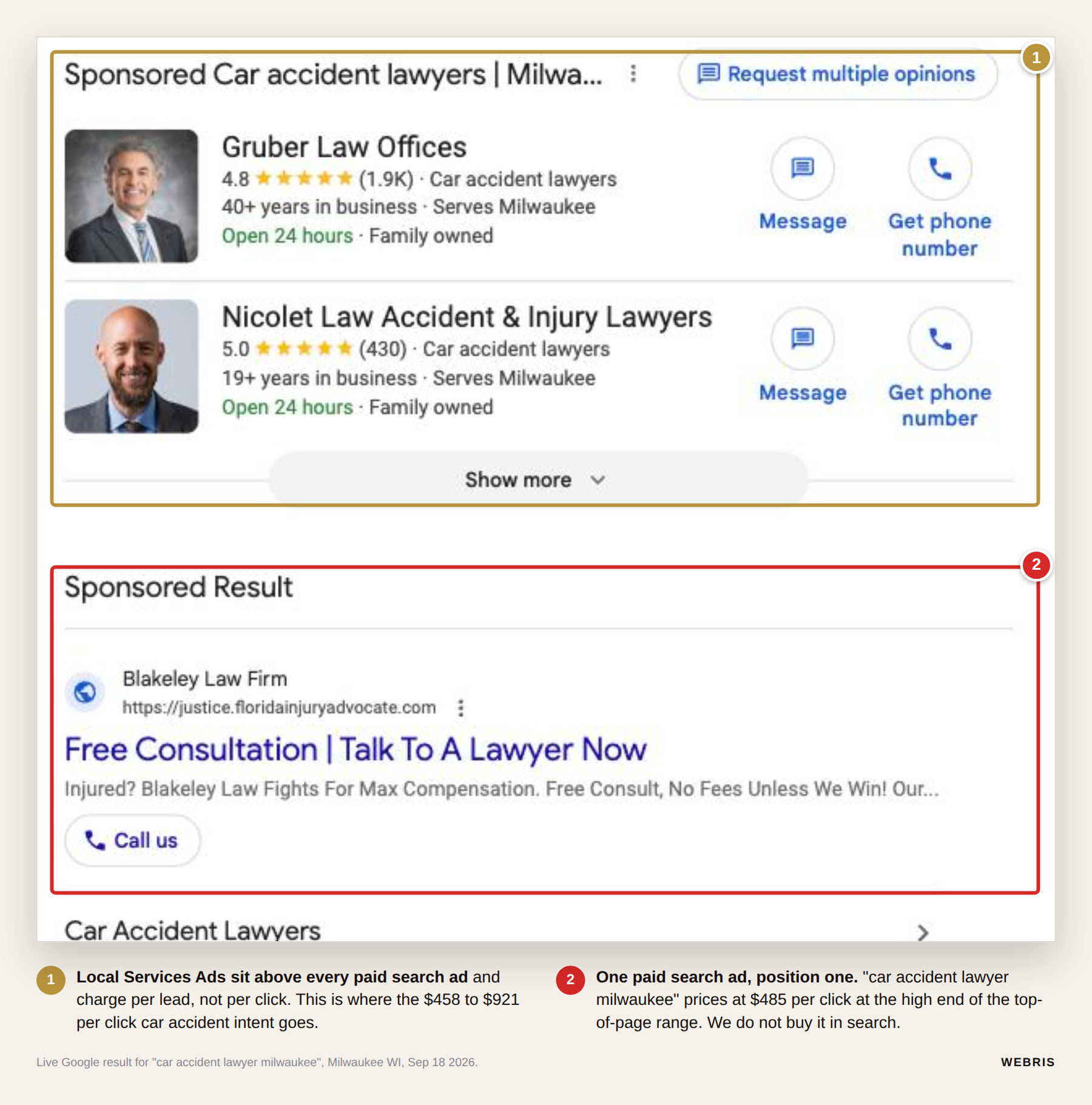
Lever two: send car accident intent to Local Services Ads instead. You don't abandon "car accident lawyer near me." You buy it differently. Local Services Ads sit above paid search and charge per lead, not per click, so you can catch that intent without paying $485 to $921 every time someone taps. We budgeted $3,000 to $5,000 a month for LSAs alongside the search campaign. If your LSAs have been underperforming, this is usually why.
Lever three: Quality Score and the sign rate. Google's own definition of actual CPC says you're "often charged less than your maximum bid." Tight ad groups with matching landing pages routinely clear position one 10 to 15% under the high bid. That takes $200 to about $175 a click and $3,200 to $2,800 per case. And if intake really does sign at the 30% they quoted, $3,200 becomes $2,667.
Three structures, three answers:
- Full list, including car accident and motorcycle: $284 per click, $4,544 per case
- Recommended structure, expensive groups moved to LSAs: $200 per click, $3,200 per case
- Recommended structure with a Quality Score discount: $175 per click, $2,800 per case
We recommended the middle row and told the firm the third row is where it lands if we do our jobs. That's the honest version. Not "we'll get you $1,200 cases," which is what the other agency on the call said.
Step Seven: Pick the Spend
Only now do you talk budget. Budget is the last input, not the first.
At $200 per click, 25% conversion, 25% sign, the spend scenarios for this firm looked like this:
- $10,000 a month: 50 clicks, 12 leads, about 3 signed cases. Enough to prove the landing page converts and intake can sign. Not enough to be in Milwaukee.
- $15,000 a month: 75 clicks, 19 leads, about 5 signed cases at 25% and closer to 6 at 30%. Statewide, Milwaukee and Madison weighted, full PI structure, car accident on LSAs. This is what we recommended.
- $20,000 a month: 100 clicks, 25 leads, about 6 signed cases. Adds the long tail and broad match once offline conversion data is feeding Smart Bidding.
Plus $3,000 to $5,000 in Local Services Ads for the car accident intent we pulled out of search.
The scale rule is written into the plan before launch: hold at $15,000 until cost per signed case sits at or under $3,000 for a full month, then step to $20,000. Not "let's see how it feels." A number and a trigger.
Here's the short version of the whole forecast for this firm: $15,000 a month in Google Search on the PI terms they can win, $3,000 to $5,000 in LSAs, a planned cost per signed case of $3,200, and a credible path to $2,700. Five to six signed cases a month at launch.
That's what "what's this going to cost us per case" should sound like when someone answers it.
What This Forecast is not
I'll be honest about the limits, because a forecast that pretends it has none is a sales document.
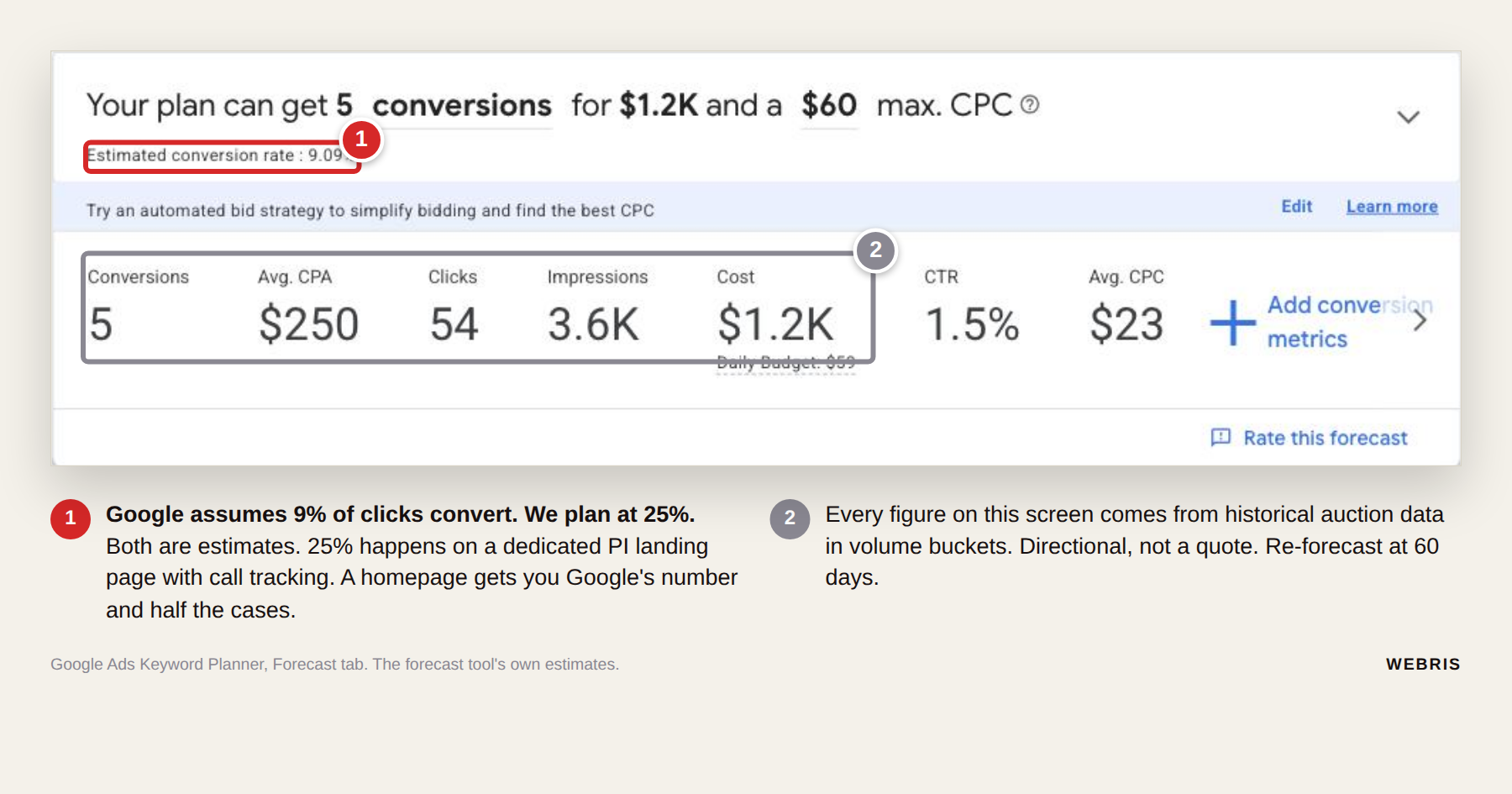
It's an estimate built on Google's estimates. Keyword Planner volumes come in buckets (100 to 1K, 1K to 10K). Bids are historical 80th percentiles, not a quote. Google says so itself. The model is directional and it is much closer to the truth than $9.87 a click.
It assumes you can convert. 25% landing page conversion doesn't happen on a homepage with a contact form at the bottom. 25% signing doesn't happen if the phone rings to voicemail at 6pm. If your intake process is the weak link, fix it first or divide every case number above by two.
It only works if you can measure it. Cost per signed case is the only metric in this model that matters, and you can't calculate it unless every lead carries its click ID into your CRM and signed matters get sent back to Google. That's lead tracking, and it's not optional. Without it you're back to judging the campaign on cost per lead, which is how firms end up celebrating cheap junk.
The thin auctions will move. The $193 floor is our best guess at where wrongful death and premises terms settle once a real bidder shows up. They could settle lower. They could settle at $240. We'll know in 60 days, and we'll re-forecast.
Where This Leaves You
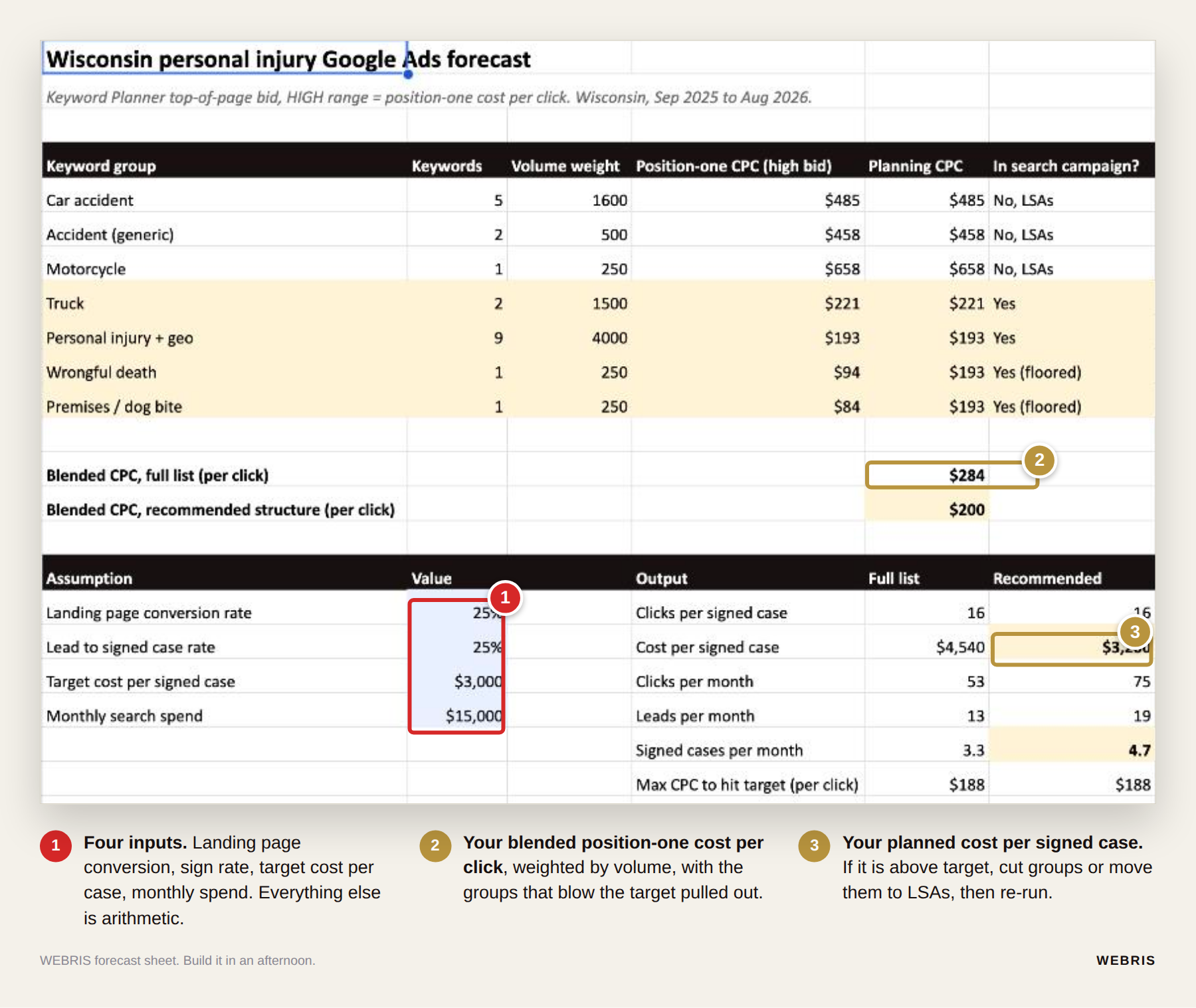
If you're a personal injury firm thinking about Google Ads, you can do most of this yourself in an afternoon:
- Pull your keyword list in Keyword Planner, geo-targeted to your state, and take the high top-of-page bid for every term.
- Blend it by volume. That's your position-one cost per click.
- Multiply by 16. That's your cost per signed case at 25% and 25%.
- If the number is above your target, find the groups dragging the blend, pull them out of search, and buy that intent through LSAs.
- Pick a spend that puts you in the markets where the demand actually is. Write down the trigger to scale before you launch.
Want Us to Build Your Forecast?
If you'd rather we run it, this exact forecast is the first thing we build for every PI firm that talks to us, before any proposal and before any spend. You'll see your keywords, your market split, your cost per click at position one and your cost per signed case, and you'll see the keywords we'd tell you not to buy. Get your free growth plan here.