Data collected Nov 4, 2026. Next update: February 2027.
The firm ChatGPT called its “top choice” in Los Angeles doesn’t appear in Google’s Map Pack. At all.
In Chicago, the firm Gemini named at 43 of 49 test points doesn’t either.
Google ranks one set of firms. AI recommends a different set.
We spent a day testing ChatGPT, Gemini, Google AI Mode and Claude in two of the most competitive car accident markets in the country. Here’s what they said, where they got it, and what the firms that win both have in common.
Here’s the Short Version
- AI’s top picks barely exist in Google Maps. Panish | Shea | Ravipudi (LA) and Clifford Law Offices (Chicago) were the #1 picks on ChatGPT and Gemini. Neither appears in the Map Pack for “best car accident lawyer.”
- Huge review counts don’t fix it. Wilshire Law Firm (2,527 reviews) and Horwitz, Horwitz & Associates (1,127 reviews) are AI favorites with a 0% share of the Map Pack’s top 3.
- But some firms win both. In Chicago, Malman Law and The Kryder Law Group ranked high in Google Maps and showed up on every AI we tested.
- Every AI behaves differently. In LA, ChatGPT named 116 different firms across the grid. Gemini named 29.
- The recommended firms shared 9 factors. Five showed up in both cities and on more than one AI, led by peer recognition, checkable results and specific review content.
Read that again: ranking in Google Maps doesn’t get you recommended by AI. And AI recommendations don’t get you into the Map Pack.
The firms that win both are the ones built for both. That starts with treating law firm SEO and AI visibility as one plan.
How We Ran the Test
One day, two cities, four AIs
- 2 cities: Los Angeles and Chicago
- 4 AIs: ChatGPT, Gemini, Google AI Mode, Claude
- 49 grid points per city, plus a Google Maps baseline
- 5 real-world prompts, each run twice in Claude
- All data collected Nov 4, 2026
We ran every test on Nov 4, 2026, using two methods together.
Method 1: geo-grid scans. We used Local Falcon to query ChatGPT, Gemini, Google AI Mode and Google Maps from 49 points in each city. That shows how answers change by neighborhood.
Method 2: full-answer screenshots. We asked each AI directly and captured the complete response, including sources. That shows why each firm got named.
The 4 AIs We Tested
| Platform | Grid scan (49 points) | Full-answer screenshot |
|---|---|---|
| ChatGPT | Yes | Yes |
| Google Gemini | Yes | Yes |
| Google AI Mode | Yes | Yes |
| Claude | No | 18 runs with search on |
We tested ChatGPT, Google Gemini, Google AI Mode and Claude.
According to StatCounter’s AI chatbot referral data for the United States, ChatGPT, Gemini and Claude together accounted for 88.24% of AI chatbot referrals in August 2026. AI Mode sits on top of that, inside Google search itself.
Showing up across all four is what GEO for lawyers is about.
We left out Microsoft Copilot this round. We also captured Google’s AI Overview as a bonus, since it isn’t a separate assistant.
The Prompts and Keywords
What we asked
- 1 grid keyword
- 5 Claude prompts
- 2 runs each
For the grid scans, the keyword was “best car accident lawyer.” In LA, we also scanned “car accident lawyer” as a comparison.
For Claude, we ran 5 prompts written the way a real person asks, in each city:
- Who is the best car accident lawyer in [city]?
- I was rear-ended in [city]. Which lawyer should I call?
- Top personal injury attorneys in [city] for car accidents
- Car accident lawyer near me in [city]
- Which [city] car accident lawyers have the best reviews?
Each prompt ran twice in a fresh chat with web search on. Prompt 2 returned the same result every time, so it ran once per city.
Limitations you should know:
- Claude runs were done from outside the US, with the city named in every prompt.
- In Chicago, 21 of the 49 grid points fall over Lake Michigan (see the grid below), so Chicago’s results lean toward the Loop and the lakefront.
- AI answers change between runs. Treat every number here as a snapshot, not a ranking.
- We report what each AI said. We didn’t verify the claims AI made about any firm.
The Grids: 49 Points in Each City
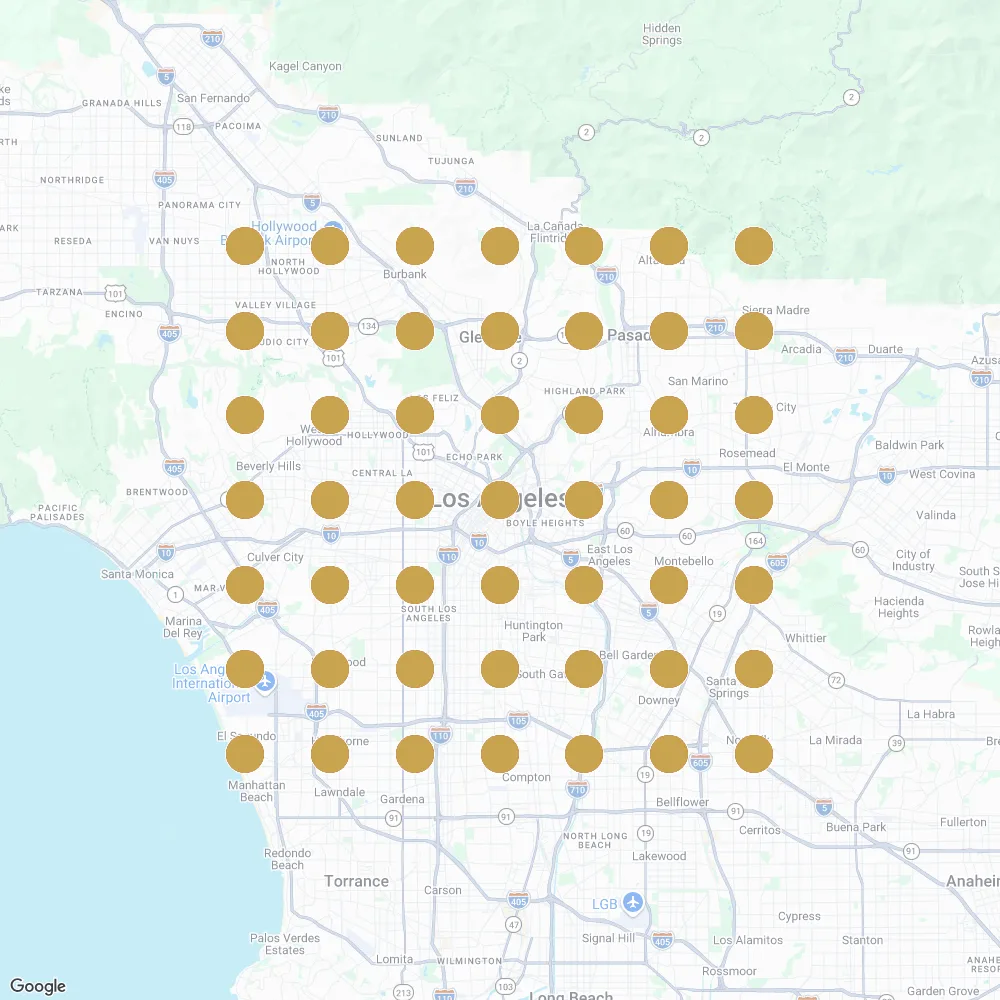
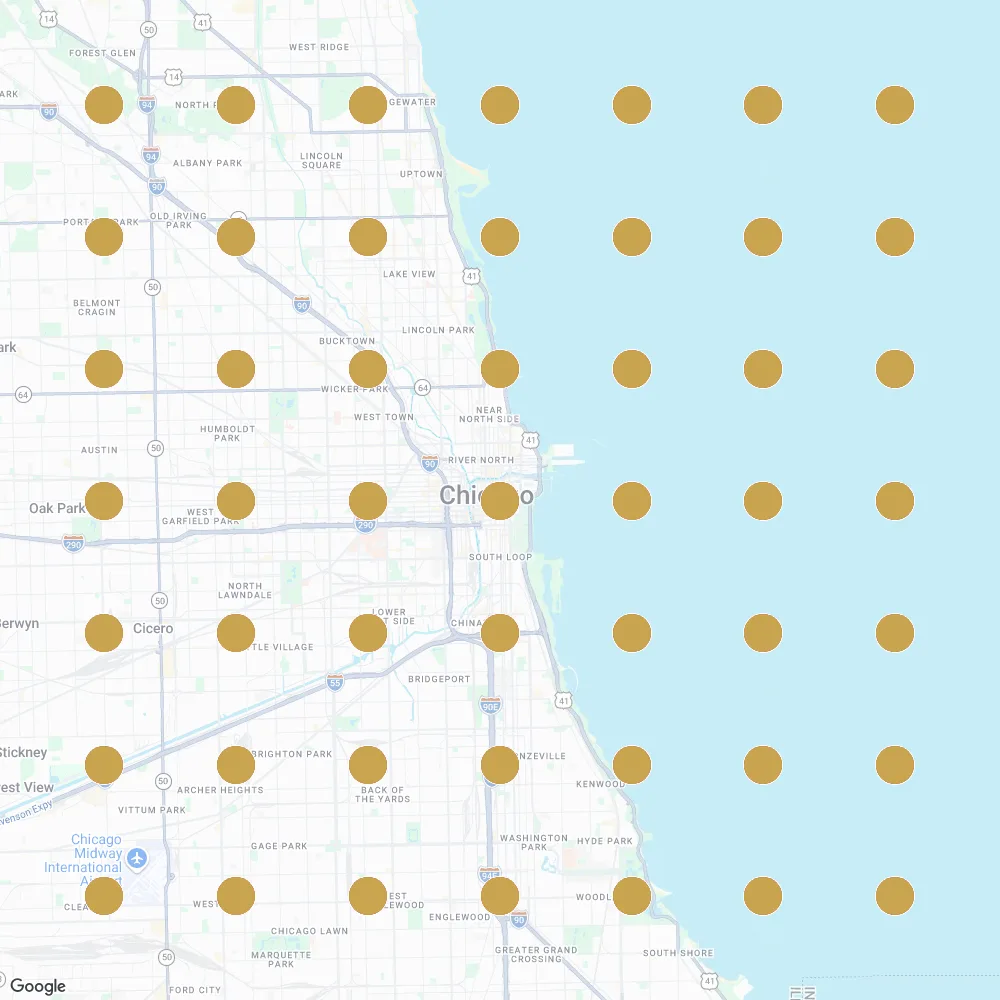
Picture a map of the city with 49 pins spread evenly across it, 7 rows of 7. Each pin is one search, sent from that exact spot. The AI answers as if someone standing in that neighborhood had asked.
That’s 49 searches per city, and 98 across both. It matters because AI and Google Maps both change their answers depending on where you are.
- Los Angeles: centered on City Hall, 10-mile radius.
- Chicago: centered on the Loop, 7-mile radius.
LA got the wider radius because the city is far more spread out.
One thing to know about Chicago: the grid is centered on the Loop, so the 3 eastern columns, 21 of the 49 points, sit over Lake Michigan. Those searches still ran from those coordinates, so they behave like someone near the lakefront. Chicago’s results lean toward the Loop and the lakefront as a result.
Which Firms Did AI Recommend Most?
Gemini grid points out of 49, “best car accident lawyer”
The most consistent names weren’t the Map Pack leaders in either city.
How to read the tables: grid numbers show how many of the 49 points named the firm for “best car accident lawyer.” Map Pack share is the percentage of points where the firm ranked in Google Maps’ top 3. Claude counts are runs where at least one firm was named (8 per city).
Los Angeles
| Firm | ChatGPT answer | Gemini grid | AI Mode grid | Claude runs | Map Pack share |
|---|---|---|---|---|---|
| Panish Shea Ravipudi | #1 top choice | 41 | 2 | 4 | Not in Map Pack |
| The Dominguez Firm | Not named | 33 | 25 | 1 | 0% (main listing) |
| Wilshire Law Firm | Not named | 24 | 21 | 5 | 0% |
| Arash Law | Not named | Not named | 18 | 4 | 0% |
| Law Offices of Jennie Levin | Not named | Not named | 8 | 4 | 0% |
Two kinds of firms dominate here. Panish wins on trial reputation. Wilshire, Arash and Jennie Levin win on reviews.
Neither group wins the Map Pack.
Chicago
| Firm | ChatGPT answer | Gemini grid | AI Mode grid | Claude runs | Map Pack share |
|---|---|---|---|---|---|
| Clifford Law Offices | #1 top choice | 43 | 10 | 3 | Not in Map Pack |
| Horwitz, Horwitz & Associates | Not named | 43 | 2 | 6 | 0% |
| Malman Law | Not named | 39 | 1 | 5 | 55.10% |
| Salvi, Schostok & Pritchard | Not named | 32 | 11 | 2 | 0% |
| The Kryder Law Group | #4 | 8 | 4 | 3 | 24.49% |
Chicago looks different. The reputation leaders (Clifford, Horwitz, Salvi) follow the LA pattern: big in AI, absent in Maps.
But Malman and Kryder win both. That’s the story LA didn’t have, and we’ll come back to it.
If you want the full background on how ChatGPT picks firms, start with how law firms rank in ChatGPT.
What Did the Recommended Firms Have in Common?
The recommended firms shared 9 factors. Five showed up in both cities and on more than one AI. Four showed up less consistently.
These are patterns we observed in our tests on Nov 4, 2026. They are not confirmed ranking factors from OpenAI, Google or Anthropic. Every row below points to the test it came from, so you can judge the evidence yourself.
How we rated strength:
- Strong: seen in both cities and on 2 or more AIs.
- Moderate: seen on one AI only, or with counterexamples, or split across different kinds of evidence.
| # | Factor | What we saw in the tests | Where we saw it | Strength |
|---|---|---|---|---|
| 1 | Peer recognition | Super Lawyers, Best Lawyers, ABOTA, Top Verdict or Doyle’s Guide sat behind the “best lawyer” picks | Claude: 3 of 4 “best/top” runs in each city. ChatGPT: Doyle’s Guide for 3 of 5 Chicago picks. Gemini: Super Lawyers in Chicago | Strong |
| 2 | Published, checkable results | Specific verdict amounts and case types were cited; self-awarded titles were not | Claude: PARRIS (LA), Corboy & Demetrio (Chicago). Gemini: Panish verdicts (LA). AI Overview: Gerald L. Marcus (LA) | Strong |
| 3 | Specific review content | Named staff, case types and outcomes were repeated almost word for word | Claude: 7 of 8 “near me” and “best reviews” runs across both cities. AI Mode: LA answer | Strong |
| 4 | Third-party mentions | Syndicated press releases and Reddit threads were cited as sources | Claude: 4 of 6 firms via press releases (LA), 2 of 6 (Chicago). AI Overview and AI Mode: r/AskLosAngeles, r/AskChicago | Strong |
| 5 | Business Profile details | Languages, hours, 24/7 intake and ownership attributes were used to describe firms | Claude: “near me” runs in both cities. AI Mode: LA answer | Strong |
| 6 | Proximity to the searcher | Asked from grid points, ChatGPT dropped city-wide favorites for nearby firms | ChatGPT only: Panish (LA) and Willens & Baez (Chicago) named in screenshots, absent from the grids | Moderate |
| 7 | Review volume and rating | Most “near me” picks had 1,000+ reviews, but a firm with 251 ranked first on review quality | Claude: Chicago “near me” (4 of 5 firms over 1,000 reviews) and “best reviews” (251-review firm first in both runs) | Moderate |
| 8 | Directory profiles | Numbers were quoted straight from directory listings | Claude only: FindLaw (Chicago); Lantern, Avvo and FindLaw (LA) | Moderate |
| 9 | Useful firm-published content | A firm’s own roundup page and state-specific legal guides were cited | Gemini: Starpoint Law’s page (LA, 29 of 49 grid points). Claude: Illinois deadlines page (Chicago). AI Overview: two firm sites (LA) | Moderate |
Three warning signs also showed up:
| Warning sign | What we saw | Where we saw it |
|---|---|---|
| Lists that rank yourself #1 | Used as Claude’s example of a biased list | Claude: 2 LA runs |
| Unanswered complaints | One critical review repeated across answers | Claude: 2 LA runs, 4 Chicago runs |
| Reviews written for clients | Claude told users to read that firm’s reviews skeptically | Claude: 2 Chicago runs |
One observation didn’t make the table. ChatGPT’s top firm on the LA grid has roughly 15 Google Business Profile listings across the area. We saw that once, in one city, so we’re noting it rather than calling it a factor.
The next section shows how these factors connect to the way a question is worded. For ChatGPT specifically, see what ChatGPT looks at when it recommends a firm.
How Does AI Decide Which Car Accident Lawyer to Recommend?
How the question is worded decides the route
- Question wording
- Where AI looks
- What gets you in
It depends on how the question is worded. The 9 factors group into 4 routes, and we found the same routes in both cities:
| How the question is asked | Where AI looks | What gets you in |
|---|---|---|
| “Best” / “top” lawyer | Web search, model memory | Recognition, verdicts, press coverage |
| “Near me” / “best reviews” | Google Business Profile data | Ratings, review volume, review content |
| Local, community-style questions | Directories, Reddit | Directory profiles, community mentions |
| “Which lawyer should I call?” | Bar referral services, legal info | Not a recommendation, but educational content gets cited |
Route 1: Recognition and Verdicts
❌ Ignored
- “We’re the best car accident lawyers in LA”
- Self-awarded titles
✅ Cited
- “3 verdicts named among Top Verdict’s Top 20 California verdicts”
- Peer recognition in the attorney’s name
For “best lawyer” questions, every firm Claude named was tied to specific results or peer credentials, in both cities.
Specific, checkable results get cited. Self-awarded titles don’t.
- ✅ Verdict amounts, case types and third-party recognition
- ✅ A case results page on your own site, with specifics
- ✅ Award announcements distributed through a press release wire
- ✅ Recognition in the attorney’s own name, not just the firm’s
- ❌ “Best car accident lawyer in [city]” on your own homepage
There’s a nuance. When a Chicago firm’s own site claimed “the largest personal injury verdict in Illinois history,” Claude used it but added: that claim comes from the firm’s own website. Third-party confirmation is what makes AI repeat a result without a caveat.
Claude also named four LA trial firms “from my general knowledge rather than today’s search.” That’s reputation baked into the model itself. You earn it over years of verdicts and press coverage.
Route 2: Google Business Profile and Reviews
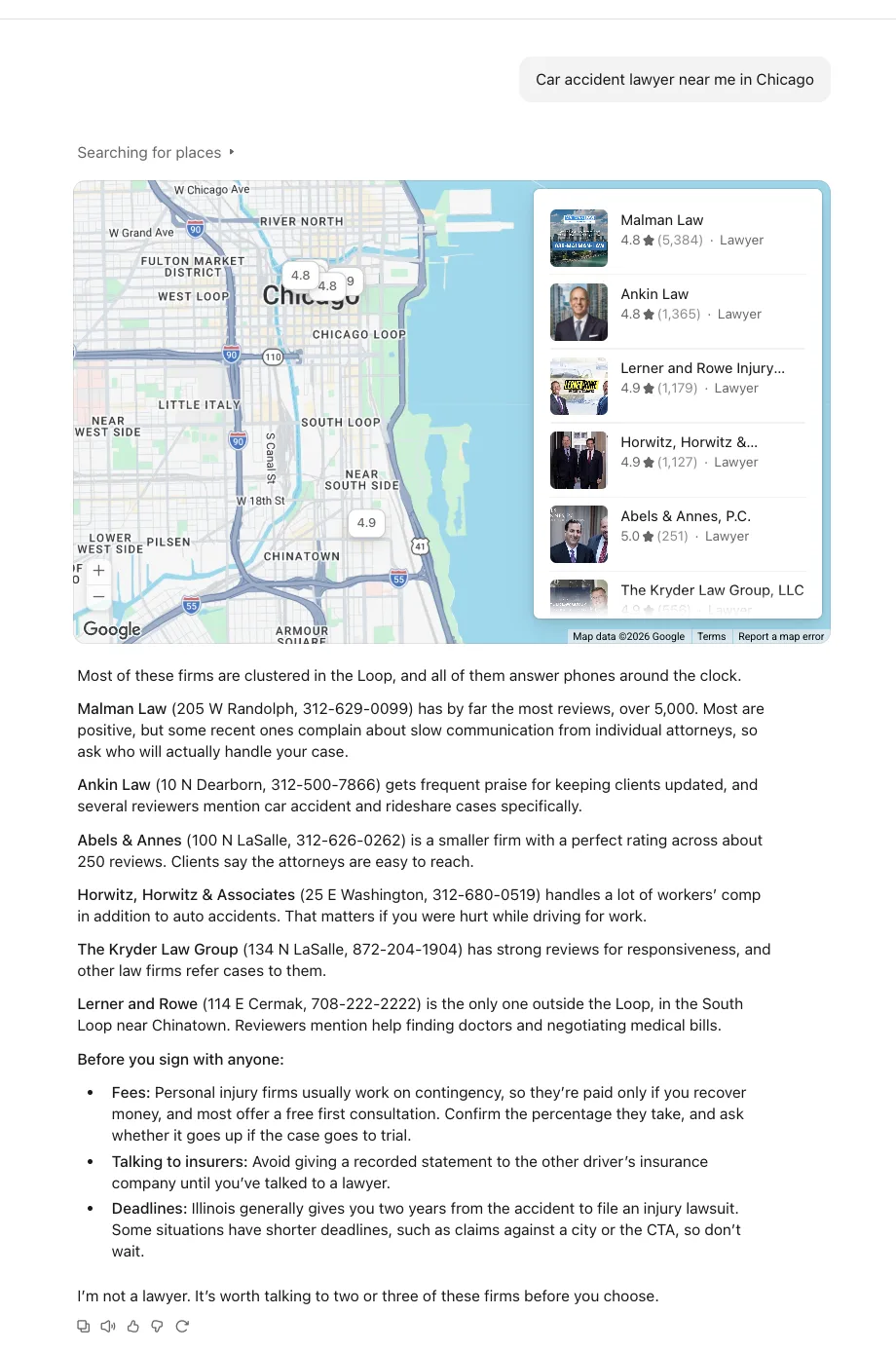
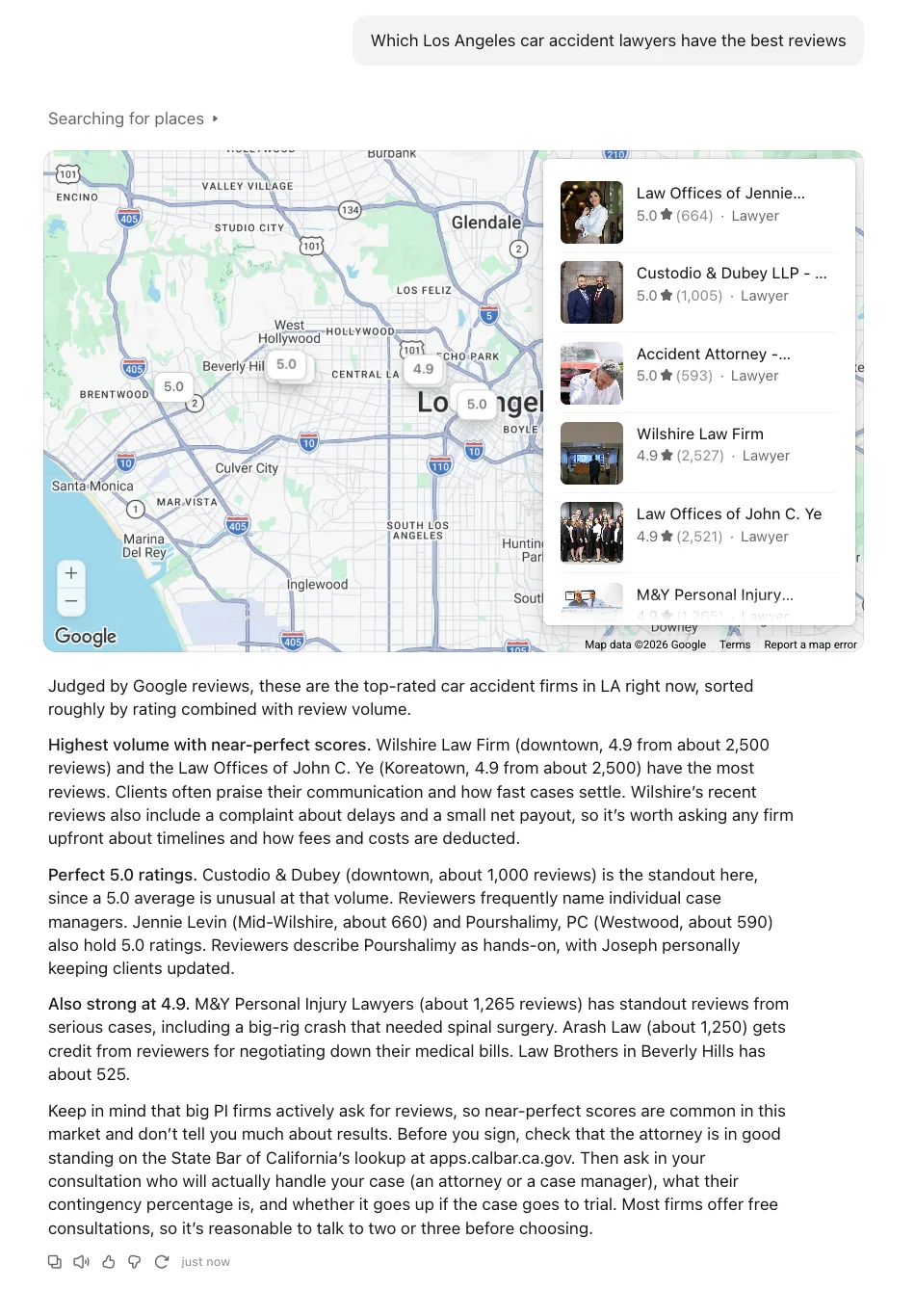
Ask “near me” or “best reviews” and Claude switches to Google Business Profile data. AI Mode does too.
This was the most predictable route in the study. Claude’s two Chicago “near me” runs named the same core firms. In LA, they shared 6 of 9. The web-search prompts barely overlapped at all.
What AI repeats from reviews:
- Names. Reviewers naming their case manager, or saying a specific attorney kept them updated.
- Case specifics. “Big-rig crash.” “Spinal surgery.” “Hit-and-run while driving for Uber.”
- Peer signals. “Other law firms refer cases to them.”
- Complaints. More on that below.
Content beats volume. In both Chicago “best reviews” runs, Claude ranked Abels & Annes first. It had 251 reviews, against competitors with 1,000 to 5,000+. Its reviews were uniformly specific and positive.
Case type matters. Claude flagged one Chicago firm because many of its reviews were about workers’ comp, not car accidents. If your car accident clients don’t mention car accidents, AI may not connect you to those searches.
Our guide to lawyer reviews covers how to ask for detailed reviews without crossing ethical lines.
Route 3: Directories and Community Threads
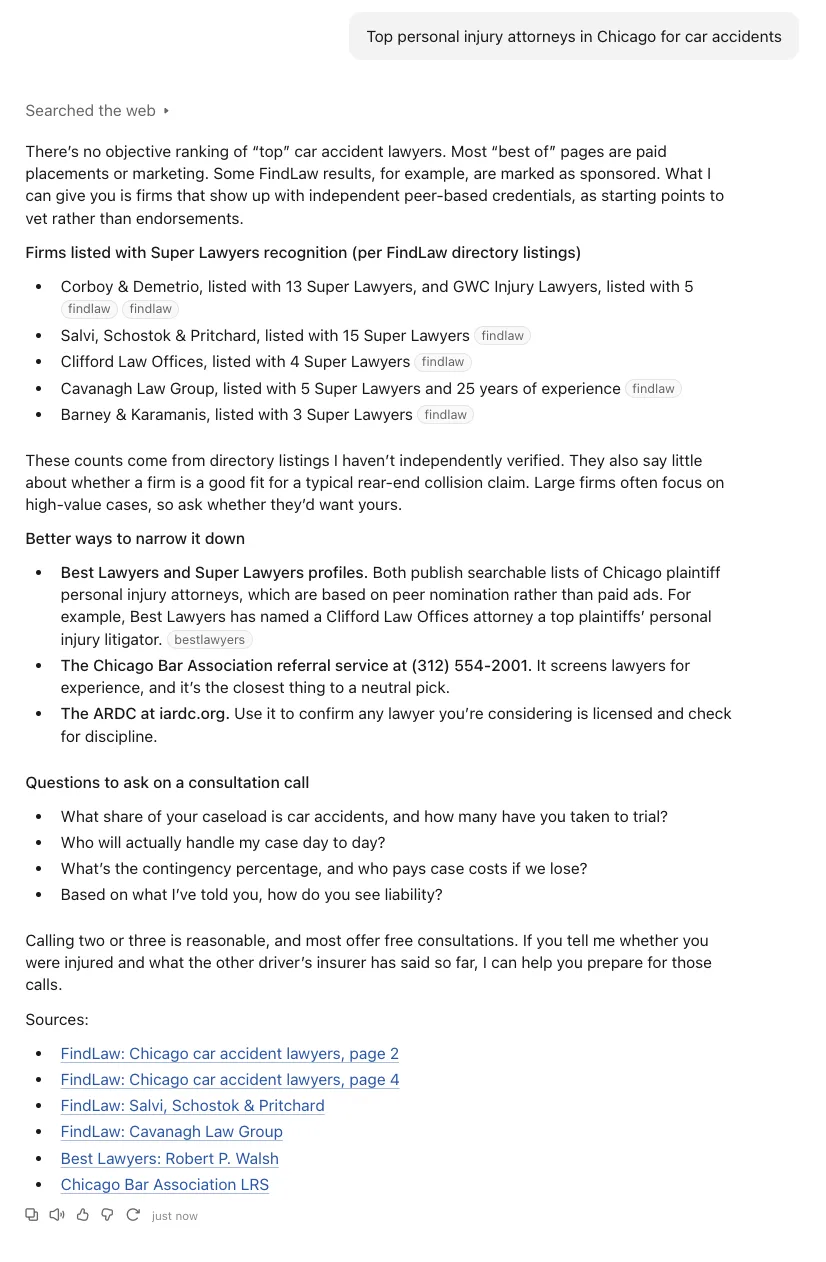
In one Chicago run, every number Claude cited came from FindLaw profiles, including each firm’s Super Lawyers count and years in practice. It pulled from pages 2 and 4 of FindLaw’s results, not just page 1.
In LA, one “best reviews” run came entirely from Lantern, Avvo and FindLaw.
The numbers didn’t always match. One Chicago firm’s own site claimed 21 Super Lawyers selections. Its FindLaw profile showed 4. An outdated directory profile can undersell you to AI.
Google’s AI Overview and AI Mode went to Reddit instead, in both cities.
Keep every directory profile complete and current. Our guide to local citations for law firms covers which ones matter.
Route 4: Educational Content
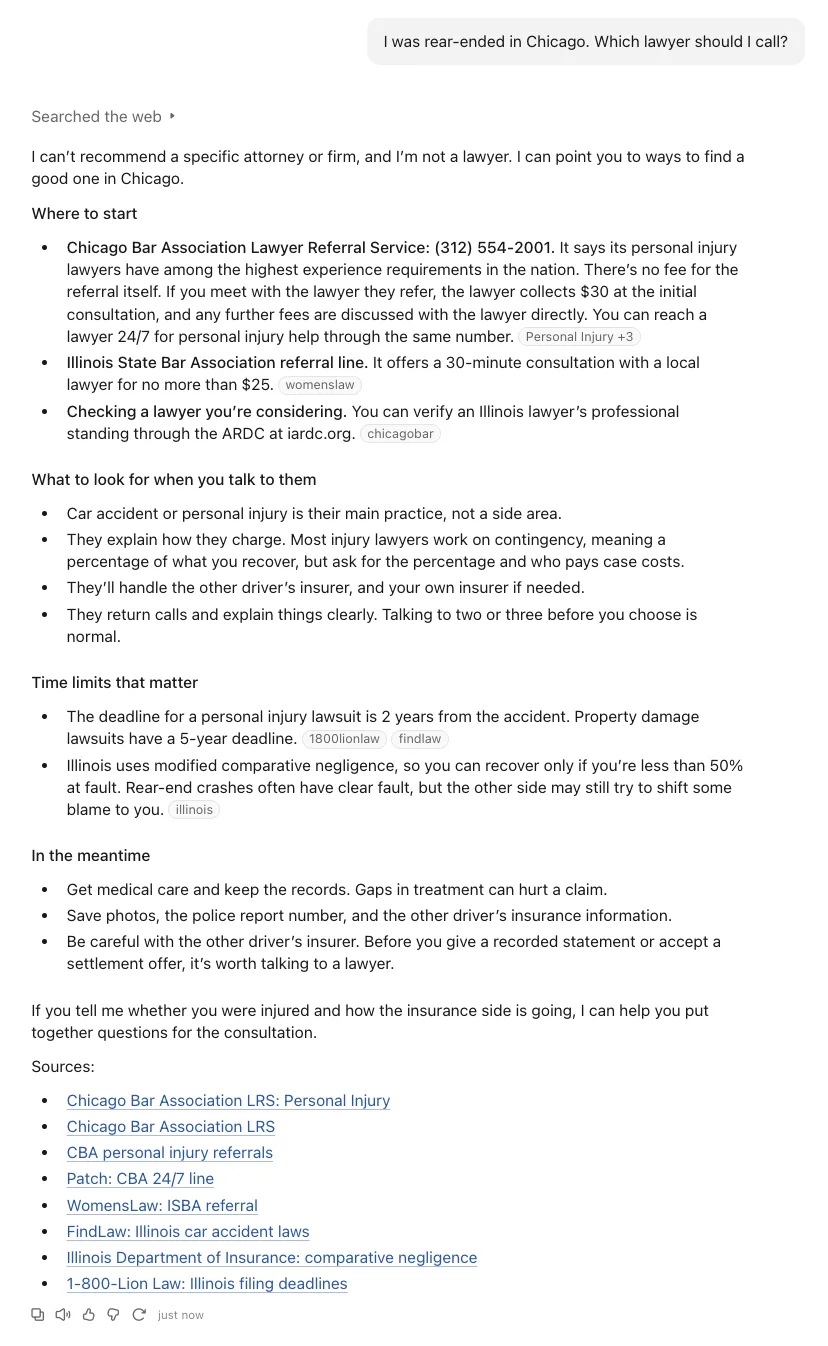
Ask Claude “I was rear-ended, which lawyer should I call?” and it names nobody, in either city. It sends you to the local bar’s referral service.
But law firm content still gets in. In Chicago, Claude cited a personal injury firm’s page on Illinois filing deadlines, with a link, in an answer to someone who’d just been rear-ended.
Google’s AI Overview cited two LA firms’ websites for advice on fees and communication.
When AI won’t recommend anyone, it still cites someone. Answer-first, state-specific legal content is how you get in front of that person. California and Illinois have different rules, so the content has to be written for your state. That’s the core of content marketing for law firms in an AI world.
What Each AI Said When We Asked for the Best Car Accident Lawyer
| AI | How it answered | Named a #1? |
|---|---|---|
| ChatGPT | Ranked list plus “My top choice” | Yes |
| Gemini | List of firms, heavily sourced to firm websites | No |
| Google AI Mode | “Best for” labels, map, Reddit picks | No |
| Claude | “There’s no objective best,” then firms with documented results | No |
Same question, four AIs, four very different answers. The pattern held in both cities.
ChatGPT Picks a Winner (and Names Attorneys)
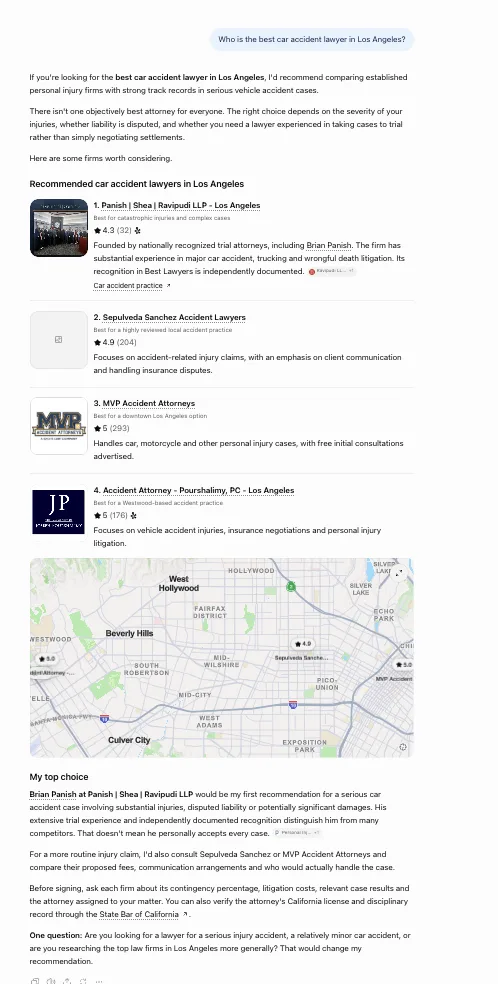
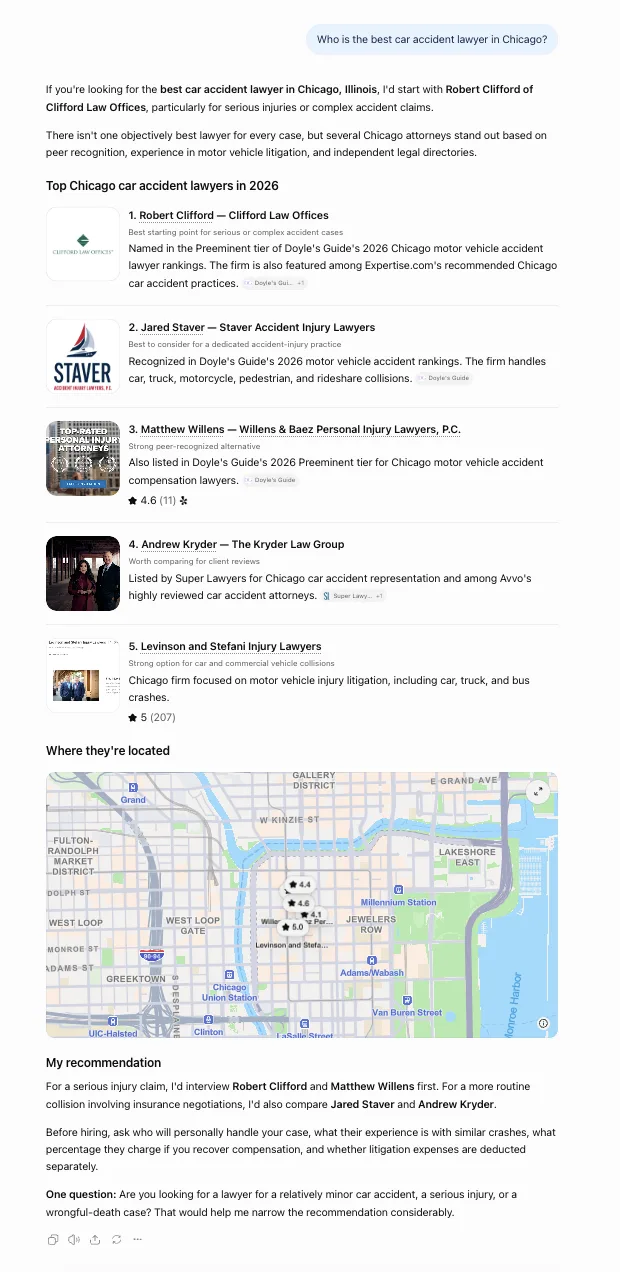
ChatGPT was the only AI that crowned a winner.
| City | ChatGPT’s top choice | Rating (reviews) shown | Why it said so |
|---|---|---|---|
| Los Angeles | Brian Panish, Panish Shea Ravipudi | 4.3 (32) | Catastrophic and complex cases; Best Lawyers recognition |
| Chicago | Robert Clifford, Clifford Law Offices | Not shown | Doyle’s Guide “Preeminent” tier; Expertise.com listing |
Look at LA’s review numbers. The #1 pick had the weakest rating and fewest reviews on its list. In Chicago, the #3 pick (Matthew Willens of Willens & Baez) had just 11 reviews.
For “best lawyer” questions, ChatGPT weighted reputation over reviews.
Chicago added one more detail: 4 of ChatGPT’s 5 picks were named attorneys, not just firms. Attorney-level signals (bio pages, individual directory profiles, awards in the lawyer’s name) feed that.
ChatGPT cited Doyle’s Guide for 3 of the 5 Chicago picks. According to Doyle’s Guide’s methodology page, its rankings draw on recommendations from clients and peers, prior listings and research interviews. LawFuel notes the guide says rankings can’t be bought, though ranked lawyers can pay to enhance their profiles afterward.
Gemini Leaned on One Firm’s Own Website
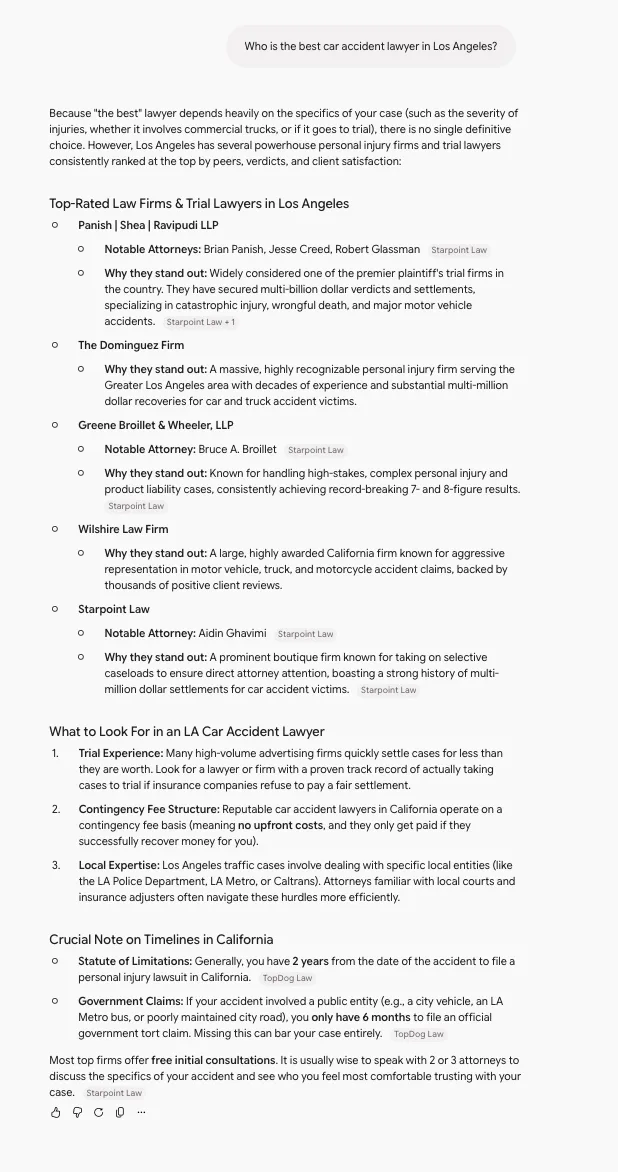
In LA, Gemini named 5 firms: Panish | Shea | Ravipudi, The Dominguez Firm, Greene Broillet & Wheeler, Wilshire Law Firm and Starpoint Law.
Almost every claim Gemini made, about competitors and itself, was sourced to one firm’s website: Starpoint Law’s.
Starpoint published a page about LA’s top firms. It included itself. Gemini used that page as its main source.
The grid confirms it wasn’t a fluke. Gemini named Starpoint at 29 of 49 LA points, more than Wilshire Law Firm and its 2,527 reviews.
In Chicago, Gemini’s answer leaned on Super Lawyers and named Clifford, Power Rogers, Salvi, Horwitz, Willens & Baez and Briskman Briskman & Greenberg.
Hold the Starpoint thought. Claude treated the same tactic very differently.
Google AI Mode Went Its Own Way
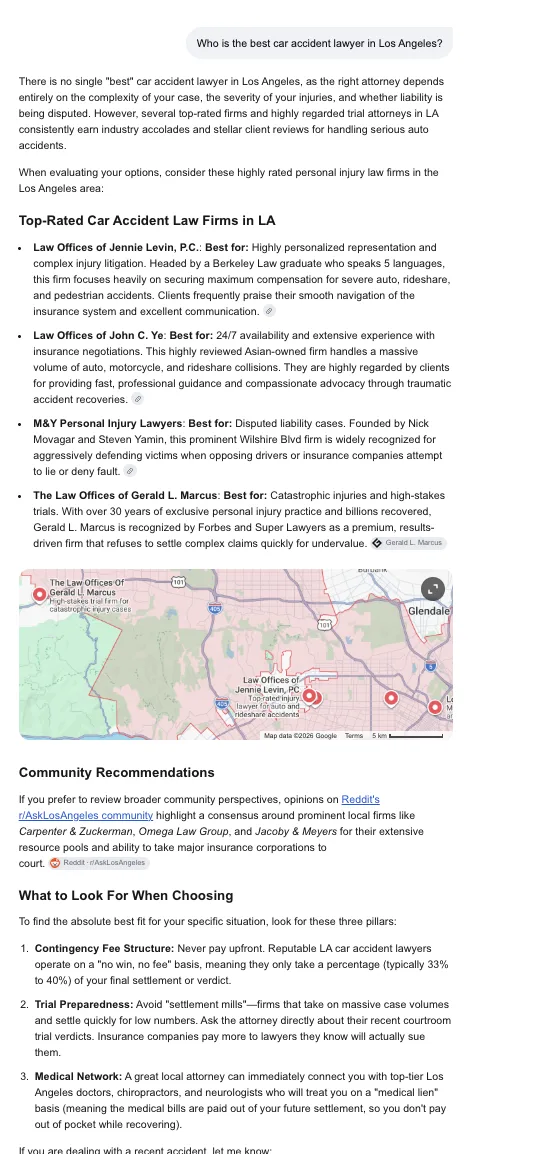
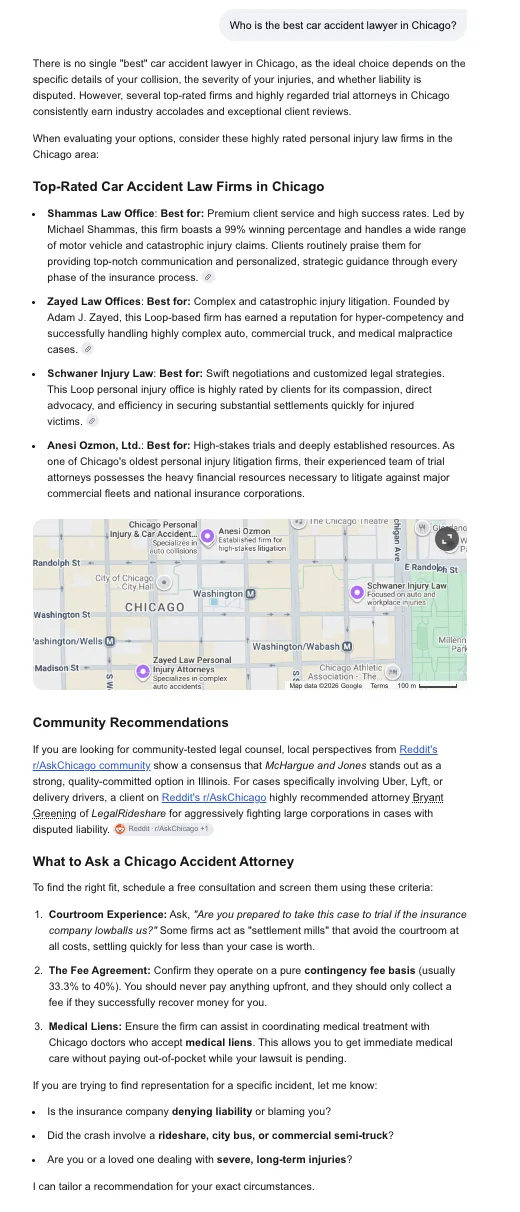
AI Mode skipped the big reputation leaders in both cities. Neither Panish nor Clifford made its answer.
In LA, it picked firms with strong Google Business Profiles: Law Offices of Jennie Levin (described by the 5 languages she speaks), Law Offices of John C. Ye (24/7 availability, labeled “Asian-owned”), M&Y Personal Injury Lawyers and Law Offices of Gerald L. Marcus.
In Chicago, it picked a list no other AI matched: Shammas Law Office, Zayed Law Offices, Schwaner Injury Law and Anesi Ozmon. On the grid, Shammas was AI Mode’s top firm (18 of 49 points). It wasn’t a top pick anywhere else.
Three things stood out:
- Business Profile fields go straight into the answer. Languages, ownership attributes, hours.
- Niche positioning wins niche questions. AI Mode named a rideshare-focused lawyer specifically for Uber and Lyft cases.
- It doesn’t check claims. It repeated one firm’s stated “99% winning percentage” as written.
Both cities’ answers also included “community recommendations” sourced from Reddit: r/AskLosAngeles and r/AskChicago.
Claude Refused to Rank Anyone (Then Named Award Winners)
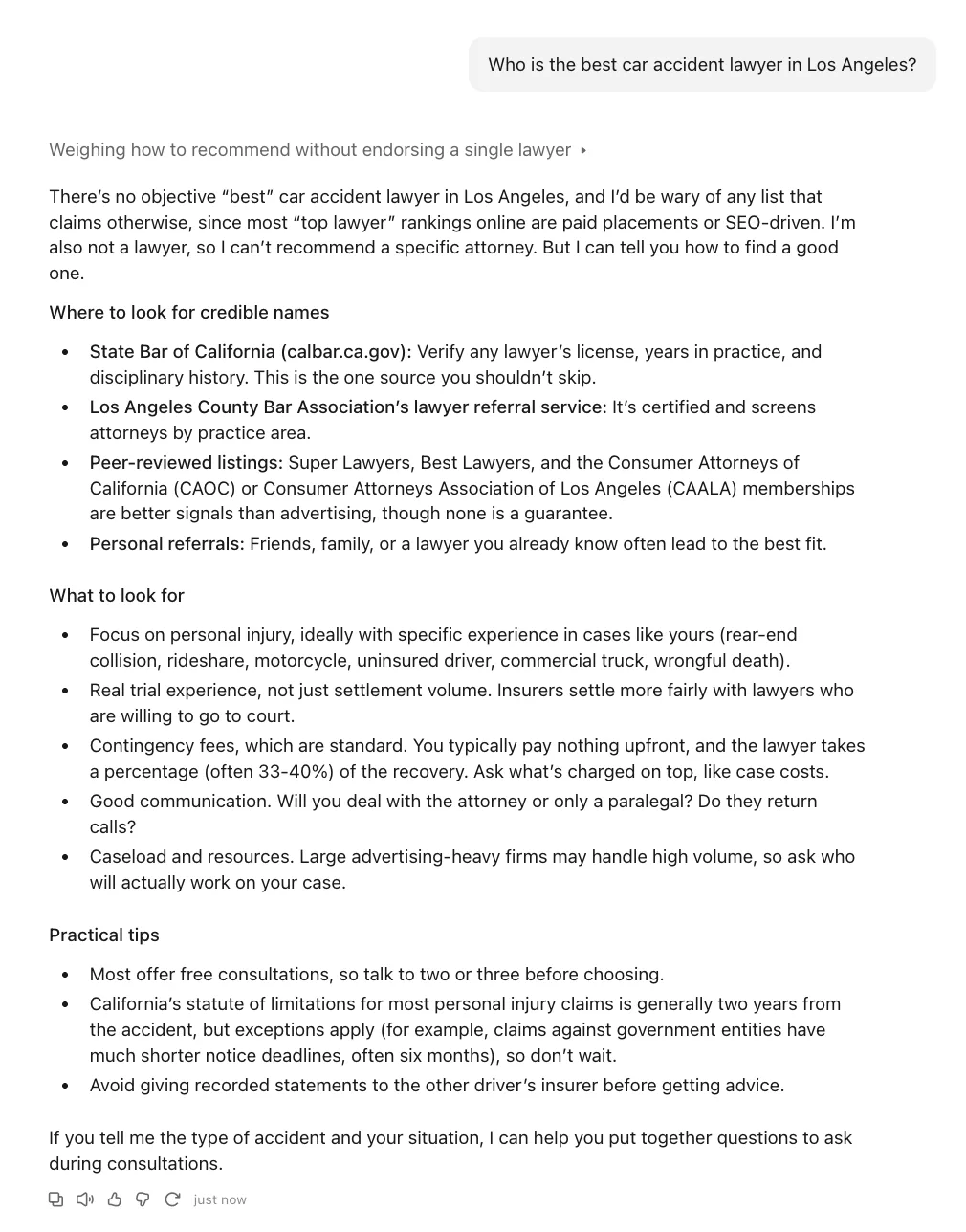
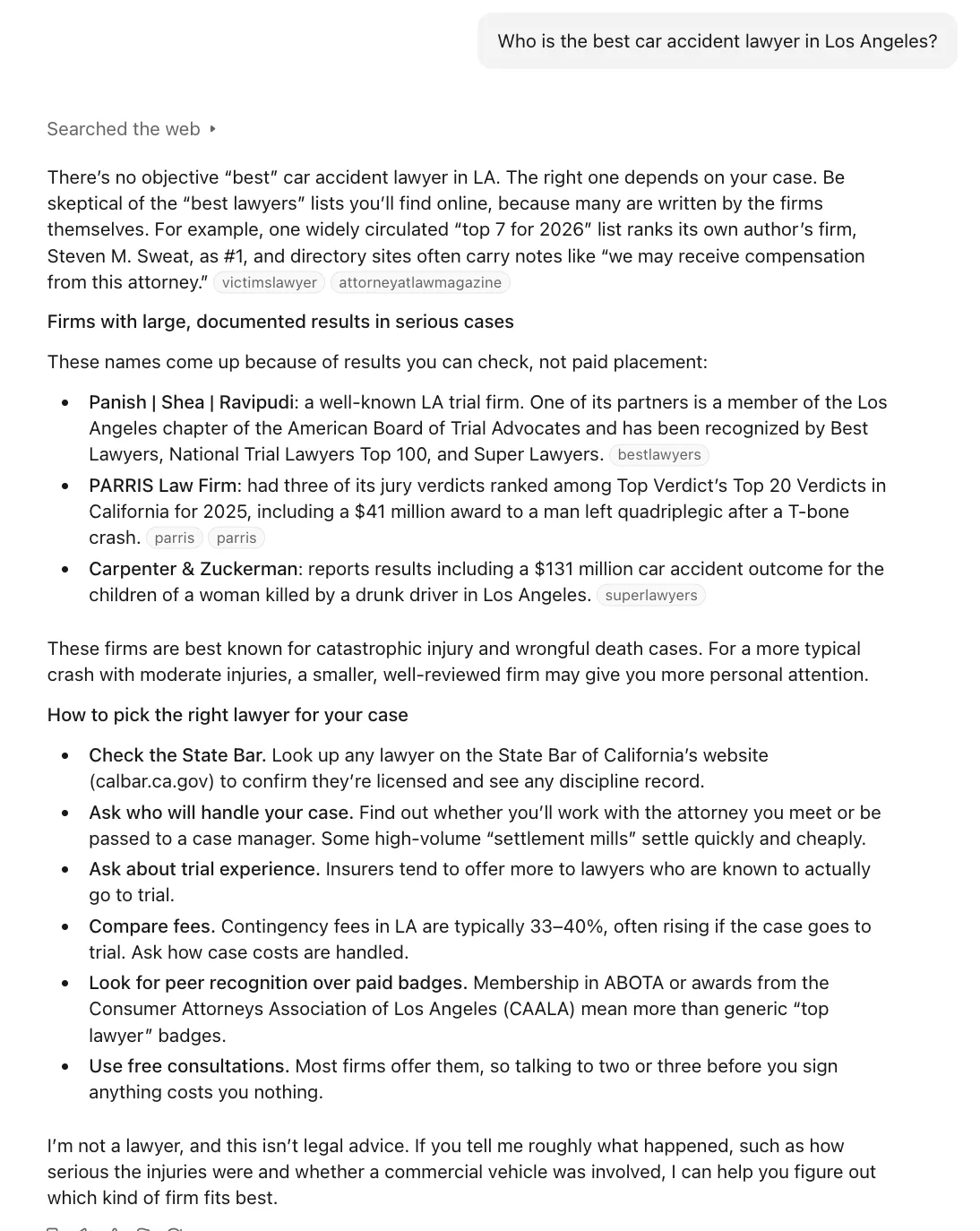
Claude opened every answer the same way: there’s no objective “best,” and most “top lawyer” lists are paid placements or written by the firms themselves.
With web search off, it named zero firms. With search on, it named firms with documented, checkable results:
- LA: Panish | Shea | Ravipudi (ABOTA, Best Lawyers, National Trial Lawyers Top 100), PARRIS Law Firm (3 verdicts in Top Verdict’s Top 20 California verdicts for 2025), Carpenter & Zuckerman (a reported $131 million outcome).
- Chicago: Corboy & Demetrio ($4 billion+ in reported verdicts and settlements), Clifford Law Offices, plus firms with Super Lawyers selections listed on FindLaw.
Claude also told LA users to value ABOTA membership and CAALA awards over generic “top lawyer” badges.
Bonus: Google’s AI Overview Quoted Reddit
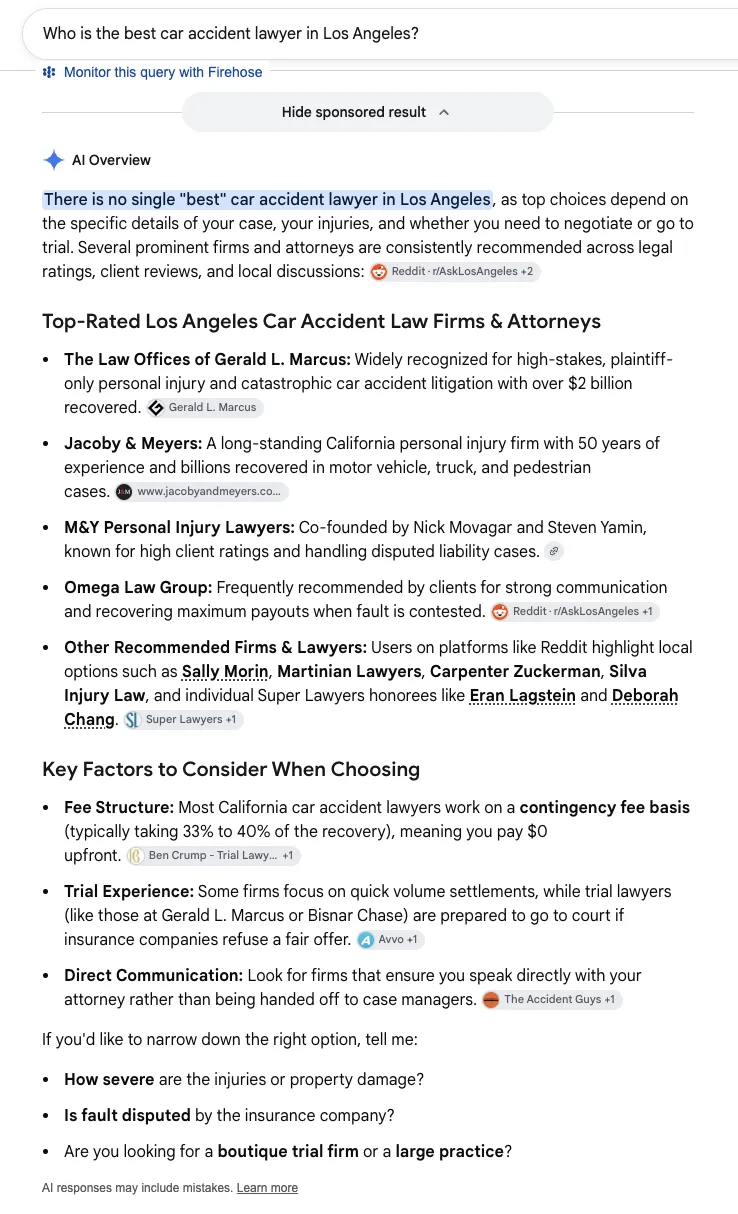
The full question “Who is the best car accident lawyer in Los Angeles?” triggered an AI Overview in regular Google results. Short keywords like “car accident lawyer los angeles” mostly don’t.
Its opening sentence was sourced to r/AskLosAngeles, and so were several firm mentions. Panish wasn’t named.
It also sat under a sponsored result. Ads still come first. (If you’re weighing that trade-off, see our breakdown of PPC for law firms.)
Do the 4 AIs Agree on Who’s Best?
Different firms named across 49 points
No. Not even close. Here’s how many different firms each AI named across the same 49 points:
| Platform | Los Angeles | Chicago | Behavior |
|---|---|---|---|
| ChatGPT | 116 firms | 60 firms | Fragmented: most firms named at 1 or 2 points |
| Gemini | 29 firms | 16 firms | Concentrated: a few firms cover the whole city |
| Google AI Mode | 37 firms | 36 firms | Its own list, often unlike any other AI |
Gemini was the most extreme. In Chicago, just 16 firms appeared across the entire grid, and Clifford and Horwitz were each named at 43 of 49 points.
ChatGPT was the opposite. Whoever is close to the searcher gets a shot.
Wording mattered too. In LA, AI Mode named only 23 firms for “car accident lawyer,” mostly at a single point each. Add “best” and Dominguez, Wilshire and Arash were suddenly named across the city.
Even the same AI disagreed with itself. Claude’s two LA runs of “top personal injury attorneys” shared exactly one firm.
I’ll be honest: there is no single “AI ranking” to win. There are four platforms with four different logics.
That’s why a promise to “rank you #1 in AI” doesn’t hold up. If ChatGPT is your main focus, start with ChatGPT ranking factors for law firms.
Does Location Change What AI Recommends?
No location
- LA: Panish named top choice
- Chicago: Willens & Baez named #3
- Rewards city-wide reputation
From 49 grid points
- LA: Panish not named once
- Chicago: Willens & Baez not named
- Rewards proximity and local signals
Yes. Dramatically.
Asked without a location, ChatGPT named Panish its LA top choice. Asked from 49 specific points across LA, Panish didn’t appear once.
Chicago did the same. Willens & Baez was ChatGPT’s #3 pick in the screenshot and didn’t appear anywhere on the grid.
Here’s what that tells you:
- Without a location, ChatGPT rewards city-wide reputation.
- With a location, it rewards proximity and local signals.
Most people asking about a car accident are on their phone, often right after the crash. Local signals may matter more than any single screenshot suggests.
One LA pattern worth flagging: Braff Law, ChatGPT’s top firm on the LA grid, has roughly 15 separate Google Business Profile listings across the area. That’s a correlation, not proof. But a wide local footprint and wide ChatGPT coverage showed up together.
This is why we track by grid, not by a single search. It’s the same logic behind local SEO for attorneys: visibility is block by block.
Why Google Maps Winners Aren’t AI’s Winners
Google Map Pack rewards
- Proximity to the searcher
- Office location
- Local listing strength
AI rewards
- City-wide reputation
- Recognition and verdicts
- What reviews and sources say
This is the finding that should change how you budget.
Map Pack rankings are heavily driven by proximity to the searcher. A firm with one office competes in a small radius, no matter how many reviews it has.
AI reads reputation across the whole city. So the best-known firms win AI, and the closest firms win Maps.
Los Angeles: Almost No Overlap
Who wins LA’s Map Pack for “best car accident lawyer”:
| Firm | Map Pack share | Google reviews |
|---|---|---|
| DK Law | 16.33% | 324 |
| KJT Law Group | 14.29% | 313 |
| The JLF Firm | 14.29% | 528 |
| Big Ben Lawyers | 10.20% | 120 |
| Farahi Law Firm | 8.16% | 517 |
AI’s LA favorites on the same grid:
| Firm | Google reviews | Map Pack share |
|---|---|---|
| Wilshire Law Firm | 2,527 | 0% |
| Law Offices of John C. Ye | 2,521 | 0% |
| The Dominguez Firm | 2,042 | 0% |
| Arash Law | 1,247 | 0% |
| Panish Shea Ravipudi | Not listed | Not in Map Pack |
Two firms with 2,500+ reviews each never made the top 3 anywhere on the LA grid. AI names them constantly.
I know what you’re thinking: “So reviews don’t matter for Maps?” They do. They just can’t overcome distance on their own.
Chicago: The Firms That Win Both
Chicago’s reputation leaders followed the LA pattern:
| Firm | Gemini grid | Map Pack share |
|---|---|---|
| Clifford Law Offices | 43 | Not in Map Pack |
| Horwitz, Horwitz & Associates | 43 | 0% (1,127 reviews) |
| Salvi, Schostok & Pritchard | 32 | 0% |
| Corboy & Demetrio | 10 | Not in Map Pack |
But two firms broke the pattern:
| Firm | Map Pack share | Google reviews | Where AI named it |
|---|---|---|---|
| Malman Law | 55.10% (#1) | 5,384 | Gemini 39 points; ChatGPT grid co-leader; every Claude “near me” and “best reviews” run |
| The Kryder Law Group | 24.49% (#3) | 556 | ChatGPT #4 pick; ChatGPT grid co-leader; Gemini; AI Mode; Claude |
What do they have in common? Both are strong on more than one route. Big review volume and a central office for Maps. Plus recognition and review content AI can cite.
Kryder’s reviews even mention that other law firms refer cases to it. Claude repeated that in its answer.
That’s the target. A strong attorney SEO program now has to cover your Business Profile, your reputation signals and your AI visibility as one system.
Where Does AI Get Its Information About Law Firms?
Every AI cited different sources:
| Source type | Which AIs used it | Example |
|---|---|---|
| Firm’s own website | Gemini, Claude, AI Overview | Starpoint Law’s roundup page; case results pages |
| Peer recognition | ChatGPT, Claude, Gemini | Super Lawyers, Best Lawyers, ABOTA, Doyle’s Guide |
| Syndicated press releases | Claude | Award announcements republished on local news sites |
| Google Business Profile | AI Mode, Claude (maps mode) | Ratings, hours, languages, attributes |
| AI Overview, AI Mode | r/AskLosAngeles, r/AskChicago | |
| Directories | Claude | Avvo, FindLaw, Lantern |
| Bar associations | Claude | LA County Bar, Chicago Bar Association referral services |
One detail stood out. In a single LA run, 4 of the 6 firms Claude named got in through press releases announcing a Super Lawyers selection.
The releases had been syndicated onto local news sites in other states. Claude found them there.
Claude even noted the announcements were marketing. It cited them anyway.
Earned coverage does double duty: it feeds AI answers and builds the links covered in our guide to link building for law firms.
What Gets a Firm Penalized in AI Answers?
Four things that backfired
- ❌ Lists that rank yourself #1
- ❌ Reviews written for clients
- ❌ Complaints left unanswered
- ❌ Perfect scores with low volume
Some tactics don’t just fail. They backfire, in public.
Self-ranking listicles (on Claude). In one LA answer, Claude pointed to a “top 7 for 2026” list that ranks its author’s firm, Steven M. Sweat, as #1, and used it as its example of a biased list. In another, it said Morgan & Morgan, Jacoby & Meyers, Steven Sweat’s firm and DK Law “all rank themselves highly” on their own pages, so it would skip those as evidence.
That’s four firms, including two national brands. It’s a common practice, and Claude is actively filtering it out.
Gemini rewarded a similar tactic with Starpoint’s page. The difference: Claude checks who wrote a list.
- ✅ A genuinely useful, fair roundup page: can work on Gemini.
- ❌ A list that crowns yourself: can get you named as a warning on Claude.
Reviews written for clients. In Chicago, Claude said one Malman Law reviewer reported that a firm representative wrote their original positive review for them. Claude told users that’s a reason to read Malman’s reviews skeptically.
Remember, Malman is also one of the study’s biggest winners. One review comment was enough to add a caveat to its AI answer.
A repeated complaint. In LA, a review about slow communication and a small payout after fees appeared in two separate Claude answers about Wilshire Law Firm. Claude also noted that mixed reviews are normal for large firms.
In Chicago, a client’s complaint about months going by without updates appeared in four Claude answers about Horwitz, Horwitz & Associates.
Both firms have thousands of positive reviews and rank among AI’s most-recommended firms. Claude still surfaced the complaint.
AI repeats what’s written. One critical review can make it into the answer, even next to thousands of good ones. Here’s how to handle bad lawyer reviews.
Perfect scores with low volume. Claude called a 5.0 from 90 reviews weaker evidence than a 4.9 from 2,000. It also said big PI firms actively ask for reviews, so near-perfect scores “don’t tell you much about results.”
How Much Does AI Search Matter for a Car Accident Practice?
More than most firms are tracking.
According to BrightLocal’s 2026 consumer survey, 58% of consumers have already used AI to find or get a recommendation for a local business. Among AI users, 18% contact an AI-recommended business directly, and 75% head to Google to verify further.
That last number is the whole strategy in one line. AI builds the shortlist. Google closes the deal.
That makes AI visibility part of personal injury lead generation now, not a side project.
Here’s the search demand AI is sitting on top of in both cities:
| Keyword | Monthly US searches | Keyword difficulty |
|---|---|---|
| los angeles car accident lawyer | 4,300 | 35 |
| car accident attorney los angeles | 2,200 | 18 |
| car accident lawyer los angeles | 1,900 | 19 |
| best car accident lawyer los angeles | 800 | 15 |
| car accident lawyer chicago | 2,300 | 36 |
| chicago car accident lawyer | 1,800 | 21 |
| car accident attorney chicago | 1,200 | 42 |
| best car accident lawyer chicago | 100 | 0 |
Source: Ahrefs Keywords Explorer, US, Nov 2026.
According to Google Keyword Planner, the top-of-page bid for “car accident attorney los angeles” reaches $400 per click (high range, Oct 2025 to Sep 2026).
At that price, one signed case from paid search costs about $6,400, assuming 25% of visitors become leads and 25% of leads sign. That’s the demand AI is now answering before anyone clicks an ad.
What This Means for Your Firm
Win on more than one route
- Recognition and results
- Google Business Profile and reviews
- Directories and community
- State-specific content
- Measure by grid
Malman and Kryder showed what winning looks like. They were strong on more than one route.
Here’s the playbook:
Recognition and results 1. Publish a case results page with specific amounts, case types and dates. 2. When you win peer recognition, distribute the announcement through a press release wire. 3. Build recognition in your attorneys’ names, not just the firm’s.
Google Business Profile and reviews 4. Fill in every Business Profile field: hours, languages, attributes, services. 5. Ask clients to name who helped them and the type of case in their review. 6. Respond to negative reviews. AI repeats them.
Directories and community 7. Complete and update your Avvo, FindLaw, Justia and Super Lawyers profiles.
Content 8. Publish answer-first pages on your state’s rules: deadlines, fault, what to do after a crash.
Measurement 9. Test yourself: run the 5 prompts from this study with your city, in a fresh chat, twice each. Note whether you’re named and which sources get cited. 10. Then track by grid, not by one search. A single screenshot can make you look invisible, or dominant, when you’re neither. It’s the same block-by-block logic behind Map Pack tracking.
Here’s the short version: the Map Pack and AI reward different things. The firms that win both sign the cases, because AI builds the shortlist and Google confirms it.
For the full strategy behind this study, see GEO for lawyers and our guide to personal injury lawyer SEO.