
Does your law firm need a blog?
The short answer is no.
And that might come as a shock considering how many SEO agencies insist that "content is king" and that you must constantly publish "fresh content" to stay relevant online.
As someone who conducts over 15 consultations weekly with attorneys, I've witnessed firsthand the regurgitation of outdated marketing advice that keeps law firms investing in content that simply doesn't deliver results.
From Gary Vaynerchuk's "content machine" philosophy to agencies pushing fluff pieces about snowbirds in Florida, there's an epidemic of misguided content strategy in legal marketing.
Let's be brutally honest about something:
You pay for marketing to make money. Period. If your content isn't generating phone calls, it's failing—regardless of how impressive your traffic graphs look.In our latest video we break down why the "blog" is a myth, and what you should do instead.
The Traffic Illusion: A Real-World Case Study
Recently, I audited a law firm's website after they approached me with a common complaint: "Our traffic is going up, but our phone calls aren't."This disconnect is the telltale sign of ineffective content strategy.
Using Ahrefs (an SEO analysis tool), I examined their performance metrics. At first glance, the numbers looked promising: approximately 3,200 monthly visitors and an estimated traffic value of $12,000 per month.
For an injury firm, 3,200 visits should translate to at least 10 phone calls monthly (assuming a conservative 0.3% conversion rate).
But something was off. In the personal injury space, where keywords typically cost $400+ per click, a traffic value of only $12,000 is suspiciously low. This suggested they weren't ranking for commercially valuable terms.
Digging deeper into their top-performing pages revealed the truth:
- "How to get a restraining order" (23% of traffic)
- Branded searches (16%)
- "Rush hour traffic" (7.5%)
- "What is a snowbird in Florida?" (3.5%)
None of these search terms indicate someone looking to hire a personal injury attorney. They're pulling in traffic, sure—but it's completely irrelevant traffic that will never convert into clients.
The Marketing Funnel Trap
To understand why this happens, we need to look at the traditional marketing funnel:- Top Funnel (Awareness): Blog posts, informational content
- Mid Funnel (Consideration): Resource guides, comparisons
- Bottom Funnel (Decision): Practice area pages, location-specific content
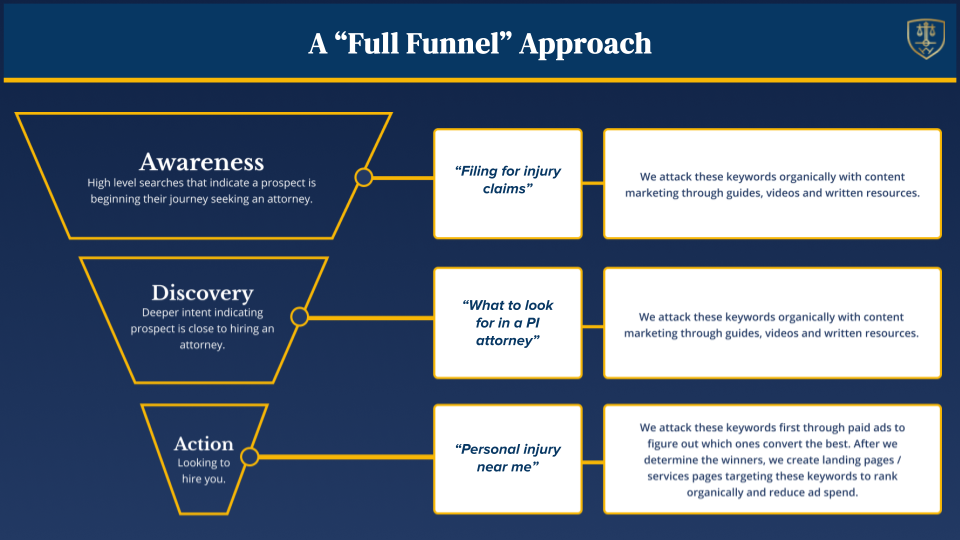
Most agencies focus heavily on top-funnel content because it's easier to rank for terms like "what is a snowbird" than "personal injury attorney in Miami."
They're taking the path of least resistance, creating content that generates traffic but not clients.
These agencies aren't equipped to compete in the ultra-competitive legal landscape where the real money keywords live. Instead, they give you vanity metrics to justify their retainer, knowing they'll make their money and move on within six months when you inevitably get frustrated with the lack of actual results.
Flipping the Funnel: The Strategy That Actually Works
The effective approach is to flip this funnel completely upside down. Start at the bottom where the money is:Bottom Funnel (Months 1-12)
Focus first on practice area pages optimized for high-intent keywords:- " Attorney in "
- " Lawyer Near Me"
- "Best Law Firm "
For these pages, you need:
- Comprehensive, authoritative content about your practice area
- Location-specific information that establishes local relevance
- Strong calls-to-action and multiple contact options
- Testimonials and case results that build credibility
- Aggressive link building campaigns to boost authority
Mid Funnel (Months 12-16)
Only after you've maximized your bottom-funnel pages should you expand to mid-funnel content like:- Guides on what to do after an accident
- Explanations of legal processes relevant to your practice
- Comparisons of different legal options
- Resource libraries for potential clients
Top Funnel (After 16+ Months)
Finally, once you have a strong foundation of converting content, you can consider true "blog" content that targets broader awareness:- Common legal questions in your practice area
- Current legal news and developments
- Community-focused content
- General educational material
This content should still be strategically aligned with your practice areas and target audience. No more random "snowbird" articles with zero commercial intent.
Why Agencies Push the Wrong Approach
Why do so many agencies get this backward? Three simple reasons:- Quick wins: Top-funnel content is easier to rank, allowing them to show you nice graphs of increasing traffic early in your relationship.
- Lower skill ceiling: Competing for commercial keywords requires advanced SEO skills, extensive experience, and higher-quality link building—capabilities many agencies simply don't have.
- Set expectations low, deliver mediocre results: If they pitch you on bottom-funnel keywords from the start, they'd need to show actual client acquisition metrics, not just traffic increases.
They're not equipped to handle the competitive reality of law firm marketing.
How to Identify Your Money Keywords (Without an Agency)
You don't need to pay an expert thousands of dollars to identify your most valuable keywords. Here's a simple process:- Open ChatGPT and prompt it: "I'm a attorney in . What search terms would potential clients use to find my services?"
- Review the list and prioritize terms that show clear hiring intent (containing words like "attorney," "lawyer," "hire," "best," etc.)
- Check search volume using free tools like Ubersuggest or Google Keyword Planner
- Prioritize keywords based on a combination of search volume, competition, and commercial intent
The True Test of Marketing Success: Phone Calls, Not Traffic
Let's return to our fundamental metric: leads. If your SEO agency reports show traffic increasing while your phone remains silent, you're paying for vanity metrics.For a personal injury firm getting 3,000+ monthly visitors, you should be receiving at least 10 new case inquiries per month. Anything less means your traffic isn't targeted to potential clients.
Next time your agency shows you an impressive traffic graph, ask these questions:
- "What specific keywords are driving this traffic?"
- "What percentage of our traffic is coming from commercial-intent keywords?"
- "How many phone calls and form submissions has this traffic generated?"
- "What's the conversion rate from visitor to inquiry?"
Building a Revenue-Generating Content Strategy
A truly effective content strategy for law firms follows this progression:- Audit existing content to identify gaps in bottom-funnel coverage
- Create or optimize practice area pages targeting your primary services and locations
- Develop location-specific landing pages for all areas you serve
- Build quality backlinks to your commercial pages (not just your homepage)
- Add mid-funnel content that supports your practice areas
- Implement conversion optimization to maximize inquiry rate
- Track and measure phone calls by source to validate effectiveness
The Bottom Line: Marketing Is About Making Money
In the competitive world of legal marketing, you can't afford to waste resources on content that doesn't convert. Your marketing budget should be an investment with measurable returns, not an expense justified by vanity metrics.Remember: You're in business to make money.Your marketing should serve that goal directly. If an agency isn't comfortable discussing your marketing in terms of revenue generation and client acquisition, they're the wrong partner for your law firm.
When evaluating your content strategy, ask yourself this simple question: "If someone reads this page, are they likely to need my services and contact my firm?" If the answer is no, it's time to redirect your resources to content that actually drives business growth.
The legal market is too competitive for half-measures and outdated tactics. Demand marketing that delivers clients, not just clicks.
Ready to Transform Your Law Firm's Digital Marketing?
If you're tired of paying for traffic that never calls, it's time for a different approach. Focus on the bottom-funnel keywords that drive real clients, build authority in your practice areas, and measure success by inquiries, not page views.The most valuable investment isn't in producing more content—it's in creating the right content that connects with potential clients at the moment they're ready to hire an attorney. That's how successful law firms grow in today's competitive digital landscape.