But because they’re still executing strategies from 2022 that fundamentally don’t work anymore.
I know this because we audit 3-5 law firm SEO campaigns every single week. And the pattern is always the same:
Agencies focused on pumping out blog content, chasing keyword rankings, and building links while the actual game has moved to an entirely different playing field.
The truth?Legal SEO in 2026 looks nothing like it did even 18 months ago.
Google’s AI Overviews are killing blog traffic
ChatGPT is making lawyer recommendations based on intimate conversations
Generic content is being cannibalized before anyone clicks through to your website
And the strategies that actually work? Most agencies don’t even know about them yet.
Here are the 5 critical SEO trends every law firm needs to understand and act on right now.
Trend #1: The CTR Collapse (And Why Your Blog Traffic Is Dying)
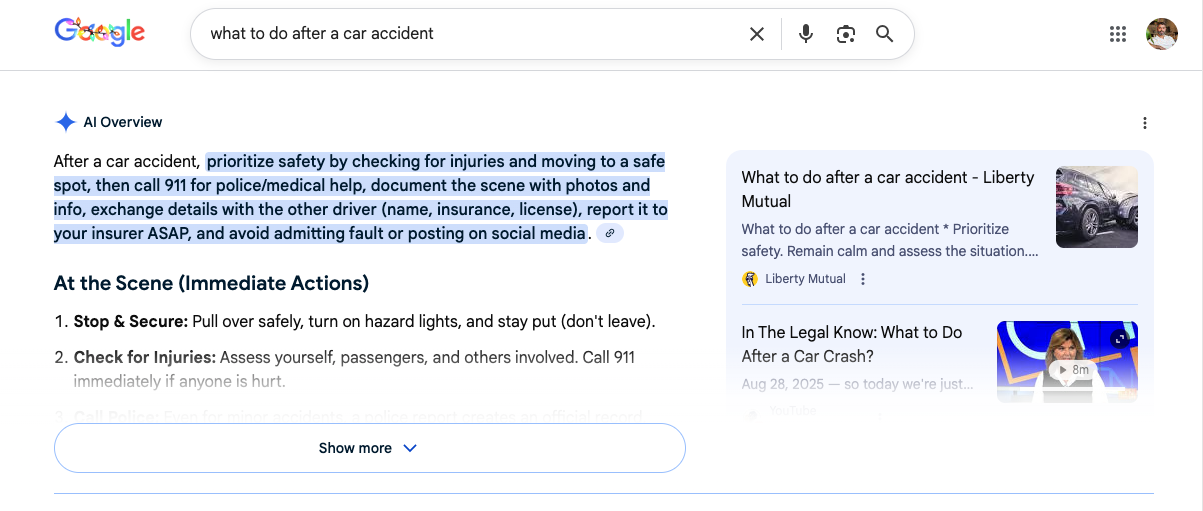
Search for “what to do after a car accident” on Google.
What do you see?
Before you even get to the first organic result, you’re scrolling past ads, Local Service Ads, and now—the big one—AI Overviews.
Google’s AI Overview gives you a complete answer right there on the search results page. A numbered list of exactly what to do. No need to click anything. No need to visit a website.
The content still exists on your website. It might even “rank.” But nobody’s clicking through because Google is answering the question directly with AI.
But here’s the kicker: This mostly affects top-of-funnel, informational content.
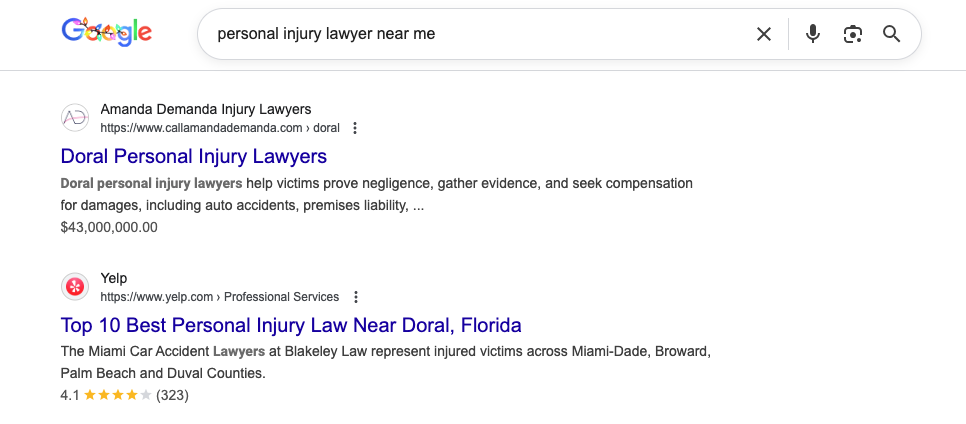
Bottom-funnel searches—”best Miami personal injury attorney,” “criminal defense lawyer near me”—still drive clicks. But even these are changing.
Look at that same search. After the ads, you see the Google Maps Pack. Three local listings with reviews, phone numbers, and one-click directions.
Our data across hundreds of law firm campaigns shows 50-60% of phone calls now come from the Maps Pack, not traditional organic rankings.
Why? Because it’s prominent, it’s trusted, and it’s frictionless—especially on mobile.
The shift: Traditional organic rankings (those blue links below the Maps Pack) are becoming less valuable by the day. The focus needs to be on Local Service Ads, Google Ads, and especially Google Business Profile optimization.
Why Content Still Matters (Just Differently)
“So should I stop creating content entirely?”
No. But the purpose has changed.
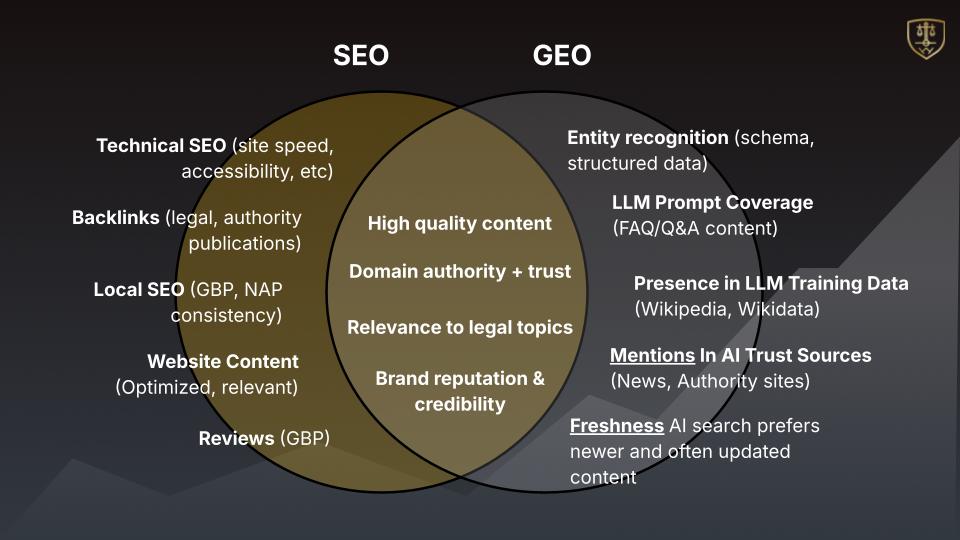
Content now serves as architectural foundation for your website, not traffic generation.
Google still crawls your site. They still want to see depth, expertise, and comprehensive topic coverage. Having that informational content helps Google understand you’re an authority in your practice area.
But don’t expect traffic from it. The real value is in:
Establishing topical authority
Creating internal linking opportunities
Providing fodder for AI to cite (which we’ll cover next)
Think of blog content as the foundation of a house. Necessary, but nobody’s coming over to admire your foundation. They care about what’s built on top of it.
Trend #2: LLMs Becoming Personal Legal Concierges (The ChatGPT Revolution)
Here’s where things get really interesting.
More people are using ChatGPT, Perplexity, and other AI tools for legal research than ever before. And the way people search on these platforms is fundamentally different from Google.
Google is linear. You type a query, scan results, click a few links, refine your search, repeat.
ChatGPT is conversational. You’re having a back-and-forth dialogue where the AI remembers everything you’ve said and tailors recommendations based on that context.
Let me show you a real example:
Someone going through a divorce might start by asking ChatGPT: “What happens to my business in a Florida divorce?”
ChatGPT answers. Then they ask: “What if my spouse was unfaithful?”
Then: “How is child custody decided?”
Then: “Should I try to hide assets?”
Then: “What about my retirement accounts?”
They’re having this deep, emotional, intimate conversation with AI about their situation. The AI is learning about their specific circumstances, their concerns, their priorities.
Finally, they ask: “Can you recommend a divorce attorney in Miami who handles high-net-worth cases with business owners?”
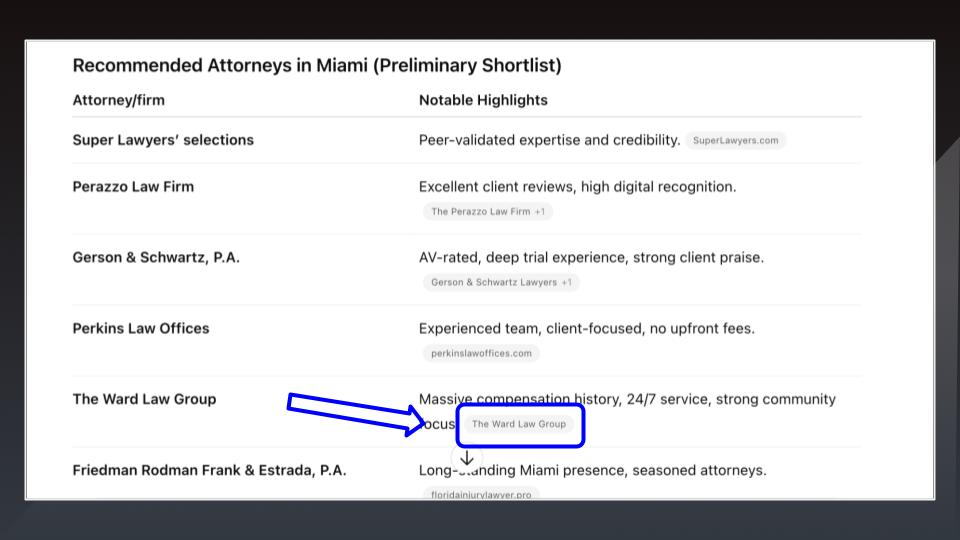
And here’s what’s wild: ChatGPT gives ONE recommendation.
Not a list of 10. One.
Based on everything it’s learned about the person’s situation through the conversation, it makes a single, confident recommendation with citations.
This is massive for certain practice areas:
Family law (emotional, intimate conversations about divorce, custody, support)
Criminal defense (detailed discussions about charges, defenses, penalties)
Business disputes (complex situations with partners, contracts, LLC issues)
Estate planning (conversations about family dynamics, wealth, wishes)
For these practice areas, ChatGPT isn’t just a search engine. It’s a personal legal concierge that gets to know the person before ever recommending a lawyer.
Where ChatGPT Pulls Its Recommendations
When ChatGPT recommends that one attorney, where is it getting the information?
We asked it. Here’s what it cited:
The law firm’s website (specifically their About page and Results page)
Reddit (yes, really—not to promote yourself, but to provide actual helpful legal information)
LinkedIn (posts and articles that get shared and discussed)
YouTube (video content is now equal to written content for AI)
Think of it as building tentacles across the web. The more places AI can find legitimate information about you and your expertise, the more likely you are to be recommended.
Trend #4: The Death (Retooling) of Generic Top Funnel Blog Content
Let’s address the elephant in the room: If your SEO agency is proposing 30 blog posts per month, fire them.
That’s not hyperbole. That’s a red flag that they don’t understand how SEO works in 2026.
Here’s why that strategy is dead:
The old model: Create tons of informational content targeting top-of-funnel keywords, drive traffic to your website, convert some percentage to leads.
The new reality: AI Overviews answer the question before anyone clicks, so traffic never reaches your website.
Go back to that “what to do after car accident” example. That used to be a great traffic driver. Now it gets almost zero clicks because the AI Overview gives a complete answer.
The traffic has been cannibalized by AI summaries.
So why create that content at all?
The retooling:
Content isn’t dead. The purpose has changed.
Instead of traffic generation, blog content now serves as:
Topical authority building – Showing Google and AI that you comprehensively cover your practice area
Citation fodder – Giving AI models content to pull from when answering questions
Internal linking structure – Creating pathways for Google to understand your site architecture
Expertise demonstration – Proving you know what you’re talking about (E-E-A-T)
The shift in topics:
Less: “5 Steps to File a Personal Injury Claim” More: “Florida Statute of Limitations for Personal Injury Cases by Type”
Less: Generic listicles anyone could write More: State-specific laws, case precedent, nuanced legal analysis
And here’s the big change: It doesn’t all need to be written content.
AI models are now multi-modal. They can understand:
Video content
Podcast audio
Social media posts
LinkedIn articles
You don’t need to transcribe your podcast into a blog post anymore. The podcast itself is now SEO content.
This opens up huge opportunities for attorneys who are more comfortable speaking than writing.
When Generic Content Still Works
There’s one exception: Opinionated, unique perspectives.
If you’re just regurgitating the same information as every other law firm, AI will summarize it and nobody will click.
But if you’re offering:
A contrarian take on a legal trend
Insider perspective on how local judges rule
Predictions based on recent case law
Personal stories from cases you’ve handled
That content can still drive traffic because it’s not generic. It’s unique. AI can’t fully summarize it without losing the value.
The proliferation of AI content has made the internet samey. Original thinking stands out more than ever.
Trend #5: The Return to Real Business & Brand Building
This is the big one. The trend that changes everything.
Brand signals are now the ranking factor you can’t manipulate.
Let me give you a real example:
We have a client—small personal injury practice in Virginia. He runs a podcast about personal injury law, marketing, and running a law firm. Does decent numbers, nothing crazy.
He also works for a much larger firm now. The larger firm spends $50,000+ per month on traditional SEO. Huge budget. Lots of blog content. Link building. The works.
His small practice (that’s basically dormant) gets more leads from ChatGPT than the large firm he works for.
Why?
Because ChatGPT sees:
His podcast episodes on YouTube
Clips and shorts across social platforms
The podcast listed on his website
Strong reviews from past clients
Media mentions from his podcast guests
LinkedIn content about his expertise
It sees a real person building a real brand, not a faceless SEO campaign.
The large firm? It sees a website with lots of content but no authentic brand presence outside of paid tactics.
The Power of Branded Search
Here’s another example: One of the biggest personal injury firms in Florida. They absolutely dominate organic search.
Our hypothesis on why? Branded search volume.
Branded search is when someone types your law firm’s name directly into Google. Why is this the ultimate signal?
Because it means:
They’ve decided to research you specifically
They’re probably ready to hire (or very close)
They’ve heard about you from somewhere else
You have real brand awareness
You can’t manipulate branded search. You can’t pay an agency to increase it (directly). It’s a pure signal of actual brand strength.
And Google knows this. If thousands of people per month are searching for your firm by name, you must be legitimate. You must be trusted. You must be who people want.
That’s why Google (and ChatGPT) reward it so heavily.
How to Drive Branded Search
This is where “real business and brand building” comes in:
Multi-platform content:
Podcast (huge for brand building)
YouTube (clips from podcast, client testimonials, educational content)
Instagram (behind-the-scenes, attorney personalities, case results)
LinkedIn (professional thought leadership)
Community involvement:
Sponsoring local events
Speaking at conferences
Teaching CLEs
Supporting local charities
Traditional advertising:
Billboards (still incredibly effective for driving branded search)
Radio spots
TV commercials
Bus stop ads
All of these drive people to Google your name. And every time someone Googles your name, it reinforces to Google that you’re a brand worth ranking.
It’s a compounding effect. The more people search your brand, the higher you rank organically, which drives more brand searches, which increases rankings, which drives more searches…
Why This Matters More Than Ever
For years, SEOs have been able to “hack” their way to the top:
Buy some links
Publish 100 blog posts
Optimize some title tags
Boom, top 3 rankings
Those tactics are increasingly ineffective because AI can detect manipulation.
But brand building? You can’t fake that.
You can’t fake:
500 people per month searching your firm name
A podcast with 50 episodes and thousands of downloads
Speaking at the Florida Bar conference
Sponsoring the local youth sports league
Video testimonials from happy clients
Active social media with real engagement
These are signals of a real business doing real marketing, not an SEO campaign trying to game an algorithm.
And as AI gets smarter, these authentic signals matter more and more.
The Mention Economy
One final piece: Mentions matter more than links now.
In traditional SEO, you needed actual HTML links pointing to your website. If a publication mentioned you but didn’t link, it didn’t help your SEO.
That’s changed.
Now, just being mentioned in authoritative places carries weight. If the Miami Herald writes about you, ChatGPT sees that even without a direct link.
If you’re a guest on a podcast and they mention your firm, AI models pick that up.
If you’re quoted in a Forbes article about legal trends, that’s a mention that builds authority.
This is why the old “followed vs. no-follow links” debate is dead. AI doesn’t care about HTML link attributes. It cares about where your name appears and in what context.
Social media posts, podcast mentions, forum discussions, news articles—it all counts now.
What This Means For Your SEO Strategy
If you’re currently paying an SEO agency, here’s your action plan:
Red flags to watch for:
Promising 20-30 blog posts per month
Only focused on your website
Not mentioning Google Business Profile optimization
Not tracking branded search volume
Obsessed with “followed links”
No multi-platform content strategy
What you should be doing instead:
Prioritize Google Business Profile optimization – This is where calls actually come from
Build a review generation system – Critical for both Google and ChatGPT
Create strategic content, not volume – Focus on unique, opinionated, useful content across multiple formats
Expand beyond your website – Active presence on Yelp, Avvo, YouTube, LinkedIn, podcasts
Invest in brand building – Even offline marketing now improves SEO through branded search
Track what matters – Calls, consultations, cases signed. Not keyword rankings.
The firms that win in 2026 are the ones building real brands with multi-platform presence and authentic community engagement.
The firms that lose are the ones still trying to manipulate rankings with blog volume and sketchy link building.
The game has changed. Make sure you’re playing the new game.
Want help navigating these shifts?We offer free SEO audits to analyze your current strategy and identify opportunities. If you’re ready to modernize your approach and stop wasting money on outdated tactics, let’s talk.
You’re Missing Out On Leads!
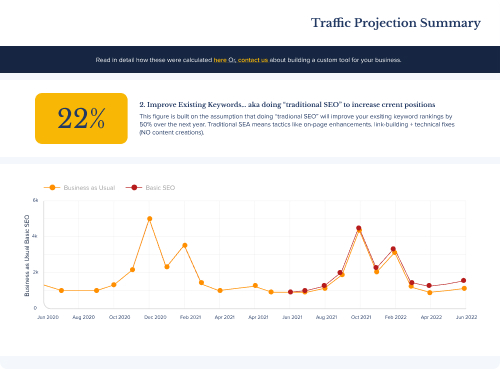
Our Traffic Projection Tool Will Show Your Website’s True Potential (aKA How Much Money You Should Be Making).
Using data from your website, our Traffic Projection analysis can accurately forecast how much traffic (and revenue) your website could be getting from Google.