
We pulled Google Search Console data for 8 personal injury firms.
Average position improved at all 8. Clicks fell 16%.
Then we pulled call tracking for the three firms with consistent tracking in both years. First-time callers from Google organic search dropped by about a third.
Read that again. Your rankings report can say you're winning while your phone says you're losing.
On September 24, Google confirmed a new spam update on top of all of it. Below is what our data shows, what caused what, and what you should do this week.
What Did Google Confirm on September 24, 2026?
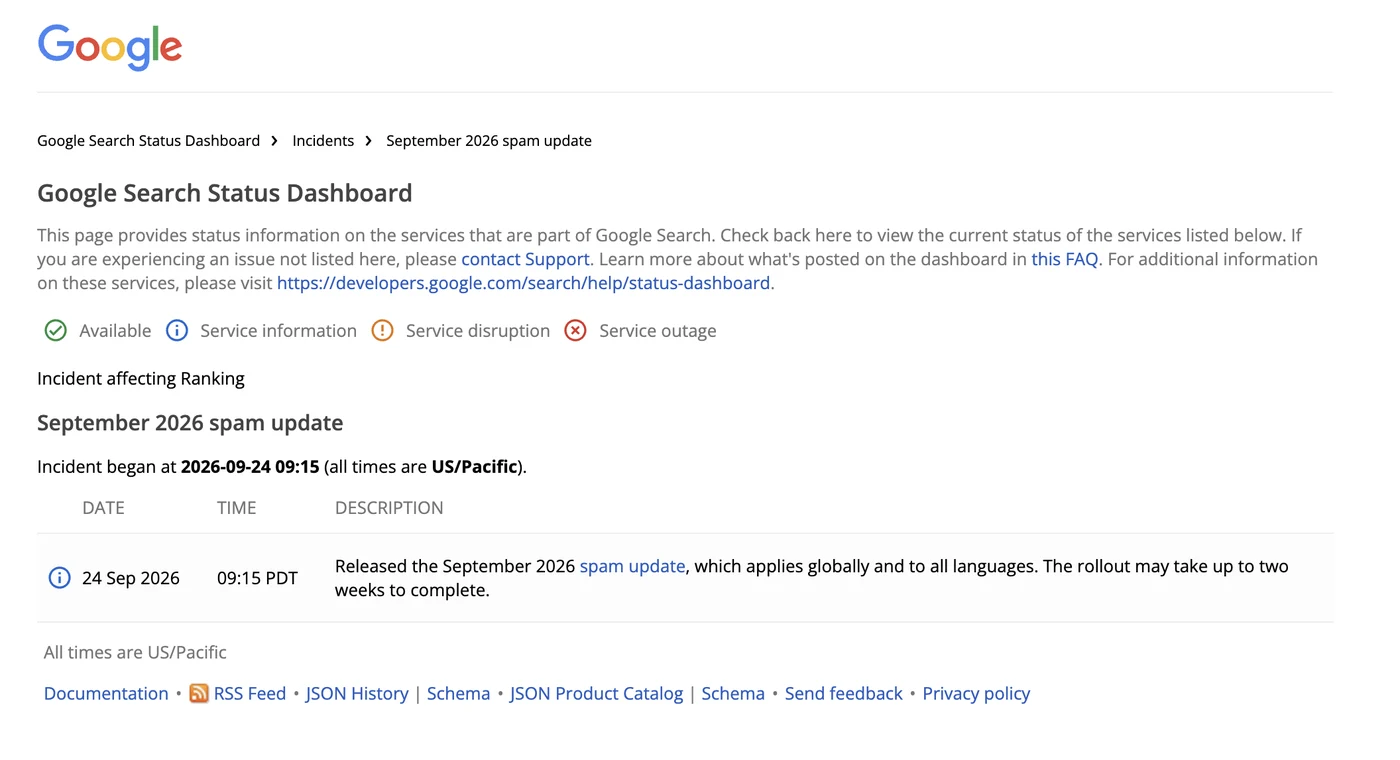
Google confirmed the September 2026 spam update on September 24, 2026. According to the Google Search Status Dashboard incident for the September 2026 spam update, the rollout began at 9:15 a.m. PDT, applies globally and to all languages, and may take up to two weeks to complete.
This is the fourth confirmed spam update of 2026. According to Search Engine Journal's coverage of the September 2026 spam update, the earlier three came in March, June and August, and Google gave each of those a rollout window of a few days.
Google hasn't said what this one targets.
Here's the short version: something new started on September 24, and it's not what moved your rankings earlier this month.
What 8 PI Firms' Search Console Data Shows
Average position improved. Clicks fell.
We looked at 8 personal injury firms we manage. Same weeks, same metrics, straight from Google Search Console.
If you're new to reading these numbers, our SEO for lawyers guide covers the basics.
The pattern was the same almost everywhere. Positions went up. Visibility went down.
Average Position Improved at Every Firm
| Firm | Avg. position, week of Aug 17 | Avg. position, week of Sep 14 | Organic clicks change |
|---|---|---|---|
| Firm A | 20 | 19 | −35% |
| Firm B | 19 | 14 | −38% |
| Firm C | 10.6 | 9.7 | −23% |
| Firm D | 17 | 13 | −18% |
| Firm E | 10 | 8 | −15% |
| Firm F | 15 | 12 | −13% |
| Firm G | 16 | 11 | −5% |
| Firm H | 16 | 12 | +11% |
Every one of the 8 firms had a better average position in the week of September 14 than in the week of August 17.
Seven of 8 firms moved up the page and still lost clicks.
If you only watch a rank tracker, you'd think September was a great month.
Clicks Fell 16%. Impressions Fell 17%.
| Week (2026) | Clicks vs. week of Aug 17 | Impressions vs. week of Aug 17 |
|---|---|---|
| Aug 17 to 23 | baseline | baseline |
| Aug 24 to 30 | −9% | +5% |
| Aug 31 to Sep 6 | −11% | +17% |
| Sep 7 to 13 | −18% | −5% |
| Sep 14 to 20 | −16% | −17% |
Across all 8 firms combined, weekly organic clicks fell week after week.
By the week of September 14, clicks were down 16% and impressions were down 17%.
Click-through rate was 0.49% at the start and 0.50% at the end. That detail matters, and we'll come back to it.
The Same Weeks in 2025 Went the Other Way
Same five weeks, opposite direction
Late August into September has its own seasonality. School starts and vacations end.
Labor Day lands in the middle.
So we checked the same calendar weeks in 2025 for all 8 firms.
In 2025, these firms gained 7% in clicks over this stretch. In 2026, they lost 16%. That's a swing of about 23 points.
This isn't seasonality.
Did the Clicks Turn Into Fewer Calls?
| Window | 2025 | 2026 |
|---|---|---|
| Two weeks before (late August) | 88 | 54 |
| Two weeks after (mid September) | 105 | 36 |
| Change | +19% | −33% |
Yes. First-time callers from Google organic fell by about a third.
Clicks don't pay your staff. Signed cases do. So we pulled call tracking for the three firms with consistent Google organic call attribution in both years.
We counted first-time inbound callers only. Repeat callers and outbound calls were excluded.
For how organic fits with your other lead sources, see our guide to lead generation for lawyers.
Calls Followed Clicks, Firm by Firm
| Firm | Organic clicks change | First-time organic callers |
|---|---|---|
| Firm C | −23% | −47% |
| Firm H | +11% | +44% |
| Firm B | −38% | 2 → 0 |
Firm H was the only one of the three whose clicks grew. It was also the only one whose calls grew.
At all three firms, calls moved in the same direction as clicks. The lost clicks weren't just browsers. Many were potential clients.
One caution: these are small numbers. Three firms and a few dozen calls per window show direction, not precision.
Why Rankings and Clicks Split Apart
Explanation 1: Fewer queries
- Google shows you for fewer searches
- The deep-ranking ones disappear first
- Your average position goes up
Explanation 2: Answered before the click
- More searches end in AI Overviews or AI Mode
- Fewer searchers reach the organic listings
- Impressions and clicks fall together
Better rankings and fewer clicks sounds like a contradiction. It isn't.
There are two explanations that fit the data. Neither is proven yet.
Fewer Queries Can Raise Your Average Position
Lose one query. "Improve" 18 spots.
| Query | Before | After |
|---|---|---|
| car accident lawyer [city] | #3 | #3 |
| long-tail injury question | #40 | not shown |
| Average position | 21.5 | 3 |
Average position is an average of every query where you appeared. When you stop appearing for queries where you ranked deep, your average goes up.
Here's a simple example. You rank #3 for "car accident lawyer [city]" and #40 for a long-tail question. Your average is 21.5.
Google stops showing you for the long-tail question. Your average jumps to 3.
Nothing got better. You just lost a query.
That fits our data. Impressions fell 17% while position improved at every firm.
The firms were being shown less often.
AI Overviews and AI Mode Answer Before the Click
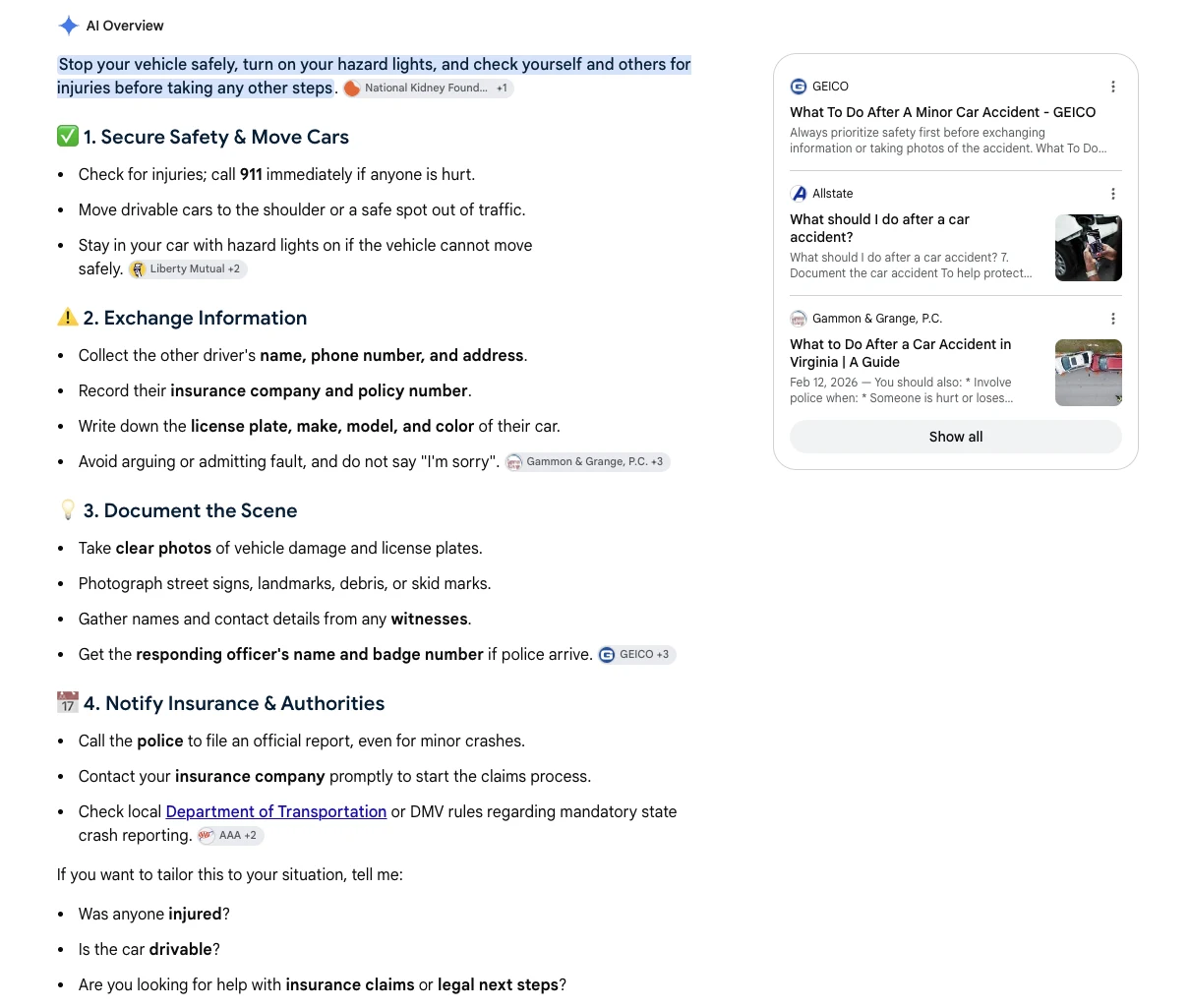
The second explanation is the AI layer. According to Search Engine Roundtable's September 2026 webmaster report, Google began pushing searchers from AI Overviews into AI Mode during the past month.
When a searcher gets an answer inside an AI surface, there may be no organic listing to click. And the searcher may never see your firm at all.
The example above answers "what to do after a car accident" in four steps. Its visible citations include insurers like GEICO, Allstate and Liberty Mutual.
Remember the flat click-through rate. CTR didn't drop. Impressions did.
That points to fewer searches reaching your listings, not fewer people clicking once they see you.
If you want your firm cited inside those AI answers, that's a separate discipline. We cover it in our guide to generative engine optimization for lawyers and in how law firms rank in ChatGPT.
What the Data Can't Tell Us Yet
✅ What we know
- Positions improved at all 8 firms
- Clicks fell 16% and impressions 17%
- The same weeks in 2025 went up
- Organic calls fell at two of three firms
❓ What we don't know
- Which explanation is doing more of the work
- Whether this is permanent
- Whether the September 24 spam update makes it better or worse
We know what moved. We don't know yet exactly why, or whether it lasts.
We'll update this post when the spam update finishes rolling out.
What Didn't Cause the Drop
Four events in five weeks
- Aug 18 to 21: August 2026 spam update (confirmed). Our firms' clicks rose 2%.
- Sep 3 to 13: Unconfirmed drop and reversal at large sites. Our firms ranked better that week.
- Sep 15 and Sep 22 to 23: Unconfirmed spikes. Our decline was already underway.
- Sep 24: September 2026 spam update (confirmed). Rollout just started.
September had four separate events. Most of them don't explain what happened to these firms.
Knowing which one hit you decides what you do next.
The August Spam Update: Clicks Held During the Rollout
During the August rollout, clicks went up.
According to the Google Search Status Dashboard ranking history, the August 2026 spam update ran from August 18 to 21.
We compared those four days against the same four weekdays one week earlier.
Clicks across the 8 firms rose 2%. Five of 8 firms gained clicks during the rollout.
The August spam update didn't cause this. The decline started the following week.
The September 4 Drop: It Didn't Show Up in Our Data
The week of Sep 4: position up, clicks barely moved.
According to Search Engine Roundtable's report on the September 4 drop, a number of large sites fell sharply around September 3 and 4, and some recovered completely on September 13.
Our firms didn't follow that pattern. In the week that included September 4, 7 of 8 firms had a better average position than the week before, and clicks slipped only 2%.
And there was no September 13 recovery for these firms, because there was no September 4 drop to recover from.
Rule of thumb: if clicks drop and position holds, check the calendar before you blame Google.
The September 15 and September 22 to 23 Spikes: Mixed So Far
Late September: no clear pattern yet.
Preliminary. Search Console's most recent days aren't final.
According to Search Engine Roundtable's September 15 report, chatter spiked that morning, with tracking tools starting to pick it up. According to Search Engine Roundtable's September 23 and 24 report, another round started around September 22 or 23.
Neither one explains our data. The decline was already underway by the week of September 7.
For September 22 and 23, clicks were down 9% against the same days a week earlier. Three of 8 firms were up.
Search Console's most recent days aren't final yet. Treat that number as preliminary.
What a Real Algorithmic Hit Looks Like
One firm outside PI: weekly clicks, indexed
One firm in our wider client group looked completely different. It sits outside personal injury, so it isn't in the numbers above.
Starting the week of September 7, its clicks fell about 80% over three weeks. Impressions fell about 60%. Average position slipped about 2 spots.
It didn't recover on September 13. It hasn't recovered since.
Visibility Problem vs. Real Hit
| Signal | The 8 PI firms | The outlier firm |
|---|---|---|
| Average position | Improved | Worse |
| Clicks | Down about 16% | Down about 80% |
| Timing | Gradual | Sharp, in one week |
| Recovery | Flat | None |
A real hit is sudden, deep, and comes with worse rankings.
A gradual click decline with better rankings is a visibility problem, not a penalty.
What the September Spam Update Could Change for Law Firms
❌ Violates Google's spam policies
- Paid links and link packages (link spam)
- Near-identical city pages (doorway abuse)
- Content mass-produced to rank (scaled content abuse)
✅ Holds up through updates
- Links you earned
- Practice pages that answer real questions
- Real reviews and local signals
Google hasn't said what this update targets. So don't believe anyone who tells you they know.
What Google has published is how spam updates work. According to Google Search Central's documentation on spam updates, sites affected by a spam update should review Google's spam policies, and changes may help over a period of months once Google's systems learn the site complies.
Two patterns are worth checking first.
Bought Links: The Benefit Doesn't Come Back
- Paid links
- Ranking boost
- Google removes their effect
- Benefit gone for good
Paid guest posts, link packages, private blog networks. If any of those are in your link profile, read this part twice.
According to Google's spam policies, buying links for ranking purposes, including paying for posts that contain links, is link spam.
Here's the part most firms miss. According to Google Search Central's documentation on spam updates, when Google removes the effect of spammy links, any ranking benefit those links generated is lost and can't be regained.
Cleaning up doesn't bring the rankings back. You have to rebuild with links you earned.
If you're not sure what a real link profile looks like for a firm, start with our guide to link building for lawyers.
Templated City Pages and Mass AI Content
❌ Templated city page
- Same text on every page
- Only the city name changes
- Nothing a local searcher can't get elsewhere
✅ Substantive location page
- Local courts and filing context
- Real cases and results from that area
- Local proof: office, reviews, community
The other pattern: 50 near-identical "[City] Car Accident Lawyer" pages with the city name swapped.
According to Google's spam policies, pages targeted at specific regions or cities that funnel users to one page are doorway abuse.
The same policies define scaled content abuse as generating many pages mainly to manipulate rankings, no matter how they're created. AI or human doesn't matter. Value to the reader does.
Ask yourself one question about every location page. If you deleted it, would a searcher in that city lose anything they can't get elsewhere?
If the answer is no, that page is a liability. Our content marketing for law firms guide covers what a page worth keeping looks like.
How to Check Your Own Firm in 15 Minutes
Four checks, in this order
- Position and clicks together: are you ranking worse, or being shown less?
- Year over year: is this normal for these weeks?
- The calendar: holidays, site changes, tracking changes.
- Calls and the map pack: which lead source actually dropped?
You don't need a rank tracker or an agency for the first read. You need Search Console and your call tracking.
Put Position and Clicks on the Same Chart
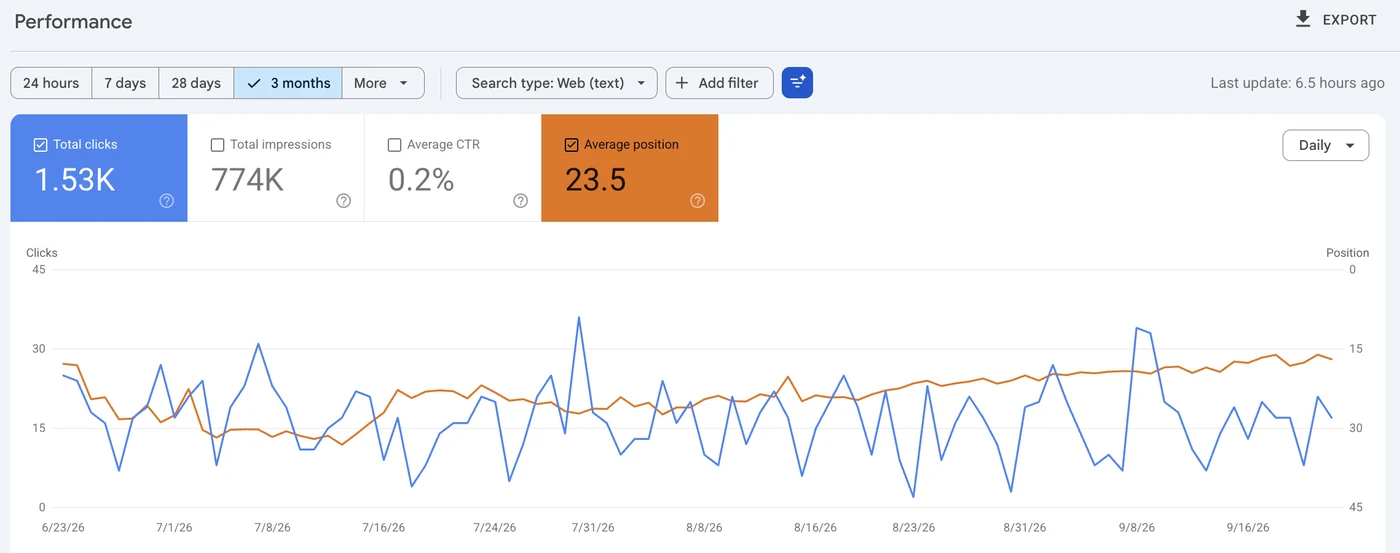
Open Search Console. Go to Performance, then Search results.
Turn on both Clicks and Average position. Set the range to the last three months.
Note that Search Console flips the position axis: 0 is at the top, so a rising orange line means a better position.
If position is flat or better and clicks are down, you're looking at a visibility or demand problem. If position fell off a cliff on one date, you're looking at a possible hit.
Compare Against the Same Weeks Last Year
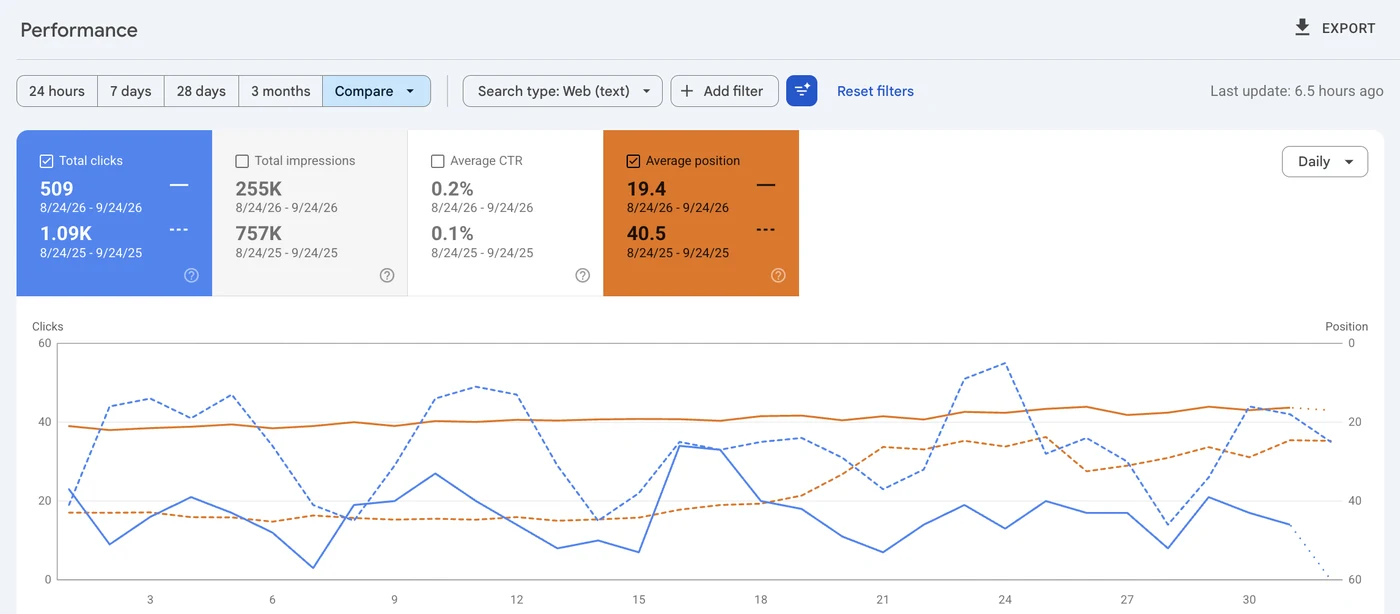
Use the date filter's Compare tab. Compare a recent period with the same dates last year. Solid lines are this year; dashed lines are last year.
This one step would have told our 8 firms that September 2026 wasn't normal. Their clicks rose in the same weeks of 2025.
Compare clicks, not impressions. In our data, 2025 impression counts for these weeks swung wildly while clicks rose steadily, so impressions made a poor year-over-year baseline.
Check the Calendar Before You Blame Google
Rule these out first
- A holiday or holiday weekend in the window
- A site change, redesign, or migration
- A tracking change: new call tracking numbers, a broken tag
- A partial week compared against a full week
- The last 2 to 3 days of Search Console data, which aren't final
Before you blame an algorithm, rule out everything on that list.
This year, Labor Day fell on September 7, inside our call comparison window. We flag it in the methodology for exactly that reason.
Check Calls and the Map Pack Separately
| Week (2026) | Business Profile call clicks | Website clicks | Direction requests |
|---|---|---|---|
| Aug 17 to 23 | baseline | baseline | baseline |
| Aug 24 to 30 | −6% | −14% | −1% |
| Aug 31 to Sep 6 | −9% | −25% | +11% |
| Sep 7 to 13 | −18% | −20% | −13% |
| Sep 14 to 20 | +3% | +3% | −9% |
Organic results, the map pack and ads are three different systems. They don't move together.
Our data shows it. For the seven PI firms with connected Google Business Profiles, map pack activity dipped over Labor Day and then came back.
The map pack recovered. Organic didn't.
If your organic calls are down, check your Business Profile calls before you assume the whole firm is down. Our guide to local SEO for attorneys covers what drives map pack rankings, and how to get more lawyer reviews covers the fastest lever you control.
What Fewer Organic Calls Costs a PI Firm in Signed Cases
| If half the lost callers were real leads | If all of them were | |
|---|---|---|
| Lost callers per firm, per month | about 13 | about 13 |
| Lost leads per firm, per month | about 6.5 | about 13 |
| Lost signed cases per firm, per month | about 1.6 | about 3.3 |
| Paid spend to replace them, per month, at a $3,000 target per signed case | about $4,900 | about $9,800 |
Across the three firms, first-time organic callers fell by 18 in two weeks compared with the late-August window.
That's about 3 fewer new callers per firm, per week.
Not every caller is a case lead. So the math above uses two assumptions, both built on our planning numbers: 25% of real leads become signed cases, and a target of roughly $3,000 per signed case if you replace them with paid.
That $3,000 is a planning target, not a guaranteed cost.
Even the low end is a real number for most PI firms. Roughly one and a half signed cases a month, gone, while the rank report says you're up.
If you need to cover the gap while organic sorts itself out, PPC for law firms and Google Local Services Ads are the fastest levers. Just watch lead quality; our breakdown of junk leads from Google Ads explains how to avoid paying for calls that never sign.
What to Do During the Rollout (and What Not to Touch)
✅ Do this week
- Export your Search Console baseline
- Mark the key dates
- Audit links you or a vendor paid for
- Score your templated city pages
- Check call tracking attribution
- Keep the map pack active
❌ Don't do this week
- Rewrite top practice pages
- Mass-delete content
- Make sitewide changes mid-rollout
The rollout may take up to two weeks. Here's how to use them.
✅ Do this week:
- Export your Search Console baseline now. Daily clicks, impressions and position for the last 90 days. You'll want a clean before-and-after.
- Mark the dates. August 18 to 21, September 4 to 7, September 15, September 22 to 24.
- Audit your link profile for anything you or a past vendor paid for.
- List your templated location pages and score each one on the delete test above.
- Check your call tracking. Make sure every number is still attributed to the right source. Two of the firms in our sample had to be excluded because their organic call tracking wasn't consistent across years.
- Keep the map pack active. Reviews, posts, accurate hours. Our local SEO for attorneys guide has the checklist.
❌ Don't do this week:
- Don't rewrite your top practice pages because a tracker spiked.
- Don't mass-delete content before you know what the update did.
- Don't make sitewide changes mid-rollout. You'll never know what caused what.
The September 4 episode is the best argument for patience. According to Search Engine Roundtable, some sites that dropped hard recovered completely nine days later.
Anyone who "fixed" their site in between got credit for nothing, and may have broken something real.
If You Were Hit: What Recovery Actually Looks Like
- Fix the violation
weeks - Google re-evaluates
months - Possible recovery
Link spam: the lost value doesn't return. Plan to earn new links.
If your data looks like our outlier firm (sudden, deep, with worse rankings starting on a specific date), treat it as a possible hit.
Check the Manual Actions report in Search Console too. Spam updates are automated, so a manual action is a separate problem with a separate fix.
Recovery from a spam update is slow by design. According to Google Search Central's documentation on spam updates, improvements can help as Google's systems learn over a period of months that a site complies with its policies.
That means three things for you:
- Fix the actual violation, not everything at once.
- Plan in months, not weeks. Cover lead flow with paid or the map pack in the meantime.
- If the problem was bought links, the lost value is gone. Budget to earn new links, not just remove old ones. Start with our guide to link building for lawyers.
Also This Week: Google Is Testing AI That Can Call Your Intake Line
- User asks Gemini
- Dials from user's number
- Phone tree + hold
- Talks to your intake
The user watches a live transcript and can take over at any time.
On the same day as the spam update, Google started testing an AI feature that calls businesses for you.
Clicks are one way potential clients reach you. Soon, some calls may come from an AI speaking for them.
What "Call for Me" Does
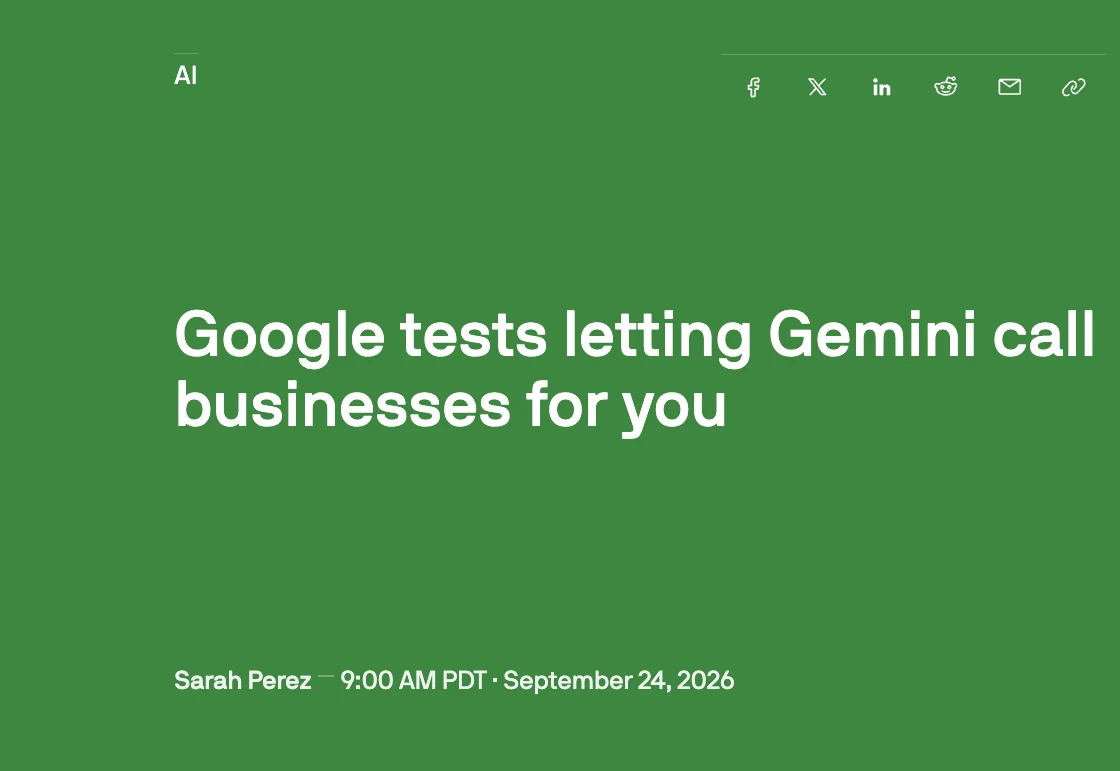
According to TechCrunch's report on Google's Call for Me test, the feature is starting with U.S. Pixel 11 owners who pay for a Gemini subscription, and it requires the beta version of Google's Phone app.
The same report says Gemini can introduce itself, navigate automated phone menus, wait on hold and handle the conversation. It can also share personal information the user has approved.
The user can follow the call through a live transcript and take over at any time. The call comes from the user's own phone number.
Google says it's starting small. This isn't an emergency. It's a heads-up.
What It Means for Your Intake Process
Five questions for your intake team
- Scripts: do we ask for a callback with the actual person?
- Phone tree: what does an AI caller experience?
- Attribution: these calls will most likely log like any other lead
- Facts: confirm details directly before any case evaluation
- Scale: watch it, don't rebuild around it yet
- Scripts. If an AI calls on behalf of an injured person, does your intake person know to ask for a callback with the actual person?
- Phone tree. An AI can get through your menu and wait on hold. A bad experience still reflects on your firm.
- Attribution. Because the call comes from the user's own number, your call tracking will most likely log it like any other lead.
- Facts. Details relayed through an AI should be confirmed directly with the person before any case evaluation.
- Scale. Watch for it. Don't rebuild intake around it yet.
If intake is already where you lose cases, fix that first. Our guide to personal injury lead generation covers what happens after the phone rings.
Is the Core Update Still Coming?
Days between confirmed core updates
Nobody outside Google knows. The September 24 update is a spam update, not a core update.
According to the Google Search Status Dashboard ranking history, the last two core updates started on March 27, 2026 and May 21, 2026. Nothing has been confirmed since.
Many SEOs are expecting one. According to Search Engine Roundtable's September 23 and 24 report, some are asking whether this month's unconfirmed volatility is a preview.
The gaps between core updates range from about one month to more than five. There's no schedule to plan around.
What you can plan around is how Google treats the volatility before an announcement. According to Search Engine Journal's report on update timing, Google's John Mueller said Google doesn't roll updates out before announcing them and tries to announce as close to launch as possible.
So movement before an announcement is something else. Don't blame the next core update for what happened this month.
How to Build a Law Firm Site That Spam Updates Don't Touch
Spam updates enforce Google's spam policies. According to Google Search Central, sites that violate them may rank lower or not appear at all. The most reliable protection is not violating them.
- Earned links. From local press, bar associations, community work and real relationships. See link building for lawyers.
- Practice pages that answer real questions. Built for the person who just got hurt, not for a keyword. See our personal injury lawyer SEO guide.
- Real reviews and local signals. They're the core of your map pack presence, which held up in our data when organic didn't. See how to get more lawyer reviews.
- Content AI answers can cite. With more searches ending in AI surfaces, being the cited source matters. See GEO for lawyers.
None of that is new. That's the point. The full playbook is in our law firm SEO guide.
How We Ran This Analysis
| Item | Detail |
|---|---|
| Sample | 8 personal injury law firms managed by WEBRIS with complete Search Console data in both 2025 and 2026, anonymized as Firms A to H |
| Search data | Google Search Console, web search, pulled directly from each property |
| Weekly windows | Monday to Sunday weeks, Aug 17 to Sep 20, 2026 |
| Average position | Weekly value is the average of each day's Search Console average position |
| Year over year | Same calendar weeks, Aug 18 to Sep 21, 2025, for all 8 firms |
| Spam update check | Aug 18 to 21, 2026 vs. Aug 11 to 14, 2026 (same weekdays) |
| Call data | First-time inbound calls attributed to Google organic, the three firms in the sample with consistent tracking |
| Map pack data | Google Business Profile call clicks, website clicks and direction requests, the seven firms in the sample with connected profiles |
| Outlier | One firm outside personal injury, reported separately and excluded from PI totals |
Limitations:
- The call sample is small: 36 to 105 calls per window across three firms. It shows direction, not precision.
- Labor Day (September 7) falls inside the 2026 post-period for calls, which biases 2026 slightly downward.
- Average position is sensitive to query mix, as explained above. It's a signal, not a score.
- Search Console data for the most recent 2 to 3 days isn't final.
- Business Profile impressions for the latest week were incomplete at the time of analysis and weren't used.
- Two firms were excluded from the call analysis because their organic call tracking wasn't consistent across both years.
- Three firms were excluded from every analysis: one because its Search Console property has no 2025 data, one because its connected Search Console property captures only part of its site, and one because it is a family law firm, not personal injury.
- This is correlation across a set of firms. It doesn't prove what Google changed.