Your website ranks.
Your SEO report is full of green arrows.
And your phones are quieter than they were two years ago.
The plan most law firms are still running was built for a Google that doesn't exist anymore.
In the first four months of 2026, 68% of US Google searches ended without a click. AI answers now name firms before anyone reaches a website. And your next client might watch a TikTok, ask ChatGPT and call from the map pack, all in the same afternoon.
I put together a deck on what's actually happening in search, and what I'd do about it if I owned a law firm going into 2027. Click through it below. Then the rest of this post walks through every slide, with the data behind it and the exact plan.
What Should a Law Firm Marketing Plan Look Like in 2027?
| Move | Channels | Its job |
|---|---|---|
| 1. Blended search | Local Services Ads, Google Ads, map pack, organic and AI answers | Own every spot on the results page when someone needs a lawyer now |
| 2. Social, organic and paid | Paid social, organic video, retargeting | Reach people before they search, and stay in front of them after |
| 3. Brand | Reviews, content, press, out-of-home | Become the firm clients, referral sources and AI already trust |
| Measurement | Call tracking and one report | Cost per signed case, by channel |
A law firm marketing plan for 2027 has three moves and one number.
The three moves:
- Move to blended search. Show up in every spot on the results page, not just the organic listings.
- Attack social, organic and paid. Reach people before they ever type a search.
- Build a moat with your brand. Reviews, content and press, so Google, ChatGPT and clients all land on your name.
The one number is cost per signed case, by channel. Not rankings. Not traffic. Not leads.
Here's the short version of why: search didn't die. It split into a dozen places. A plan that only covers one of them is a plan for a shrinking slice of your market.
Why Did the SEO-Only Plan Stop Working?
Share of US Google searches that end without a click
The SEO-only plan stopped working because most searches no longer send anyone to a website.
A zero-click search is a search where the person gets what they need on Google itself and never clicks through to a site.
According to SparkToro's 2026 zero-click study, 68.01% of US Google searches ended without a click from January through April 2026. That's up from 60.45% in 2024, and from about 45% in 2016.
Read that again. Two out of three searches never leave Google.
I get why SEO was the default plan. It had four things going for it:
- You could hand it off completely. A flat retainer, no videos, nothing to manage.
- Leads compounded. SEO leads grew over time while cost per case dropped.
- It was the easiest place to start. Build the site, show up when people search.
- A little ego. Ranking first says you're the best firm in town.
None of that is wrong. It's just that the clicks the whole model depended on are disappearing.
If you want the deeper SEO breakdown, I covered it in does SEO still work for lawyers.
What Did AI Overviews Do to Law Firm Clicks?
Click-through rate on searches that show an AI Overview
When an AI Overview shows up, both organic and paid clicks drop hard.
An AI Overview is the AI-written summary Google puts above the regular results for some searches.
According to Search Engine Land's report on a 3,119-query study, organic click-through rate on searches with an AI Overview fell 61%, from 1.76% to 0.61%, between June 2024 and September 2025. Paid click-through rate on the same searches fell 68%, from 19.7% to 6.34%.
Notice the second number. This isn't just an SEO problem. Your ads lose clicks too.
The cleanest proof comes from a randomized experiment. In Agarwal and Sen's 2026 field study of more than 1,000 US Chrome users, AI Overviews cut outbound organic clicks by about 39.8% on the searches where they appeared.
And the clicks didn't go somewhere better. According to Pew Research Center, users clicked a link inside the AI summary on just 1% of visits in March 2025.
Which legal searches get hit, and which don't, is covered in what law firm content still works with AI Overviews.
Where Do People Look for a Lawyer Now?
Consumers who used each source to find or vet a local business in the past year
People look for a lawyer in five places now: AI search, Google, local results, directories and social.
- AI search: ChatGPT, Perplexity, Gemini
- Google: organic results, Google Ads, AI Overviews
- Local: Local Services Ads and Google Maps
- Directories: Avvo, Yelp, FindLaw, Justia, Super Lawyers
- Social: TikTok, Instagram, YouTube, Facebook
The shift happened fast. According to BrightLocal's 2026 Local Consumer Review Survey, 45% of US consumers used AI tools for local business recommendations in the past year, up from 6% the year before.
Over the same period, the share who used Google to read local reviews fell from 83% to 71%.
Legal clients follow the same pattern. According to Clio's 2026 Legal Trends Report, 46% of US adults said they would consult AI before contacting a lawyer.
All in on traditional SEO? Your share of voice is now a sliver of where people actually look.
Where Is Search Going Next?
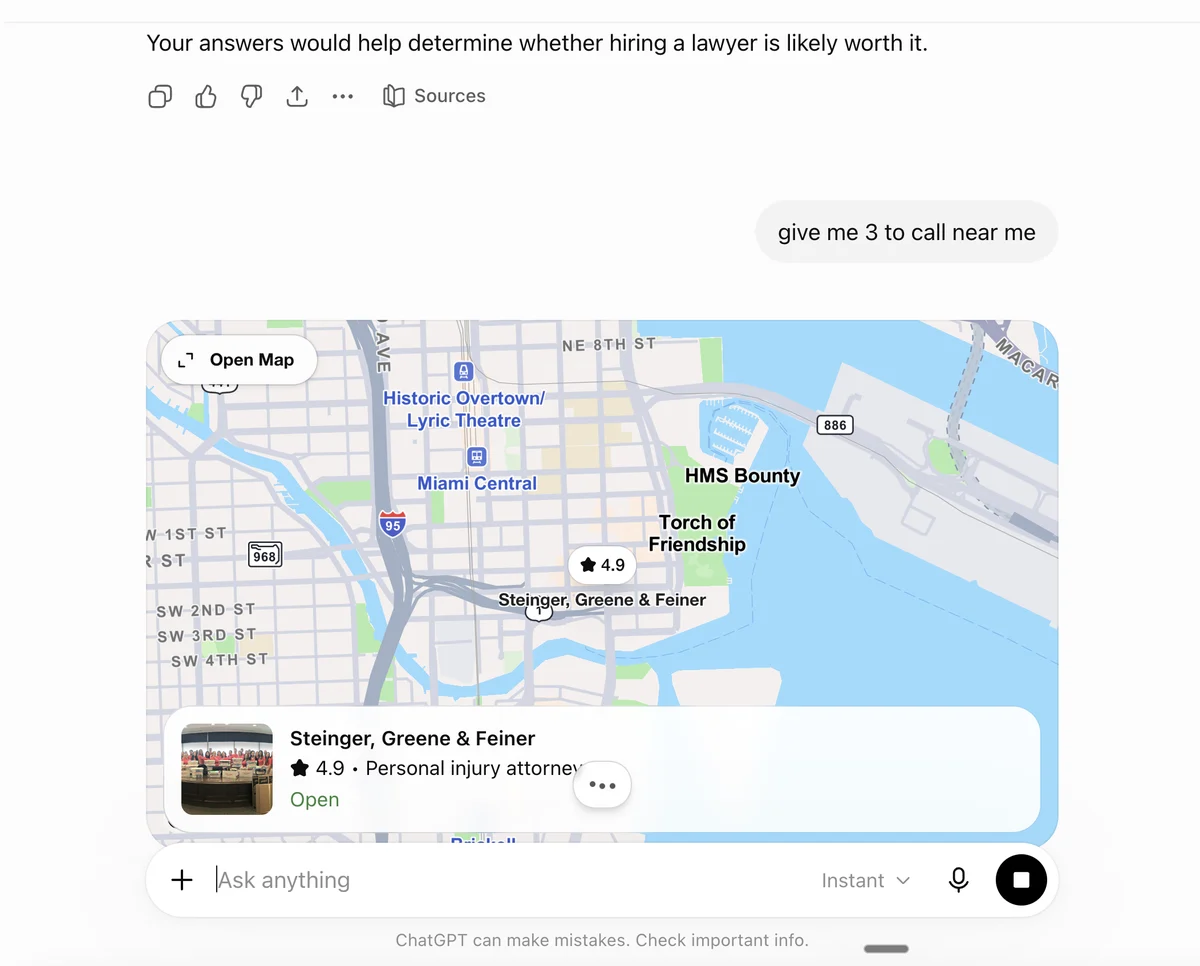
Search is turning into a conversation, and the AI picks the names.
ChatGPT is already huge. OpenAI said ChatGPT reached 900 million weekly active users in February 2026, according to TechCrunch.
But almost nobody clicks through. In a leaked OpenAI file covered by MarTech, one top-performing page had 610,775 link impressions and 4,238 clicks. That's a 0.69% click-through rate.
Look at the screenshot above. The person asked for three lawyers to call. ChatGPT gave them a map, a star rating and a phone-ready card.
There's no list of ten blue links to rank in. There's a short list of names.
Here's where it goes from here:
- AI Mode answers in a chat on Google itself. No results page to rank on.
- AI agents will shortlist firms and book the consultation for the client.
- The AI picks the names. If it doesn't trust your firm, you're not on the list.
How ChatGPT decides which firms make that list is broken down in 6 ChatGPT ranking factors for lawyers.
Why Rankings Are the Wrong Number to Report
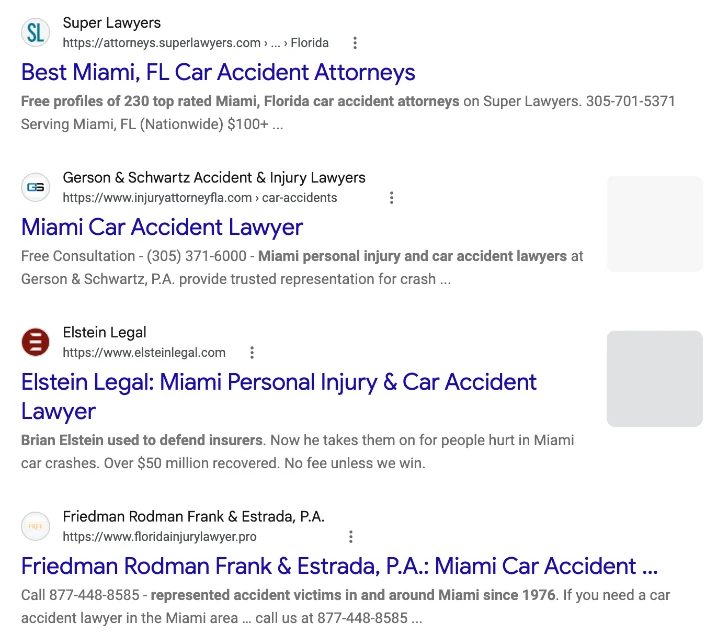
If your agency is still reporting rankings, they don't know what they're doing.
A keyword with 5,000 searches a month means nothing when most of those searches never reach a website.
I searched "car accident lawyer miami" on desktop on November 20, 2026. Before the first organic result, Google showed:
- Local Services Ads
- A sponsored Google Ad with extra sitelinks
- A map pack, topped by another sponsored listing
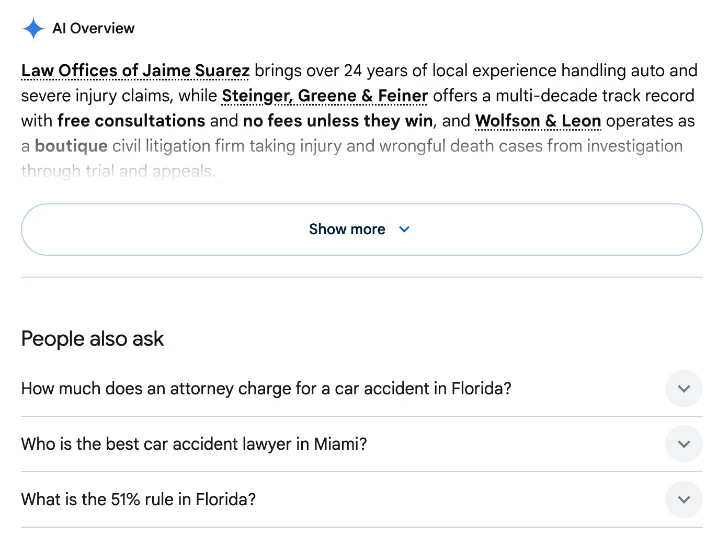
- An AI Overview that named three firms
- A People Also Ask box
The first organic result started about 2,500 pixels down the page. That's roughly three full screens of scrolling. And it was Super Lawyers, a directory, not a law firm.
"Number one" in that report was really number six on the page.
An agency reporting rankings is building your campaign around the wrong numbers, and optimizing for traffic that no longer exists. If your SEO looks great on paper and your caseload says otherwise, start with why your law firm's SEO isn't working.
Did People Stop Searching for Lawyers?
Google searches per year, worldwide
No. People are searching more than ever. The clicks moved, not the demand.
Google now handles more than 5 trillion searches a year, according to Search Engine Land's report on Google's 2025 figure. In 2016, the last time Google shared a number, it was more than 2 trillion.
That's the silver lining. Searches more than doubled.
People are still in car accidents. They still get hurt at work. They still need a lawyer.
They just find that lawyer on the map, in an AI answer, in a Facebook feed or in a review before they ever see your homepage.
The demand is still there. You just have to show up where it is now.
Move 1: Blended Search
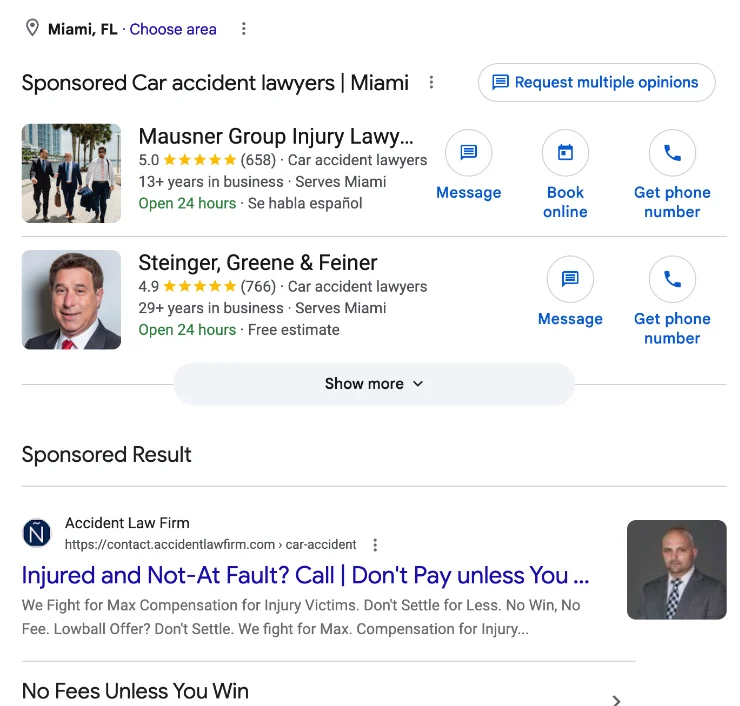
Blended search means running every search channel together, so your firm shows up in every spot on the page instead of one.
When someone searches for a lawyer right now, they're the most valuable person in your market. Blended search makes sure they see you no matter where they look.
Here's what it covers:
- Local Services Ads: verification, reviews and disputing bad leads. See the Local Services Ads guide for lawyers.
- Google Ads on the high-intent keywords that sign cases. See Google Ads for lawyers.
- Map pack: Business Profile, categories and a steady flow of new reviews. See the local SEO guide for attorneys.
- Organic and AI answers: pages built to get cited, not just ranked. See GEO for lawyers.
- Call tracking and one report: cost per signed case by channel.
Why Run Every Search Channel at Once?
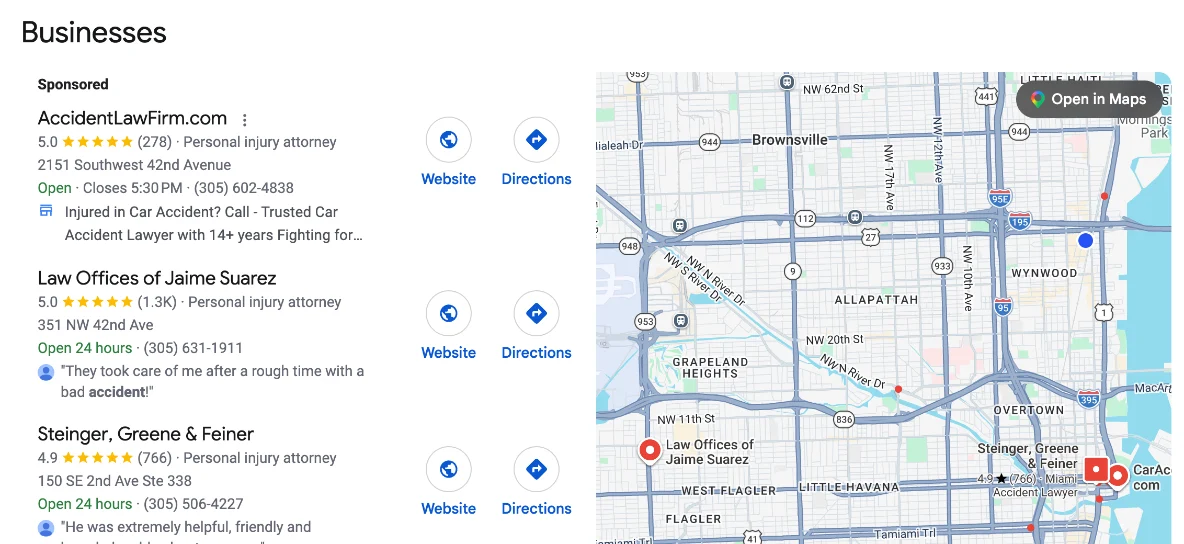
Because each channel covers a different spot, and the firms that win show up in more than one.
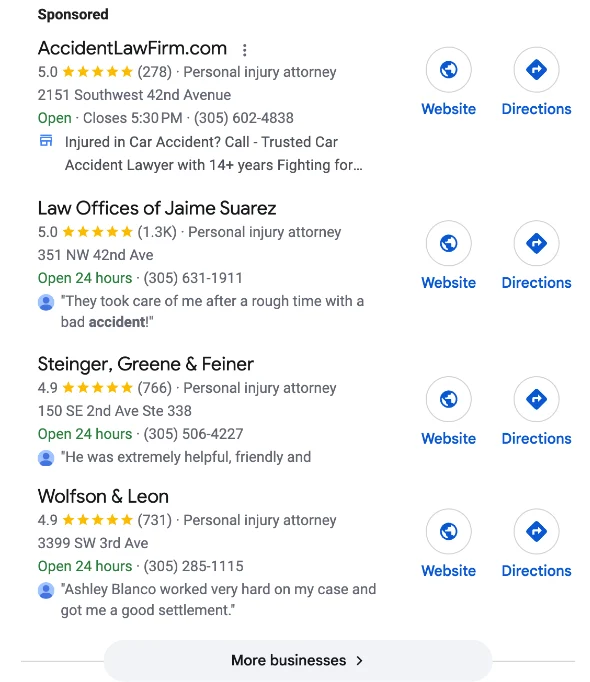
Look at the screenshots. Steinger, Greene & Feiner shows up in the Local Services Ads, again in the map pack, and again in the AI Overview further down.
That's not luck. That's three channels working together.
It's also why blended search is more stable. If an AI Overview takes clicks from organic, your ads and map pack still catch the caller. If click prices spike, organic and the map pack carry more of the load.
I'll be honest: it's more work than a flat SEO retainer. But it matches how the page actually looks now.
Move 2: Social, Organic and Paid
Move 2 reaches people before they ever search, and keeps you in front of them after.
Search only catches people once they decide to look. Social puts your face in front of them first.
The audience is there. According to Pew Research Center's 2025 social media survey of 5,022 US adults, 84% use YouTube, 71% use Facebook, 50% use Instagram and 37% use TikTok.
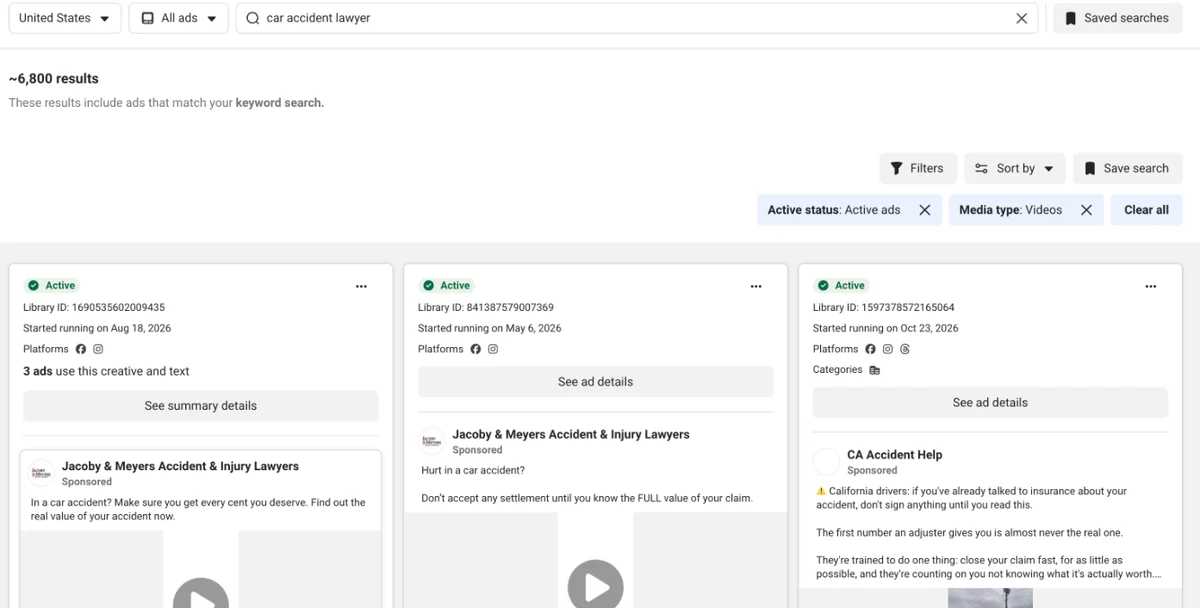
And your competitors already know it. When I searched Meta's Ad Library for active US video ads matching "car accident lawyer," it returned about 6,800 results.
Here's what Move 2 covers:
- Paid social puts your firm in front of people in your market before they need a lawyer.
- Organic video answers the questions clients ask, in your attorneys' own voices.
- Retargeting keeps you in front of everyone who visits your site or watches your videos.
- Signed-case data goes back into the ad platforms, so they find more people like your best clients.
I know what you're thinking. "I tried Facebook ads and got junk leads." That's almost always a creative and targeting problem, not a channel problem. I break that down in Facebook ads for lawyers.
Move 3: Build a Brand Moat
What consumers expect from reviews before choosing a business
For a law firm, brand is reputation, credibility, expertise and authority. It's built four ways:
- Content: real client questions, answered in your attorneys' own voices.
- Press: real coverage in local news and legal publications.
- Reviews: as many as you can get, every month.
- Out-of-home: billboards, sponsorships and local events.
Every one of them feeds the others. A billboard drives branded searches.
Branded searches lead to reviews. Reviews feed the map pack and AI answers.
Why Are Reviews the New Referral?
Reviews decide who gets found and who gets the call.
The bar keeps rising. According to BrightLocal's 2026 survey, 41% of consumers always read reviews before choosing a business, up from 29% a year earlier. And 31% will only use a business rated 4.5 stars or higher, up from 17%.
Reviews do three jobs:
- Discovery. Reviews help decide who shows up in the map pack, in AI answers and in legal directories. No reviews, no visibility.
- Decision. Once you're found, clients compare star rating, volume and how recent your reviews are. 74% look for reviews written in the past three months.
- Diversity. Not just Google. Get reviewed on Avvo, FindLaw, Justia, Martindale and Yelp, so clients and AI see the same proof everywhere.
The system for getting reviews every month is in how to get more reviews for your law firm.
Why Does Brand Win in AI Search?
AI recommends the names it already trusts.
Look at the AI Overview above. It didn't summarize a blog post. It named three firms, and all three have hundreds of reviews and show up across the page.
Being named pays off. According to the same Seer Interactive study reported by Search Engine Land, brands cited in an AI Overview earned 35% more organic clicks and 91% more paid clicks than brands that weren't cited.
One caveat from the researchers: they can't prove the citation causes the extra clicks. Stronger brands may simply be more likely to get cited.
Either way, the answer is the same. Be the brand AI is comfortable naming.
Why Is Brand So Hard to Invest In?
| Brand signal | Where to find it | What it tells you |
|---|---|---|
| Branded searches | Google Search Console | How many people search for your firm by name |
| Review count and rating | Google Business Profile, Avvo, Yelp | Whether you clear the 4.5-star bar clients now expect |
| Direct and referral calls | Call tracking | How many cases start with your name, not a search |
| AI mentions | Manual prompts in ChatGPT and AI Mode | Whether AI names your firm for your core searches |
Brand is the most important thing nobody in legal marketing truly understands.
It's a hard investment to make. A billboard or a press hit doesn't show a direct return the way a click does.
But as AI decides which firms get named, brand is the one advantage a competitor can't buy overnight.
You can track it. Watch branded searches, review count and rating, direct and referral calls, and cost per signed case across every channel.
How Do You Measure a Law Firm Marketing Plan?
| Stop reporting | Start reporting |
|---|---|
| Keyword rankings | Signed cases by channel |
| Website traffic | Cost per signed case by channel |
| Impressions and clicks | Qualified calls and forms, by source |
| Leads | Lead-to-signed-case rate |
| Cost per lead | Branded search and review growth |
Measure it by cost per signed case, by channel.
Everything else is a step on the way there. Clicks don't pay your rent. Rankings don't sign retainers.
To get the number, you need three things:
- Call tracking on every channel, so each call is tied to its source.
- Your intake data showing which calls became signed cases.
- One report that puts spend and signed cases side by side for every channel.
Then you can finally answer the only question that matters: where is my next dollar best spent?
You can build that report yourself in an afternoon. Here's how in build a law firm marketing scorecard with Claude or ChatGPT.
Your 2027 Law Firm Marketing Plan Template
| Channel | Move | Monthly work | What to track |
|---|---|---|---|
| Local Services Ads | Blended search | Keep verification current, respond fast, dispute bad leads | Cost per signed case |
| Google Ads | Blended search | Bid on high-intent case keywords, cut the rest | Cost per signed case |
| Map pack | Blended search | Business Profile updates, steady new reviews | Calls from the profile, review count and rating |
| Organic and AI answers | Blended search | Practice pages and specific posts built to get cited | Signed cases from organic, AI mentions |
| Paid social | Social | Run attorney video ads, retarget site visitors | Cost per signed case |
| Organic video | Social | Answer one client question per video | Views, embeds on practice pages |
| Reviews | Brand | Ask every closed client, on more than one site | New reviews per month, rating |
| Press and out-of-home | Brand | Local news, legal publications, sponsorships | Branded searches, direct calls |
Copy this table into a spreadsheet and you have the skeleton of your 2027 plan.
Add two columns: a monthly budget and an owner for each row. Then build your report around the last column.
Here's how I'd sequence it:
- Start with tracking. You can't move budget to what works if you can't see what works.
- Turn on blended search. It catches the people who need a lawyer today.
- Layer in social. It fills the top of the funnel for next month's cases.
- Build brand every month. Reviews first, because they help every other channel.
Every quarter, look at cost per signed case by channel. Move money toward the channels that sign cases cheapest, and fix or cut the rest.
For a ranked look at individual tactics inside each move, see 11 marketing strategies for lawyers.