
"We got leads. They were all tire kickers."
That's what I hear from almost every firm that tried Meta ads and quit.
I get it. But the leads weren't junk because Facebook doesn't work for lawyers.
They were junk because Facebook was told to find junk.
Meta ads are the best channel we run for law firms right now. We're signing personal injury cases on Meta for under $2,000 each.
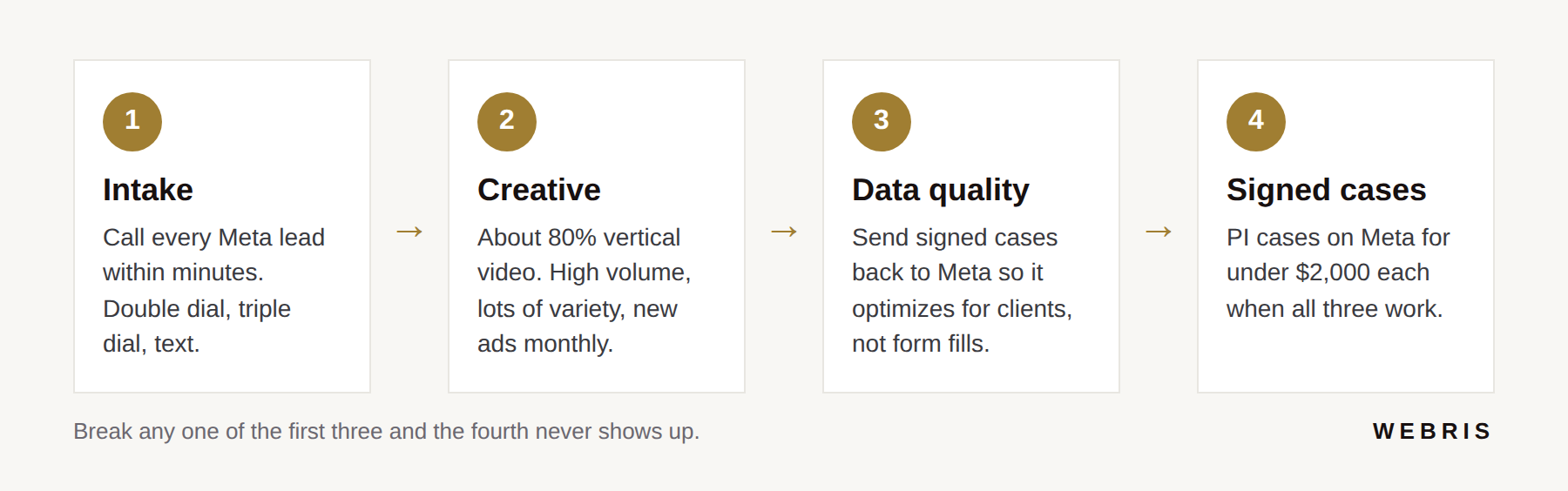
Getting there comes down to three things. Intake, creative, and data quality.
The reason your leads were bad is number three. I'm saving it for last because it only makes sense once you've seen the first two.
Why Do Meta Ads Leads Look Like Tire Kickers?
Meta ads send tire kickers when the campaign is optimizing for form fills instead of signed cases. Form fills are easy to get. Clients aren't.
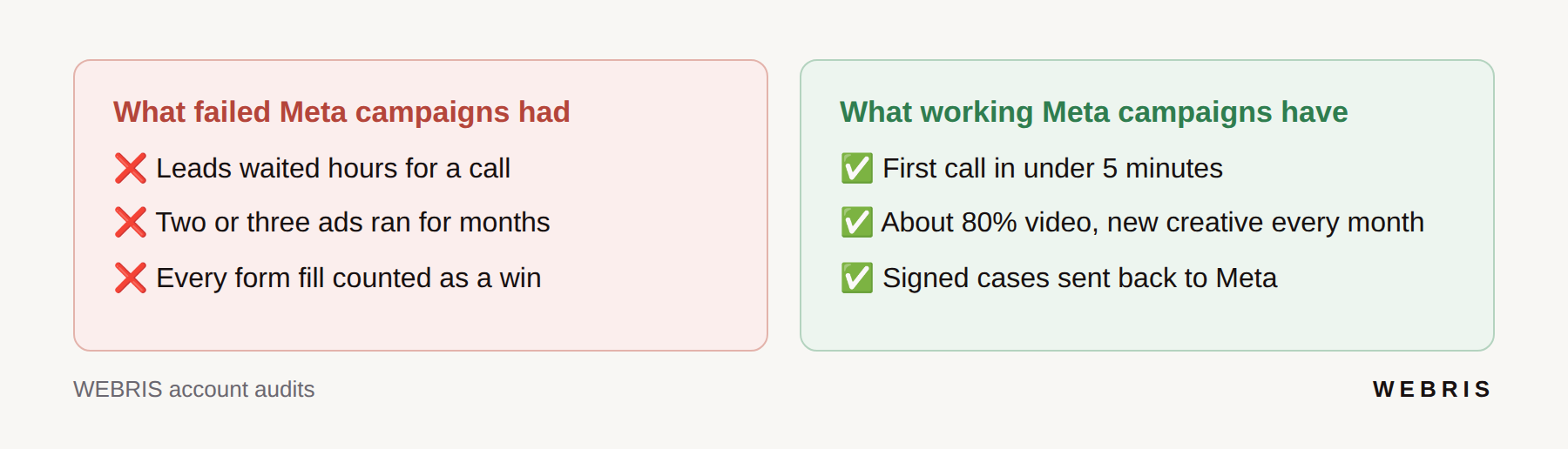
Most firms that quit Meta had some mix of these three problems:
- ❌ Leads sat for hours before anyone called
- ❌ Two or three ads ran for months
- ❌ The campaign counted every form fill as a win
Fix all three and the same platform starts sending cases.
It's the same thing we see on the search side, and I covered it in why Google Ads generate junk leads. Different platform, same root cause. If you want the version that covers every channel, read why law firms get bad leads.
Key #1: Intake Is About Speed To Contact, Not Your Script
Intake on Meta leads comes down to one number: how fast you get the person on the phone. Scripts matter less than you think.
Every firm owner I talk to swears their intake is dialed in. Then we audit it.
The problem is almost never how convincing or empathetic your team is on the call. It's how long the lead waited before the call happened.
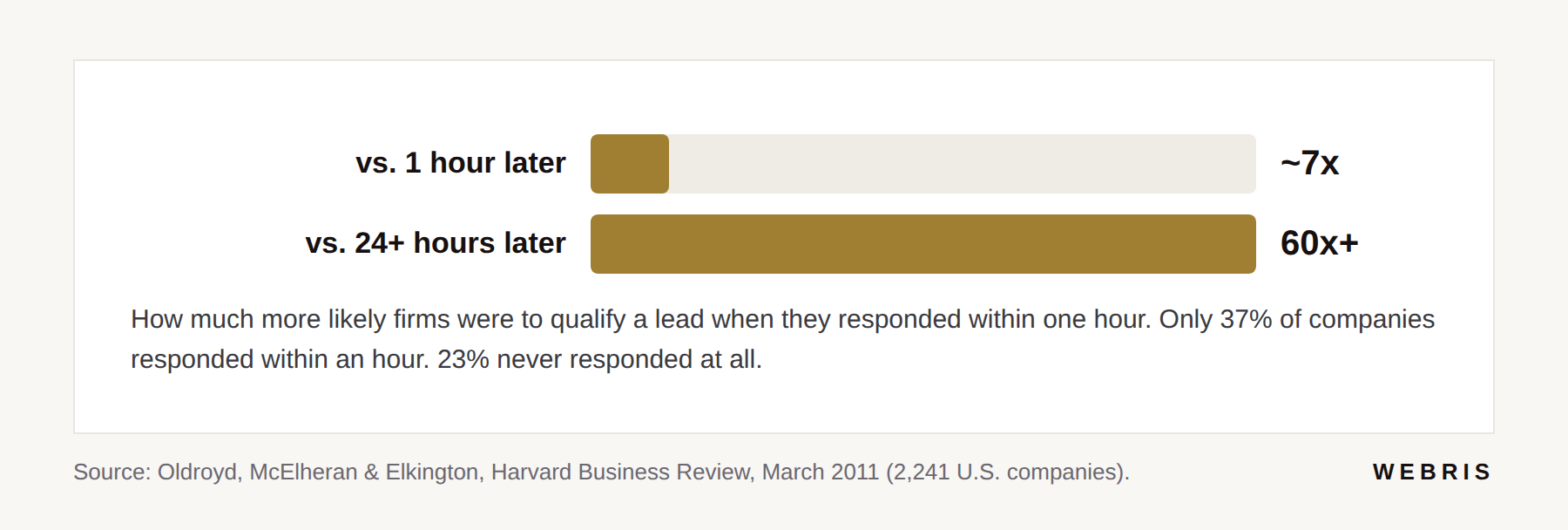
The best data on this is still a Harvard Business Review audit of 2,241 U.S. companies. According to HBR's study of online lead response, firms that responded within an hour were nearly 7 times as likely to qualify the lead as firms that waited even one more hour.
Firms that responded within an hour were more than 60 times as likely to qualify the lead as firms that waited 24 hours or longer.
Only 37% of companies responded within an hour. 23% never responded at all.
Read that again. Nearly a quarter of businesses paid for a lead and never called it.
Why Meta Leads Are Chase Leads
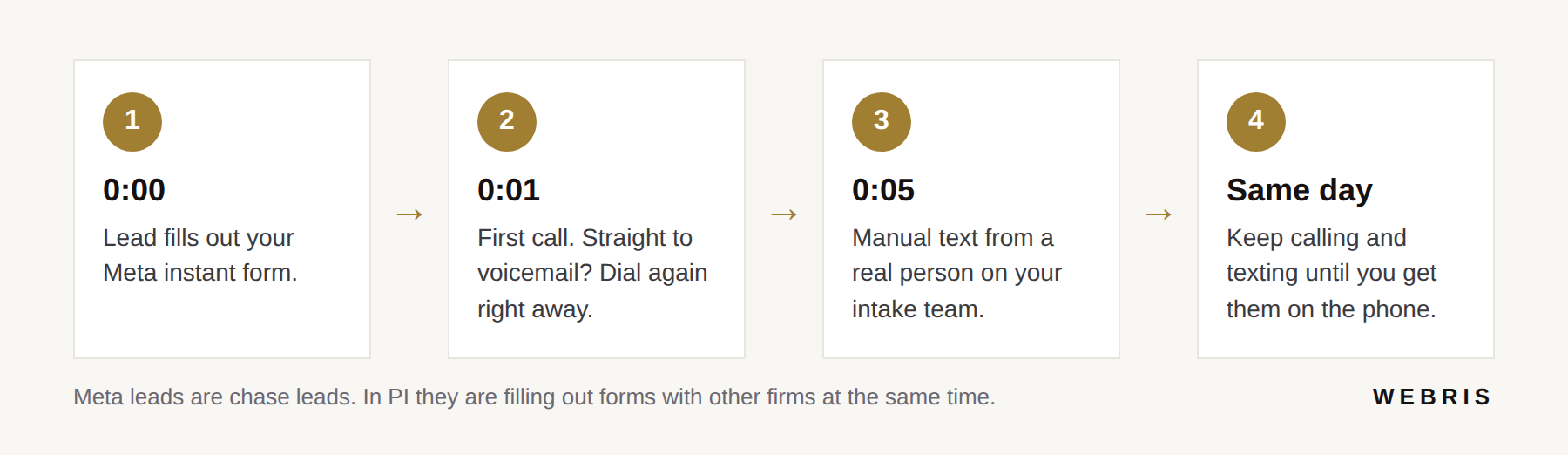
A chase lead is a lead that filled out a form instead of calling you. Your team has to chase it down.
Google is mostly a phone call platform. Someone searches "car accident lawyer," taps call, and they're talking to you.
Meta is a form platform. Someone watches your video, fills out a form, and goes back to scrolling.
In personal injury they're filling out forms with two or three other firms too. Whoever calls first usually signs the case.
That puts the weight on your intake team:
- Call within 5 minutes. One minute is better.
- Double dial. Then triple dial.
- Send a manual text if they don't pick up.
- Keep trying until you get them on the phone.
We break down the full intake process in our personal injury intake guide.
What A Speed-To-Contact Cadence Looks Like
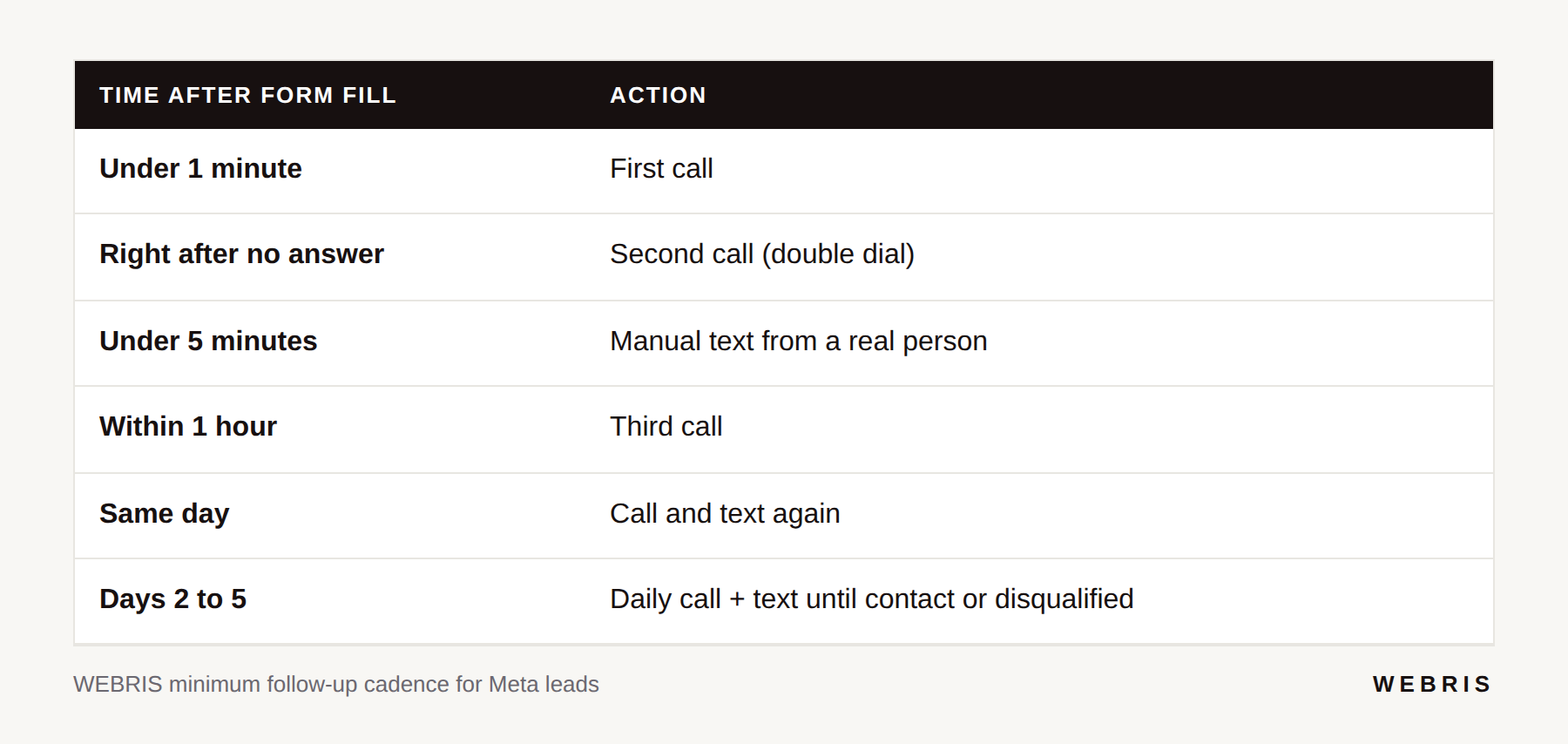
Here's the minimum cadence we set up for a Meta lead:
| Time after form fill | Action |
|---|---|
| Under 1 minute | First call |
| Right after no answer | Second call (double dial) |
| Under 5 minutes | Manual text from a real person |
| Within 1 hour | Third call |
| Same day | Call and text again |
| Days 2 to 5 | Daily call + text until contact or disqualified |
Lead generation and intake is a 50/50 relationship. You can't get signed cases with only one of them working.
That's why we run intake audits on every account. If a firm doesn't have a CRM, we roll out our own intake software. More on how intake fits into acquisition in our lead generation for lawyers guide.
Key #2: Creative Volume And Creative Variance
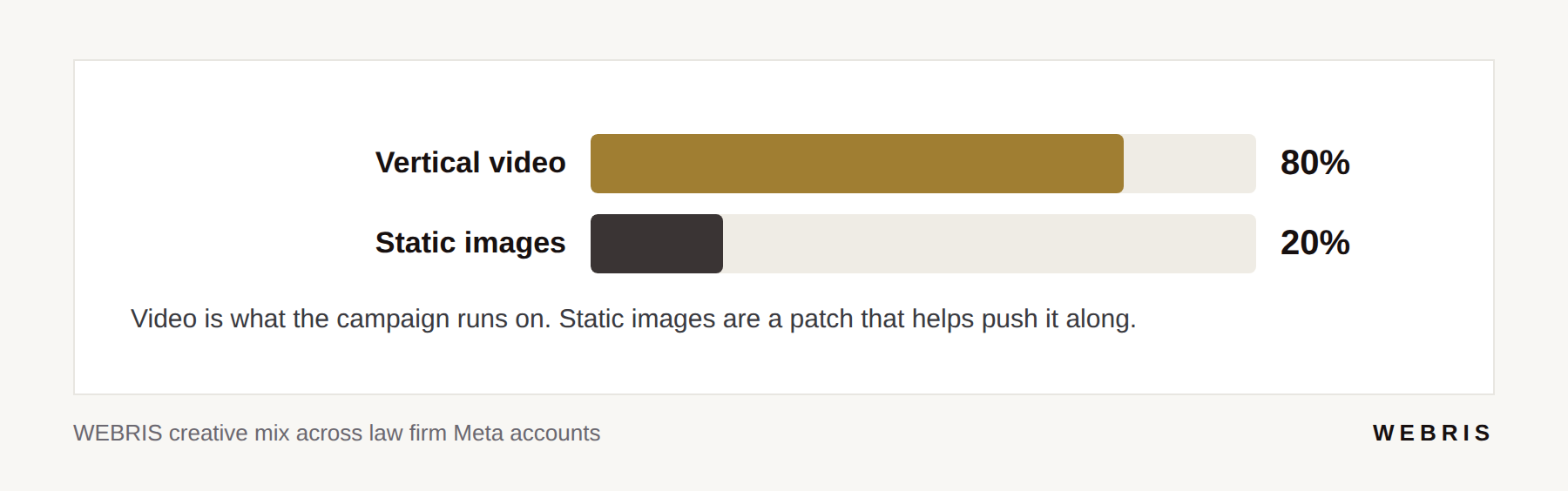
Creative is the actual ads: the videos and images. On Meta, how much creative you run and how different each piece is decides who sees your ads.
We run about 80% video and 20% static images.
Static images work as a patch. They help push a campaign along. Video is what the campaign runs on.
What A Meta Ad For A Law Firm Actually Looks Like
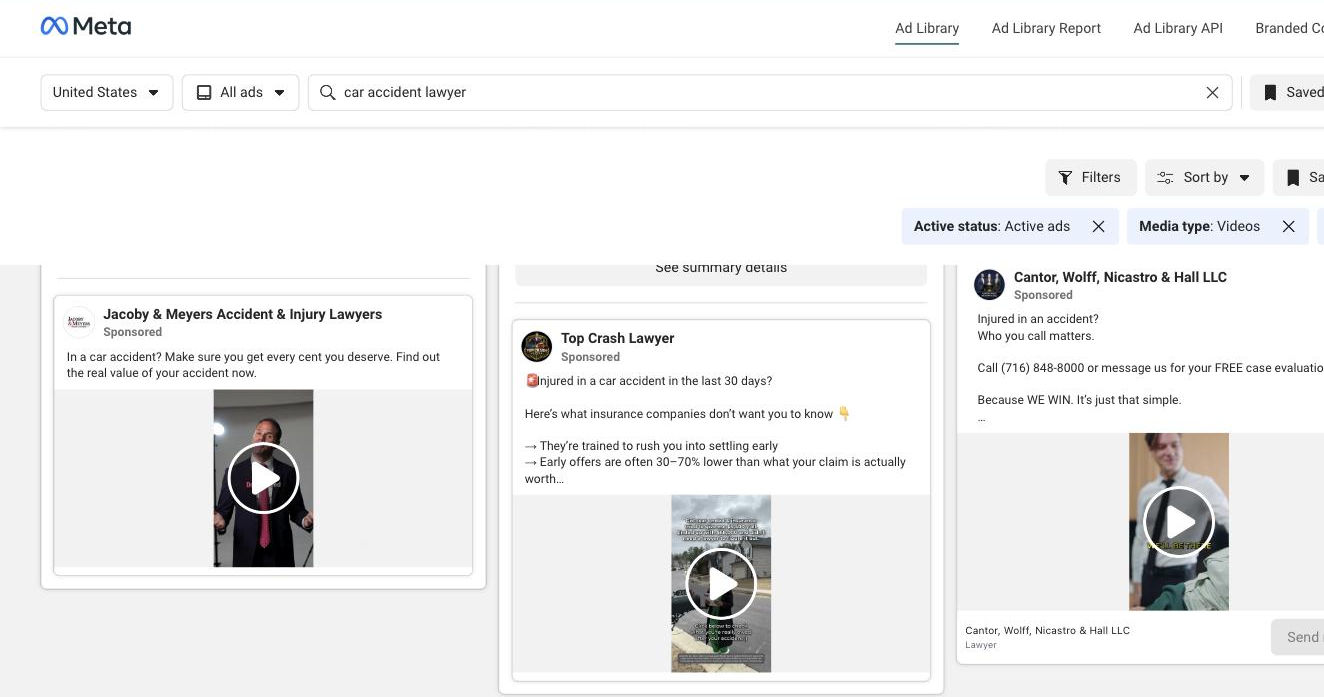
A lot of firms pay a big agency serious money for one or two polished videos for their website. Those aren't social media ads.
Here's the difference:
Website video
- ❌ One or two long, horizontal brand videos
- ❌ Same script, same office, same angle
- ❌ Built for your homepage
Social media ad
- ✅ Vertical video, 60 seconds or less
- ✅ Lots of script types (FAQ, "did you know," story, myth-busting)
- ✅ Different shots and locations
- ✅ New ads going in every month
Want to see what works? We pulled real ones in lawyer Facebook ad examples. The full breakdown of how we build them is on our Facebook ads for lawyers page.
Why Facebook Needs So Much Creative
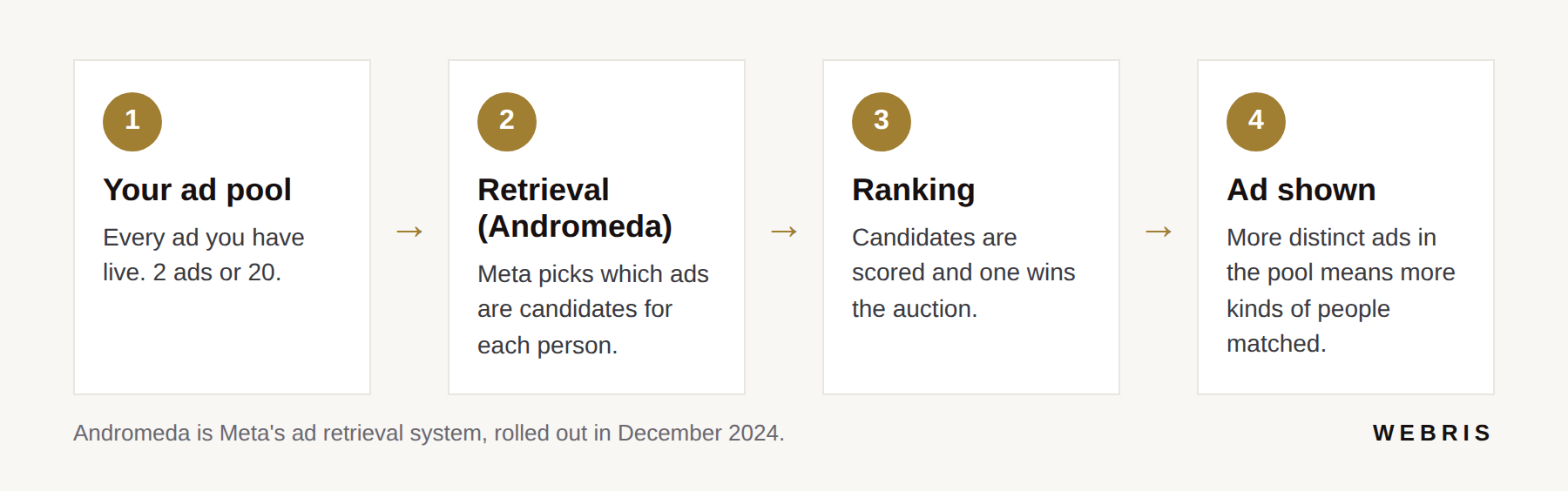
Facebook eats creative. You need a lot of it before Meta understands who you want to reach.
I live in Miami. Everything here is stucco. I painted my shed recently and that thing ate paint. Coat after coat.
Meta is the same with creative.
There's a mechanism behind it. Meta's ad retrieval system is called Andromeda. It's the stage that picks which ads out of the millions available are candidates to show each person.
According to Meta's engineering team, Andromeda rolled out in December 2024. Meta reported a 6% improvement in retrieval recall and an 8% improvement in ad quality on selected segments.
Here's our read on what that means for you. Andromeda matches individual ads to individual people. Every truly different ad is another shot at matching another kind of person.
Two ads give the system two options. Twenty different ads give it twenty.
This is where most firms, and most businesses, fail. They put up a couple of ads, get nothing, and say it didn't work.
You didn't test enough. You didn't feed it enough.
Why You Can't Target "People Who Need A Lawyer"
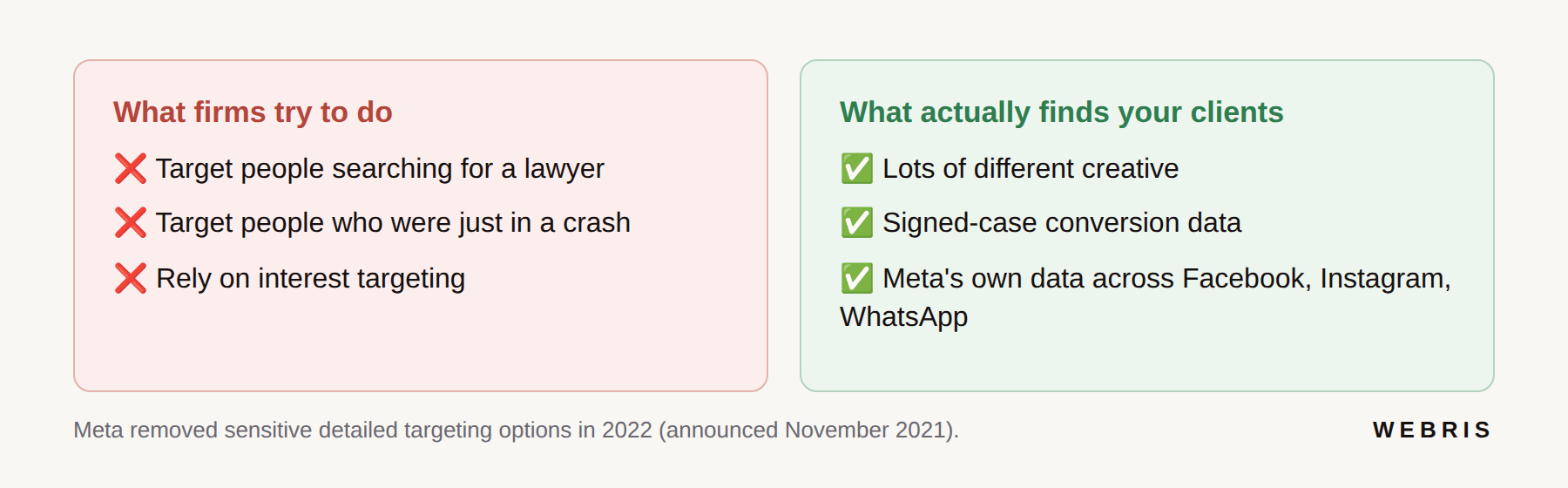
I hear this on sales calls all the time. "We couldn't target people looking for car accident help."
You can't. And you shouldn't try.
Meta can't let you target someone because they're looking for a lawyer. Meta has spent years pulling back sensitive targeting under legal and regulatory pressure.
In November 2021, Meta announced it would remove detailed targeting options tied to sensitive topics like health, religion, and politics, per NBC News.
So Meta finds your audience a different way. It uses two signals:
- Your creative. Who watches, who stops scrolling, who engages.
- Your conversion data. Who actually turns into what you told Meta you want.
Meta runs Facebook, Instagram, and WhatsApp. Pretty much everyone in the country has one of those apps. Meta has the data. You just have to give it the right signals.
More on what you can and can't do in Facebook ads targeting for lawyers.
That's why creative volume matters. And it's why number three is the one that makes or breaks you.
Key #3: Data Quality (The Real Reason Your Leads Were Junk)
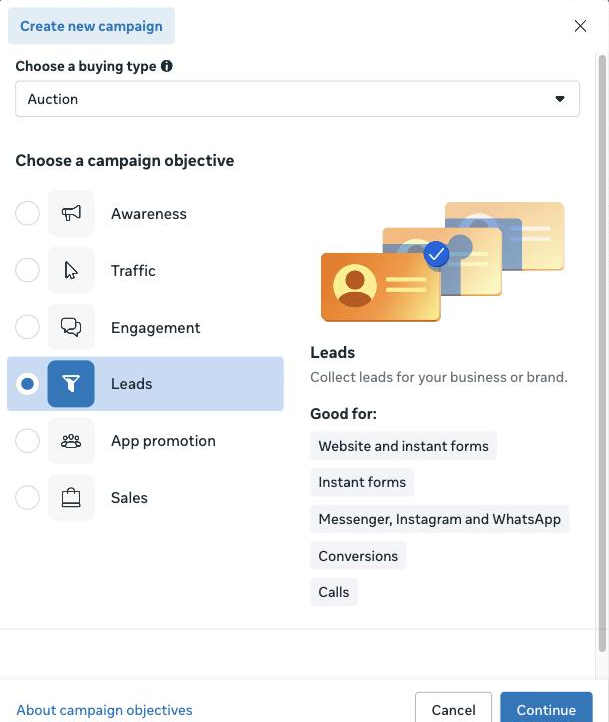
Data quality means telling Meta which leads became signed cases, not just which leads filled out a form. This is the #1 reason past Meta campaigns fail for law firms.
When you set up a Meta campaign, you pick an objective. Awareness, traffic, leads, and so on.
You should pick leads. That part's fine.
The problem is stopping there. Meta optimizes for whatever data you give it. If the only thing you ever report back is form fills, Meta goes and finds you more form fills.
What Happens When You Optimize For Form Fills
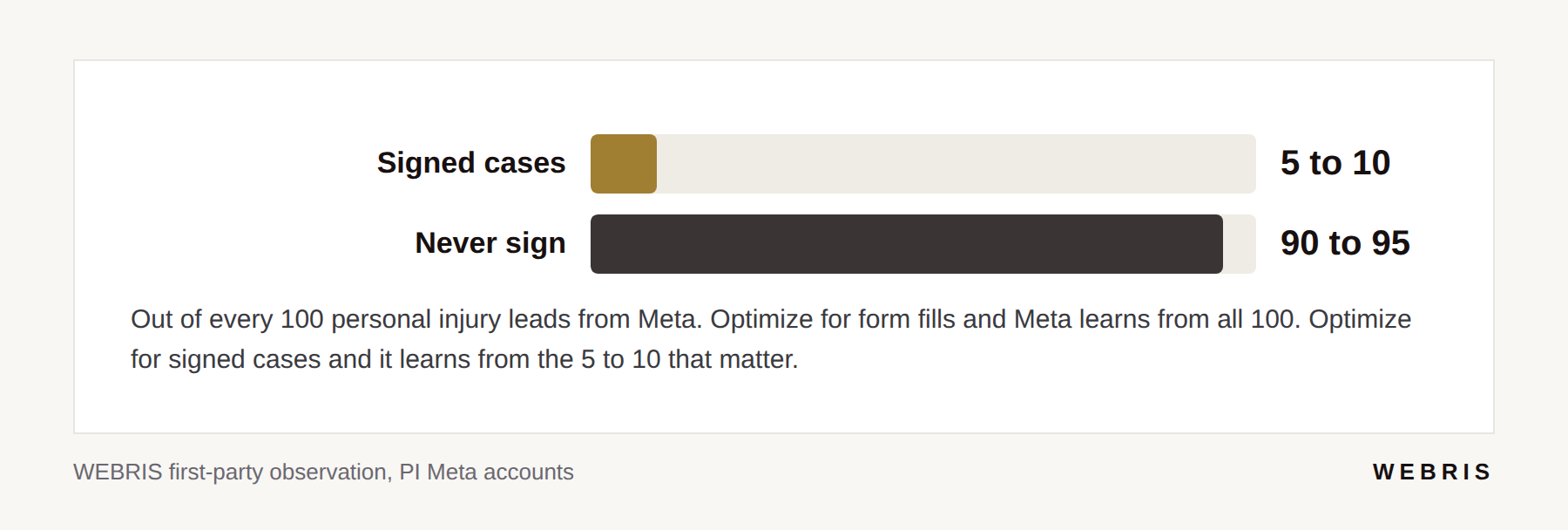
In personal injury, expect roughly 5% to 10% of Meta leads to become signed cases. That's what we see across our accounts.
There's a lot of garbage in this space. It is what it is.
Here's what that does to your campaign:
| If you tell Meta success is... | Meta learns from... | Meta finds more of... |
|---|---|---|
| A form fill | All 100 leads, including 90+ that never sign | People who fill out forms |
| A signed case | The 5 to 10 who actually signed | People who look like your clients |
If 90% of your leads are garbage and you tell Meta every one of them was a win, Meta keeps sending garbage.
That's why you got bad leads before. Nobody took the extra step of feeding the signed cases back.
How To Feed Signed Cases Back To Meta
This part gets a little technical. It's where our data engineers spend most of their time.
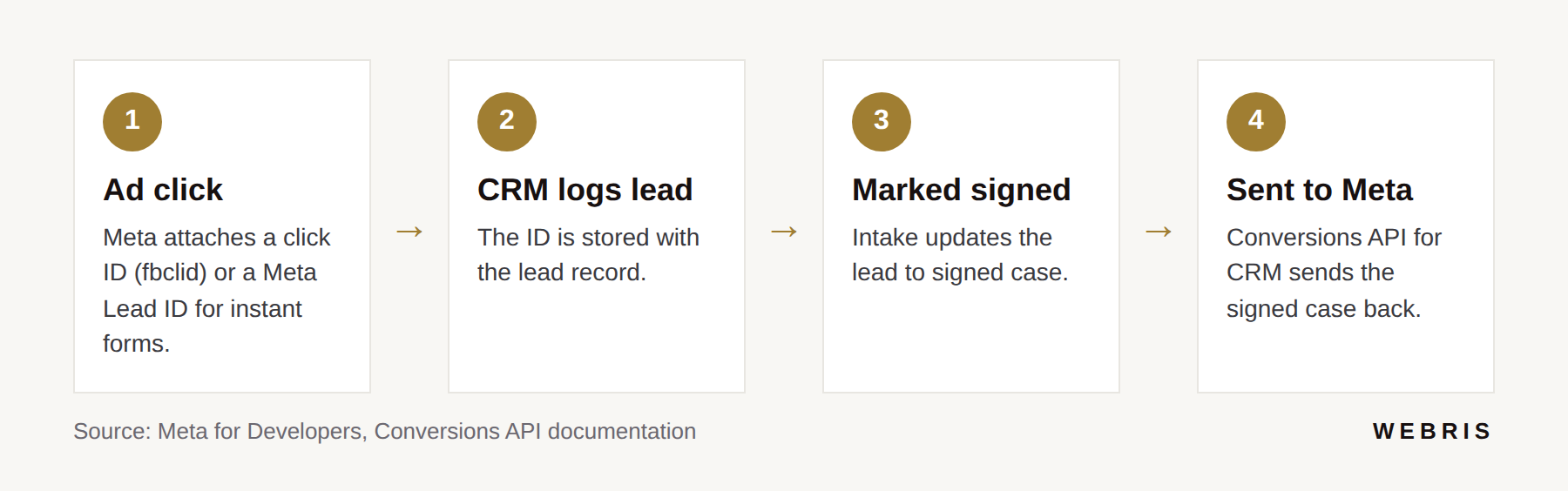
Step 1: Track every lead after it leaves Facebook. You need a CRM. At the bare, bare minimum, a spreadsheet where every lead and its outcome gets logged. Here's how to set up lead tracking for your firm, and what to look for in a personal injury CRM.
Step 2: Keep Meta's identifier with the lead. When someone clicks your ad, Meta attaches a click ID (the fbclid parameter) to the landing page URL, according to Meta's developer documentation. Leads from Meta's instant forms get a Meta Lead ID instead.
Step 3: Mark the lead as a signed case in your CRM when it signs.
Step 4: Send that signed case back to Meta. Meta's tool for this is the Conversions API for CRM. We then set up a signed-case conversion for the campaign to optimize toward.
Now Meta knows exactly who you want.
What Meta Requires To Optimize For Signed Cases
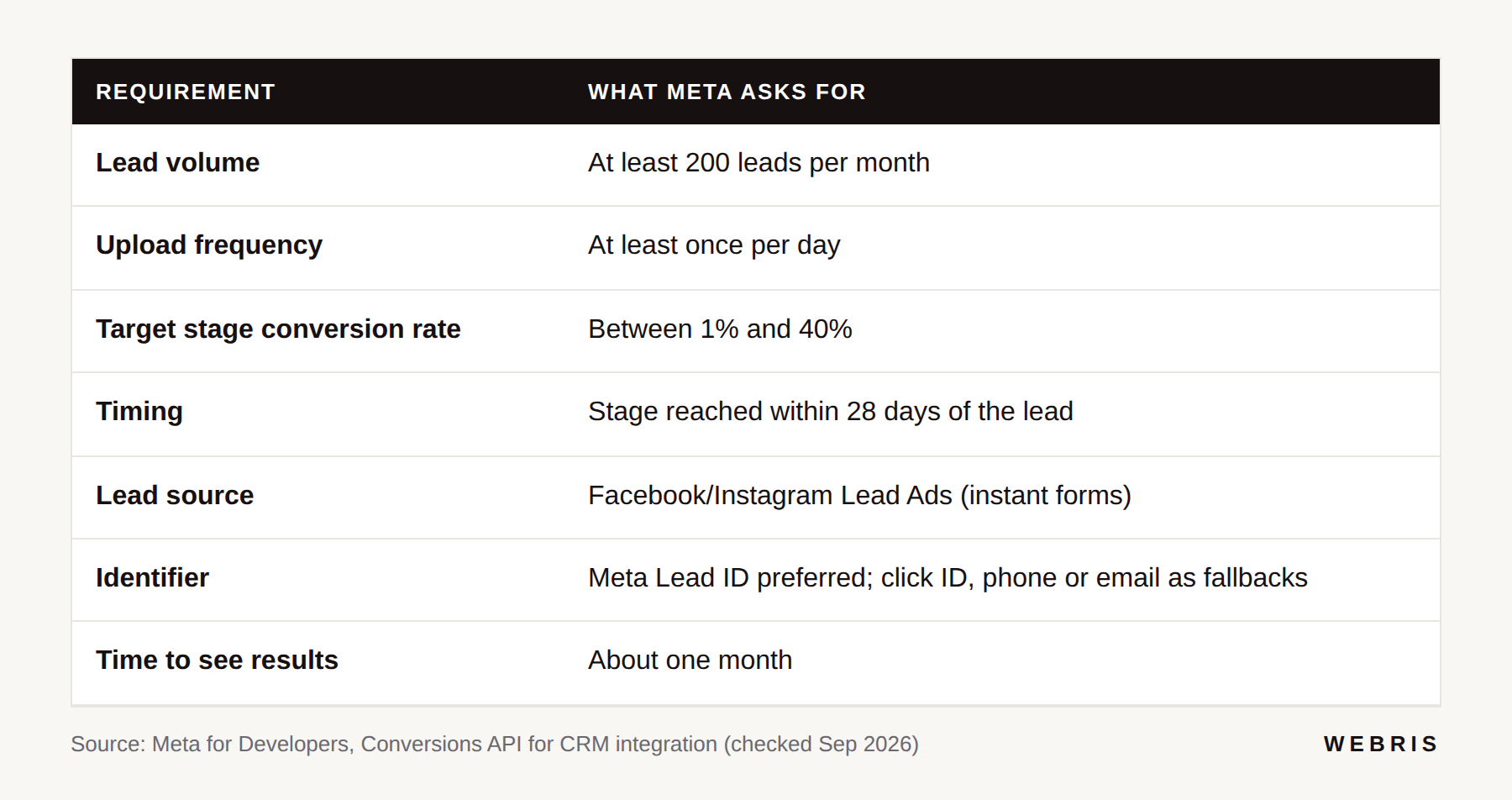
Meta has specific requirements for its CRM integration. Per Meta's Conversions API for CRM documentation, checked September 2026:
| Requirement | What Meta asks for |
|---|---|
| Lead volume | At least 200 leads per month |
| Upload frequency | At least once per day |
| Target stage conversion rate | Between 1% and 40% |
| Timing | Stage reached within 28 days of the lead |
| Lead source | Facebook/Instagram Lead Ads (instant forms) |
| Identifier | Meta Lead ID preferred; click ID, phone or email as fallbacks |
| Time to see results | About one month, per Meta |
A PI firm converting 5% to 10% of leads fits easily inside Meta's 1% to 40% range.
I'll be honest: the 200-leads-per-month bar is real. Smaller budgets may need to optimize for an earlier stage first, like qualified lead or consult booked, then move to signed cases as volume grows.
Why Uploading Your Client List Doesn't Work Anymore
People ask me this all the time. "Can't I just upload my client list and target people like them?"
Back in the day you could. I've been doing this for almost 20 years.
You'd upload a CSV of names and emails. Facebook matched them to users. You could show ads to exactly those 100 people.
Those days are gone. Meta is under so much fire for data privacy that it pulled way back.
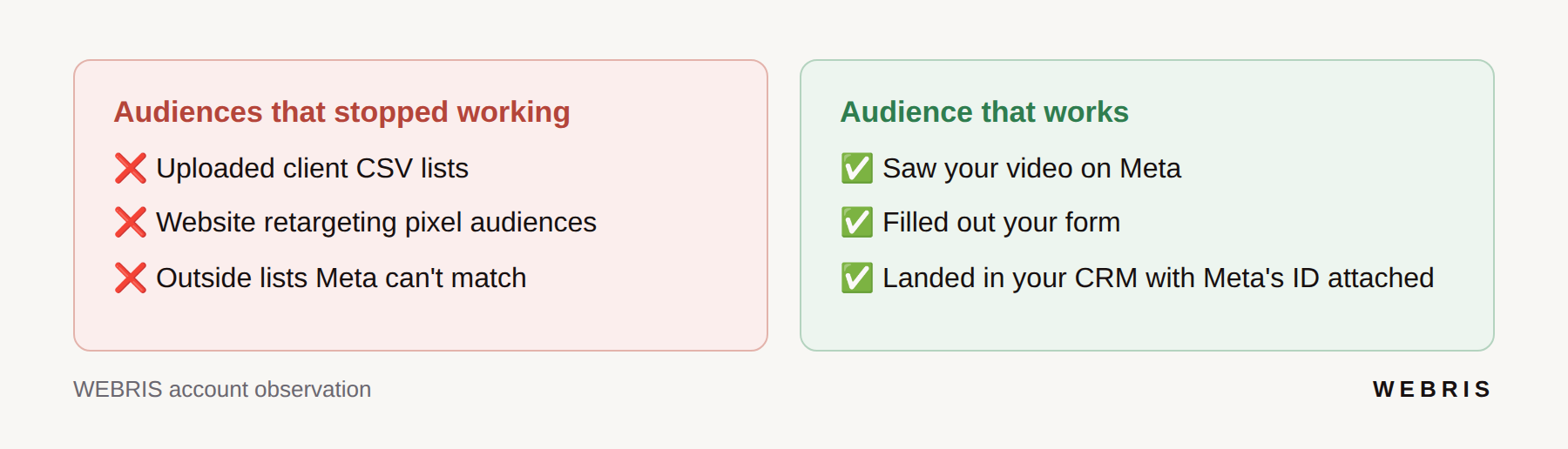
In our accounts, outside lists and website retargeting audiences barely move signed cases anymore. Meta can't match them the way it used to.
The audience that works is one you build inside Meta: they saw your video, filled out your form, and landed in your CRM with Meta's ID attached.
The Data Quality Loop, Start To Finish
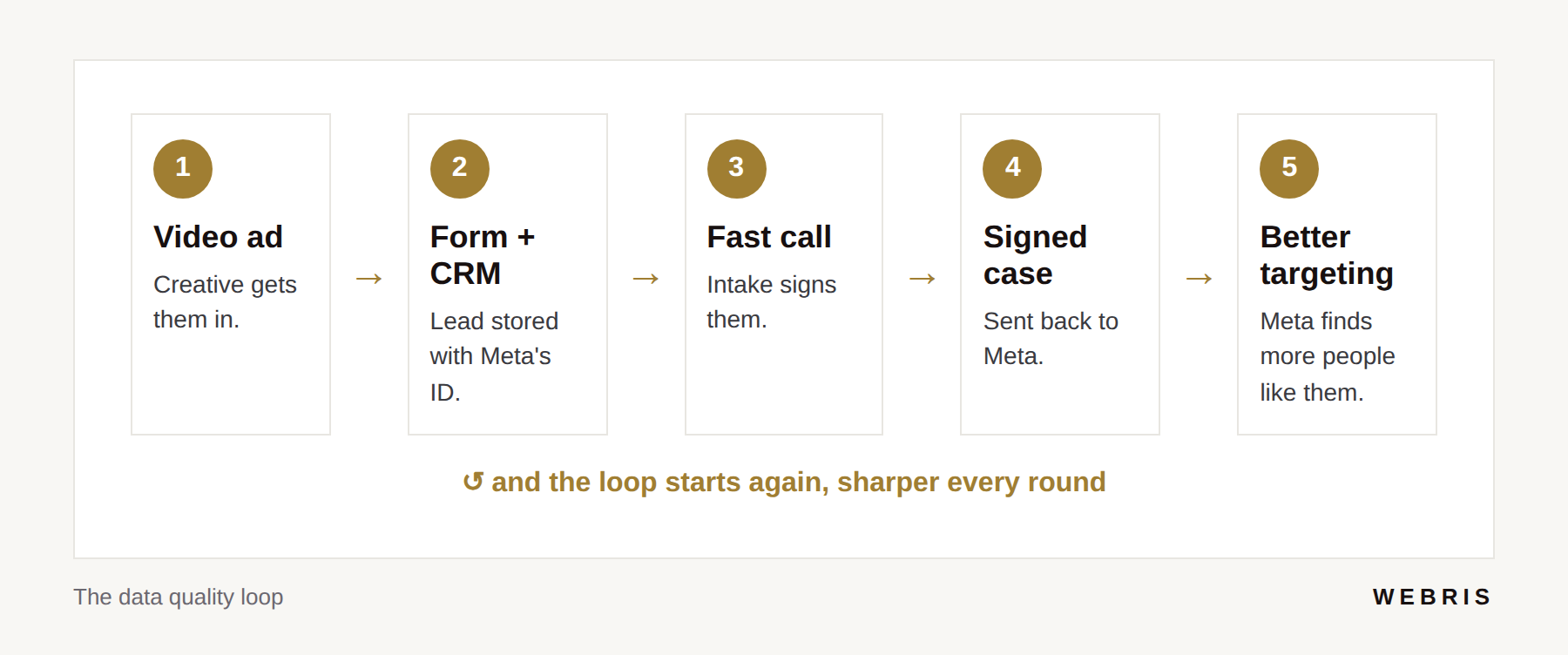
The data quality loop is the cycle that teaches Meta what a signed case looks like. Every signed case makes the next round of targeting sharper.
Here's the full loop:
- Someone sees your video ad.
- They fill out your form.
- The lead lands in your CRM with Meta's ID attached.
- Your intake team calls within minutes.
- The lead becomes a signed case.
- That signed case goes back to Meta.
- Meta finds more people like them.
All three keys show up in that loop. Creative gets them in. Intake signs them. Data quality tells Meta to go find more.
Break any one and the loop stops.
This is the key to Meta targeting for anyone. It's make-or-break in personal injury, where most leads never qualify. Our personal injury lead generation post covers how this fits with your other channels.
What Results Look Like When All Three Keys Work
Leads are a vanity metric. The one number that matters is signed cases.
We manage over $2 million a month in lawyer advertising across platforms. Meta is still my favorite channel.
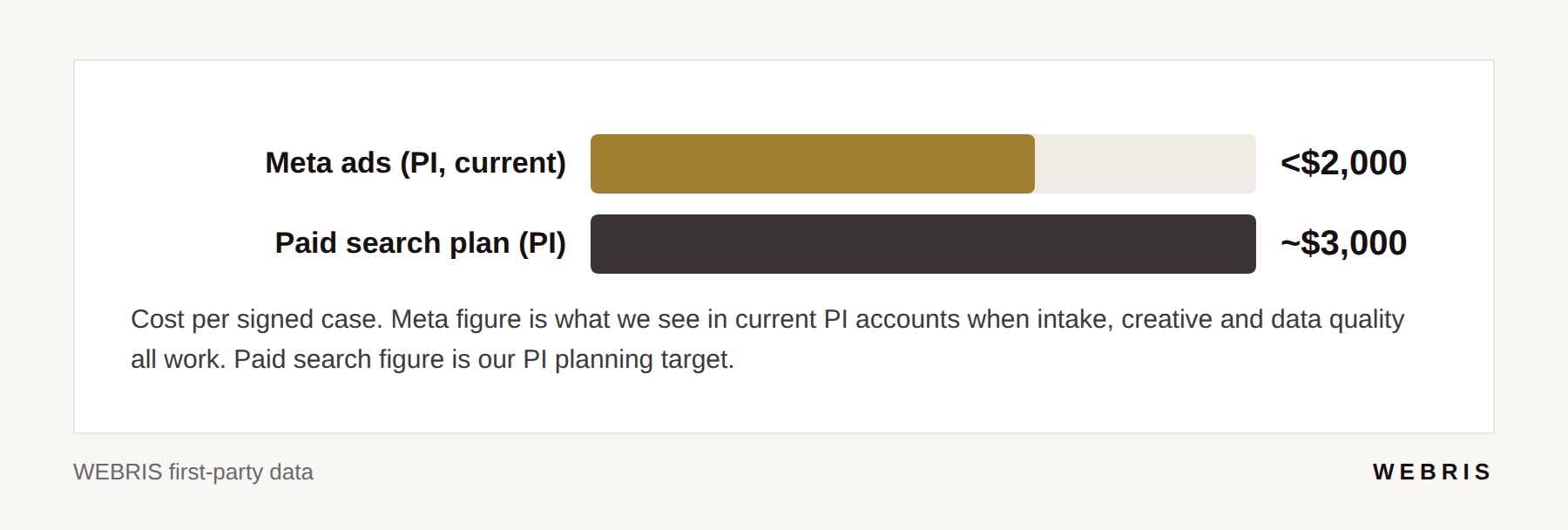
When intake, creative, and data quality are all working, we're seeing personal injury signed cases on Meta for under $2,000 each. Here's how we sign PI cases with Facebook ads in more detail.
For context, we plan paid search in PI around $3,000 per signed case. You can see how we model that in our PI Google Ads forecast.
FAQ
How Fast Should My Firm Call A Meta Ad Lead?
Within 5 minutes. Under one minute is better.
HBR found leads contacted within an hour were nearly 7 times as likely to qualify as leads contacted an hour later. In PI, the lead is filling out forms with other firms at the same time.
How Many Ads Should A Law Firm Run On Meta?
Enough that Meta always has fresh, truly different options. That means several vertical videos live at once and new ones every month.
We run about 80% video and 20% static images. Two or three ads running for months is the most common reason campaigns stall.
Do I Need A CRM To Run Meta Ads?
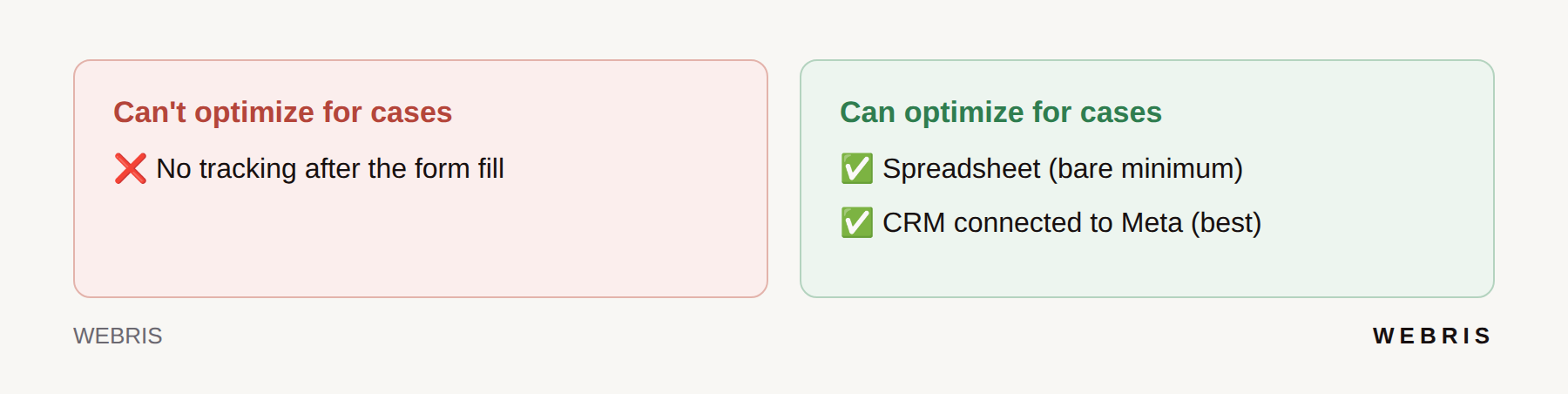
You need some way to track which leads sign. A CRM is best. A spreadsheet is the bare minimum.
Without it you can't feed signed cases back to Meta. Then the campaign keeps optimizing for form fills.