Every December, agencies publish “predictions” for law firms.
Most of the ones I read are opinion lists. One of the top-ranking posts still leads with voice search.
This post is different. Every prediction below starts from published data. You'll see the source, the math, how confident we are, and the exact metric we'll check in December 2027 to grade ourselves.
Here are all seven at a glance. Every one has a number behind it.
| # | 2027 prediction | The number behind it | Confidence |
|---|---|---|---|
| 1 | ChatGPT passes 1.4 billion weekly users | Grew from 800M to 1.2B weekly users in about a year | High |
| 2 | AI owns the research stage, the local pack owns the hire | 58% of question searches show an AI Overview vs. 8% of local searches | Medium-High |
| 3 | Clicks per ranking keep falling | The #1 result’s click penalty went from 34.5% to 58% between two Ahrefs studies | High |
| 4 | Legal cost per click hits $10.37 to $11.35 | Legal CPC jumped 15% in the latest benchmarks, from $8.58 to $9.87 per click | Medium-High |
| 5 | AI ads become a line item you test | OpenAI opened ChatGPT Ads to licensed U.S. lawyers on Aug 31, 2026 | Medium |
| 6 | Most prospects ask AI before they call you | 46% of consumers would consult AI before contacting a lawyer | Medium |
| 7 | “Best lawyer” searches move into AI answers | Comparison searches lost volume fastest in a 1M-keyword study (legal not included) | Medium |
Read the second column again.
Google search volume isn't dying. Google clicks are. And the clicks you still buy keep getting more expensive.
Let's start by grading the last big prediction everyone quoted.
How Accurate Was the Last Big Search Prediction?
Gartner called the shift. It got the mechanism wrong.
Gartner was half right. Total search volume didn't collapse. What changed is which searches carry the volume.
In February 2024, Gartner forecast that traditional search engine volume would fall 25% by 2026 as people moved to AI chatbots and other virtual agents.
In July 2026, a Fractl and Search Engine Land study of 1,010,848 keywords with 10,000+ monthly searches each found 29% of search volume in measurable decline. But volume on growing keywords offset the losses, so the net change was close to zero.
Read that again.
Searches didn't disappear. They moved. In the same study, middle-of-funnel comparison searches lost volume fastest: 36% of them were declining, compared with 19% of informational searches.
For you, that's the “best car accident lawyer in [city]” search. Hold that thought. It comes back in Prediction 7.
The lesson for 2027: don't plan around search volume. Plan around clicks and signed cases.
Prediction 1: ChatGPT Will Pass 1.4 Billion Weekly Users by Late 2027
ChatGPT is no longer an early-adopter tool. It's a mainstream search habit.
OpenAI reported 800 million weekly users in October 2025 and 900 million in February 2026, according to TechCrunch.
In a November 2026 interview with Big Technology, ChatGPT consumer product lead Adam Fry said weekly users had grown from 1 billion to 1.2 billion in about two months. He also said ChatGPT's search-like queries are roughly one-fifth of Google's volume.
How We Got to 1.4 to 1.6 Billion
2026 pace holds
- About 300M users added from Feb to Nov 2026
- That's about 36M per month
- 1.2B + (12 × 36M) ≈ 1.6B
Growth slows by half
- About 18M added per month
- Normal as a product saturates
- 1.2B + (12 × 18M) ≈ 1.4B
From February to November 2026, ChatGPT added about 300 million weekly users in roughly eight months. That's about 36 million per month.
If that pace holds for 12 more months, you get roughly 1.6 billion.
If growth slows by half, which is normal as a product saturates, you get roughly 1.4 billion.
Fry described an even faster recent pace, about 100 million a month. We don't assume that holds for a full year.
What it means for your cases: a growing share of people with a legal problem start in an AI assistant, not on Google. If your firm isn't named in those answers, you're invisible to that slice of the market.
That's why showing up in ChatGPT answers is now a channel, not an experiment.
Prediction 2: AI Will Own the Research Stage, the Local Pack Will Own the Hiring Stage
- Research“how long do I have to file a car accident claim”
- →
- AI answerAI Overview or ChatGPT
- →
- Hire“car accident lawyer near me”
- →
- Local pack, LSAs, ads
AI Overviews don't trigger evenly. They hit long, question-style searches hard and mostly leave short, local searches alone.
According to the Ahrefs AI Overview triggers study, 57.9% of question queries showed an AI Overview in September 2025, compared with 7.9% of local queries.
According to the Pew Research Center, just 8% of one- or two-word Google searches produced an AI summary in March 2025. That share rose to 53% for searches of 10 words or more.
A Washington University in St. Louis audit of 55,393 Google searches run in March and April 2026 found nearly 65% of question-form queries produced an AI Overview, compared with 9.5% of other searches.
Why This Split Matters for Personal Injury Firms
❌ Research search
- “What is the statute of limitations for a car accident in Texas?”
- Long, question-form
- AI answers it above your link
- Few clicks reach any site
✅ Hiring search
- “car accident lawyer Houston”
- Short, local
- Local pack, LSAs and ads still show
- Clicks and calls still happen
Think about how an injured person actually searches.
First they research: “Do I need a lawyer after a minor car accident?” “How much is my whiplash claim worth?” That stage now belongs to AI.
Then they hire: “car accident lawyer near me.” That stage still runs through the local pack, Local Services Ads, and paid search. For now.
Our 2027 prediction: this split holds. AI keeps eating research queries. The local pack and ads keep the hiring moment.
So your money moves to two places:
- Get cited in the research stage so your firm's name is already familiar.
- Win the hiring stage with local SEO, reviews, and Local Services Ads.
Prediction 3: Clicks Per Ranking Will Keep Falling
Ranking #1 is worth less than it was two years ago. Pew and Ahrefs measure it in different ways and land in the same place.
According to the Pew Research Center, Google users who saw an AI summary clicked a traditional search result in 8% of visits in March 2025. Users who didn't see one clicked 15% of the time.
Links inside the AI summary itself got clicked in just 1% of visits.
The Click Penalty Is Getting Worse, Not Better
In April 2025, Ahrefs found AI Overviews cut the click-through rate for the #1 result by 34.5%. Its February 2026 update, comparing December 2023 with December 2025 desktop data across 300,000 keywords, measured 58%.
The penalty grew by more than two-thirds between the two studies.
Here's rough math using Pew's click rates. Say 1,000 people a month search a long question about your practice area.
- Without an AI Overview: about 150 clicks get split across the whole page.
- With one: about 80 clicks get split across the whole page.
You didn't lose rankings. The page just has fewer clicks to give out.
Our 2027 prediction: the #1 result's click penalty stays above 50% on queries with AI Overviews. Informational blog traffic to law firm sites keeps falling even when rankings hold.
What to do about it: stop judging content marketing by sessions. Judge it by whether AI tools cite you and whether branded searches for your firm grow. We broke down which law firm content still works with AI Overviews using a year of real firm data.
Prediction 4: Legal Cost Per Click Will Rise 5% to 15% Again
Legal is still the most expensive category in WordStream's Google Ads data. And the cost per click jumped in the latest benchmark year.
According to WordStream/LocaliQ's 2026 Google Ads benchmarks, built from 13,474 US search campaigns running April 2025 through March 2026, Attorneys and Legal Services averaged $9.87 per click and $131.63 per lead. Both were the highest of 23 industries.
The 2025 edition put legal at $8.58 per click and the same $131.63 per lead.
That's a 15% jump in cost per click in one year.
| Report year | Legal CPC | Legal CPL | Legal conversion rate |
|---|---|---|---|
| 2024 report | $8.94 per click | $144.03 | 5.64% |
| 2025 report | $8.58 per click | $131.63 | 5.09% |
| 2026 report | $9.87 per click | $131.63 | 5.55% |
| 2027 projection | $10.37–$11.35 per click | Depends on conversion rate |
Why Cost Per Lead Stayed Flat While Clicks Got Pricier
- CPC up 15%$8.58 → $9.87
- +
- Conversion rate up about 9%5.09% → 5.55%
- =
- Cost per lead flat$131.63 both years
Clicks got more expensive. But legal conversion rates also rose, from 5.09% to 5.55%.
Better conversion soaked up the price increase. That's the only reason cost per lead didn't move.
Here's the 2027 math:
- If the two-year average holds (about 5% per year), legal CPC lands near $10.37 per click.
- If last year's 15% jump repeats, it lands near $11.35 per click.
The prediction you should actually care about: firms that don't improve conversion rate will see cost per lead rise in 2027. The CPC increase is coming either way.
One important note. These are averages across every practice area and market. Your personal injury keywords in your city can cost very differently.
That's why we plan PI budgets off the high end of Google Keyword Planner's top-of-page bid, not benchmark averages. In our November 2026 study, the high-range top-of-page bid for “car accident attorney los angeles” reached $400 per click (October 2025 to September 2026).
Prediction 5: AI Ads Become a Line Item You Test in 2027
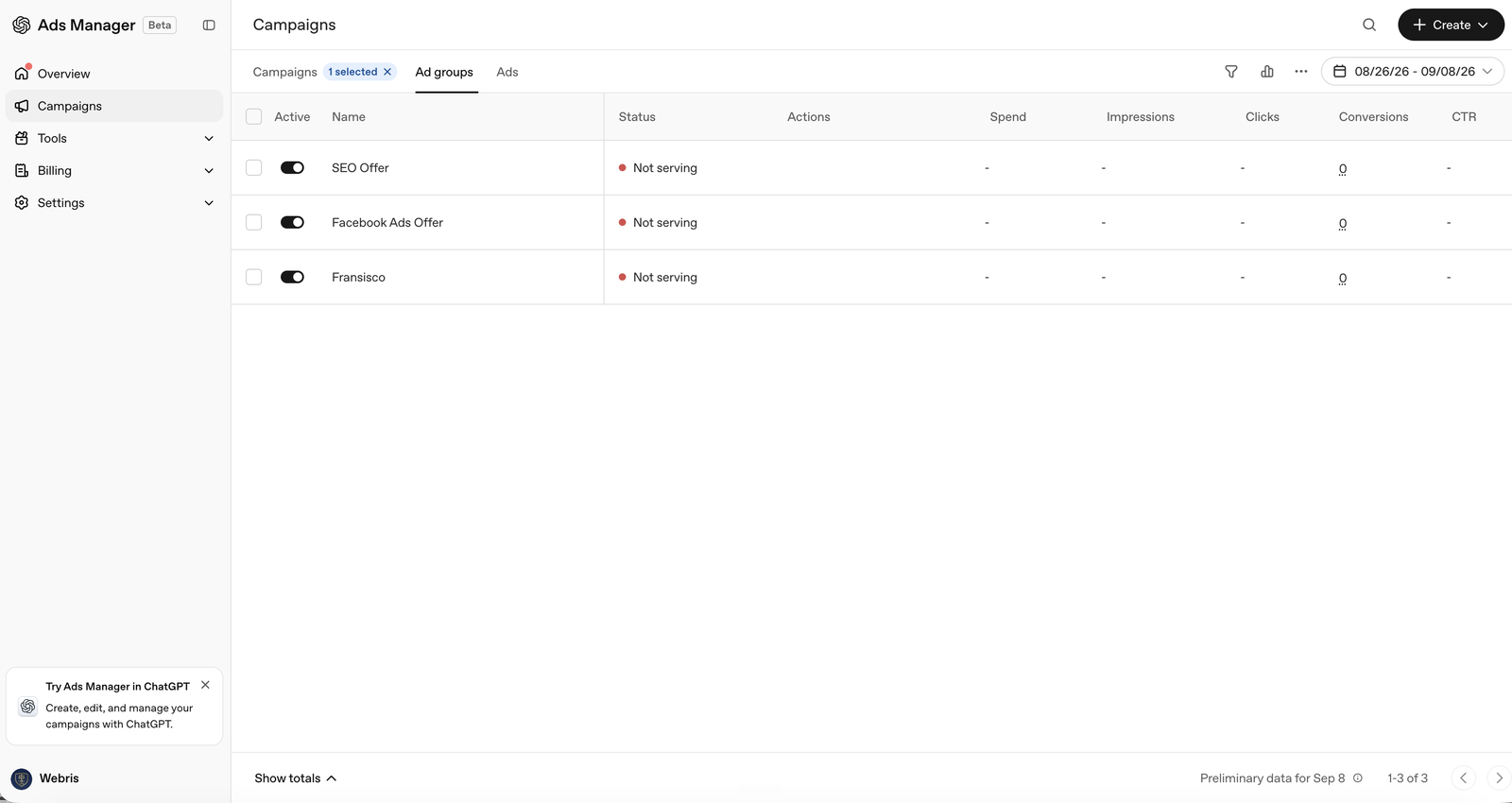
Paid placements inside AI answers went from rumor to real product in 2026. And law firms are now allowed in.
On August 31, 2026, OpenAI updated its advertising policies to allow legal-services ads in the U.S. when the advertiser is licensed where the ad is shown. Personal injury is named in the policy. We covered the change in ChatGPT ads are now open to law firms.
The platform is growing fast. According to OpenAI, over 100,000 advertisers have used ChatGPT Ads.
Google is moving too. On May 20, 2026, Google announced it is testing new ad formats in AI Mode and Search. Search Engine Land reports they include Conversational Discovery ads, Highlighted Answers and Business Agent for Leads.
What Our Own ChatGPT Ads Test Shows So Far
| Meta ads | ChatGPT ads | |
|---|---|---|
| Monthly spend | ~$1,500 | |
| Cost per click | $20 to $40 per click | |
| Cost per lead | ~$330 | ~$700 |
| Qualified leads | ~70% qualify | 1 so far |
We've been running ChatGPT ads for our own agency. Here are the numbers: about $1,500 a month, $20 to $40 per click, and about $700 per lead.
That's roughly twice what we pay per lead on Meta for the same offer. And these are ads for WEBRIS, not PI campaigns. Your numbers will be different.
So why predict growth? Because the test is cheap. We put the floor for a ChatGPT test at $1,000 to $2,000 a month, versus about $10,000 on Meta and $20,000 to $30,000 on Google Ads for PI.
There's still a lot nobody can answer yet:
- How your state bar's advertising rules apply. OpenAI allowing an ad doesn't make it compliant.
- Whether lead quality will beat or trail Google Ads once the auction fills up.
- How big the audience is. Ads only show to logged-in adults on ChatGPT's Free and Go plans.
Our 2027 prediction: competitive PI firms carve out a test budget for AI ad placements, judged on cost per signed case against Google Ads.
Our advice: test small, track to signed cases, and don't pull budget from what's already working.
Prediction 6: Most Prospects Will Ask AI Before They Call You
The client journey now starts before your intake team ever sees it.
According to Clio's 2026 Legal Trends Report, 46% of consumers would consult AI before contacting a lawyer.
Clio's earlier data shows what happens next. Among consumers who used AI to answer a legal question, the AI prompted 28% of them to contact a lawyer.
That 28% is the opportunity. The AI is doing your top-of-funnel education, then handing the person off. The question is whose name it hands them.
What This Changes at Intake
❌ Intake form today
- How did you hear about us?
- Google / TV / Billboard / Referral
✅ Intake form for 2027
- How did you hear about us?
- Adds: AI assistant (ChatGPT, Gemini, etc.)
- Follow-up: “What did it tell you?”
Our 2027 prediction: for consumer practice areas like PI, a majority of prospects will have asked an AI about their situation before calling a firm.
That changes three things:
- Add “AI assistant” to your intake source options. You can't manage a channel you don't track.
- Ask “what did it tell you?” Prospects arrive with expectations about case value and timelines. Your intake team needs to hear them.
- Fix the info AI pulls about you. Reviews, directory listings, and practice-area pages feed those answers. Start with your reviews.
Prediction 7: “Best Lawyer” Searches Move Into AI Answers
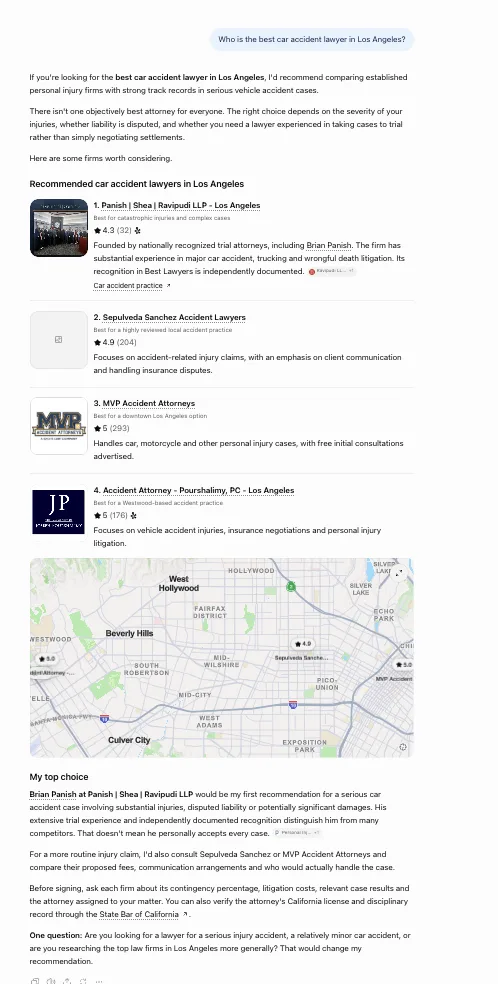
Remember the Fractl finding? Middle-of-funnel comparison searches dropped the most.
One caveat up front. Fractl's study covered eight verticals, including FinTech, HealthTech, Insurance and SaaS. Legal wasn't one of them. This prediction is our bet that legal follows the same pattern.
In legal, that's the shortlist moment. “Best car accident lawyer in Dallas.” “Top-rated injury firm near me.” We expect more people to ask AI for that shortlist instead of scrolling ten blue links.
And AI's shortlist isn't Google's. In our November 2026 test of four AIs in Los Angeles and Chicago, ChatGPT's “top choice” in LA didn't appear in Google's Map Pack at all.
Our 2027 prediction: Google volume on “best [practice area] lawyer [city]” queries keeps declining, while firms named in AI recommendations pick up a bigger share of signed cases.
What You Can Control About Which Firms AI Names
- Peer recognitionawards, verdicts
- +
- Specific reviewsnames, case types
- +
- Third-party mentionspress, directories, Reddit
- →
- More likely to be named
Nobody outside these companies knows exactly how their tools pick which firms to name. But in our test, the recommended firms had a few things in common:
- Peer recognition and checkable results, like verdict amounts and awards in the attorney's name.
- Specific review content that names staff and case types.
- Third-party mentions in press releases, directories and Reddit threads.
If you want the full playbook, read our guide to GEO for lawyers.
What This Means for Your 2027 Budget
| Move | Channel | Why (prediction) |
|---|---|---|
| Keep | Google Ads on hiring-intent keywords | The hiring stage still runs through search (#2) |
| Grow | Local SEO, reviews, LSAs | The local pack owns the hire (#2, #7) |
| Grow | AI visibility (GEO) | AI owns research and the shortlist (#1, #6, #7) |
| Test | ChatGPT and AI Mode ads | New inventory, unknown lead quality (#5) |
| Cut | Content judged only on sessions | Clicks per ranking keep falling (#3) |
Here's how the seven predictions translate into money.
If You Run Google Ads
| Example planning CPC | Leads per 100 clicks | Signed cases per 100 clicks | Cost per signed case |
|---|---|---|---|
| $100 per click | 25 | 6.25 | $1,600 |
| $150 per click | 25 | 6.25 | $2,400 |
| $187.50 per click | 25 | 6.25 | $3,000 |
| $200 per click | 25 | 6.25 | $3,200 |
| $250 per click | 25 | 6.25 | $4,000 |
| $400 per click (LA car accident, high range) | 25 | 6.25 | $6,400 |
The one metric is signed cases. So run every CPC increase through to cost per signed case.
We plan PI campaigns on a 25% landing page conversion rate and a 25% lead-to-signed-case rate. That means cost per signed case = CPC × 16.
We plan PI campaigns around roughly $3,000 per signed case. At that target, your break-even click is about $187.50 per click.
Now apply Prediction 4 to a real market. Keyword Planner's high-range bid for “car accident attorney los angeles” is $400 per click. That's about $6,400 per signed case. If it rises 15%, it becomes $460 per click and $7,360 per signed case, without anything else changing.
Two levers fight that: a higher landing page conversion rate and a tighter intake process. If your leads are junk, start here. For the full setup, see our PPC for law firms guide and our PI Google Ads forecast.
If You Rely on SEO
❌ Stop reporting on
- Keyword rankings by themselves
- Total sessions
- Blog traffic
✅ Start reporting on
- Signed cases from organic and local
- How often AI tools name your firm
- Branded search growth
- Review volume and rating
SEO isn't dead. The scorecard changed.
Rankings and sessions still matter as inputs. They just can't be the report anymore.
If you're a PI firm, our approach to personal injury SEO is built around that scorecard.
How We'll Score These Predictions in December 2027
| # | Prediction | Metric we'll check | Source | Pass if |
|---|---|---|---|---|
| 1 | ChatGPT passes 1.4B weekly users | Weekly active users | OpenAI disclosures | 1.4B or more by Dec 2027 |
| 2 | AI owns research, local pack owns hiring | AI Overview rate on question vs. local queries | Ahrefs or equivalent SERP studies | Question queries stay far above local queries |
| 3 | Clicks per ranking keep falling | CTR penalty for the #1 result with an AI Overview | Ahrefs or equivalent | Penalty stays above 50% |
| 4 | Legal CPC rises 5% to 15% | Attorneys & Legal Services CPC | WordStream/LocaliQ 2027 benchmarks | $10.37 to $11.35 per click |
| 5 | AI ads become a tested line item | Legal ad policy and law firm results | OpenAI policy; WEBRIS client tests | Legal ads still allowed, and we publish a cost per signed case from law firm campaigns |
| 6 | Most prospects ask AI first | Consumers consulting AI before a lawyer | Clio 2027 Legal Trends Report | Above 50% |
| 7 | “Best lawyer” searches move into AI | Google volume on “best [practice] lawyer [city]” | Keyword data | Continued year-over-year decline |
A prediction you can't grade is just an opinion. Here's exactly how we'll grade ours.
We'll update this post with a pass or fail next to each one. No date-swapping, no quiet edits.
Here's the short version.
The firms that win in 2027 measure signed cases, not clicks, and show up where clients actually ask.